
UNITED STATES
SECURITIES AND EXCHANGE COMMISSION
WASHINGTON, D.C. 20549
FORM
(Mark One)
| QUARTERLY REPORT PURSUANT TO SECTION 13 OR 15(d) OF THE SECURITIES EXCHANGE ACT OF 1934 |
For
the quarterly period ended
OR
| TRANSITION REPORT PURSUANT TO SECTION 13 OR 15(d) OF THE SECURITIES EXCHANGE ACT OF 1934 |
For the transition period from _________ to _________
Commission
File Number:
(Exact Name of Registrant as Specified in its Charter)
(State or other jurisdiction of incorporation or organization) |
(I.R.S.
Employer Identification No.) | |
| (Address of principal executive offices) | (Zip Code) |
Registrant’s
telephone number, including area code:
Securities registered pursuant to Section 12(b) of the Act:
Title of each class
|
Trading Symbol(s)
|
Name of each exchange on which registered
| ||
| The
|
Indicate
by check mark whether the registrant (1) has filed all reports required to be filed by Section 13 or 15(d) of the Securities Exchange
Act of 1934 during the preceding 12 months (or for such shorter period that the registrant was required to file such reports), and (2)
has been subject to such filing requirements for the past 90 days.
Indicate
by check mark whether the registrant has submitted electronically every Interactive Data File required to be submitted pursuant to Rule
405 of Regulation S-T (§232.405 of this chapter) during the preceding 12 months (or for such shorter period that the registrant
was required to submit such files).
Indicate by check mark whether the registrant is a large accelerated filer, an accelerated filer, a non-accelerated filer, a smaller reporting company, or an emerging growth company. See the definitions of “large accelerated filer,” “accelerated filer,” “smaller reporting company,” and “emerging growth company” in Rule 12b-2 of the Exchange Act.
| Large accelerated filer | ☐ | Accelerated filer | ☐ |
| ☒ | Smaller reporting company | ||
| Emerging growth company |
If
an emerging growth company, indicate by check mark if the registrant has elected not to use the extended transition period for complying
with any new or revised financial accounting standards provided pursuant to Section 13(a) of the Exchange Act.
Indicate
by check mark whether the registrant is a shell company (as defined in Rule 12b-2 of the Exchange Act). Yes ☐ No
As of May 14, 2026, the registrant had shares of common stock, $ par value per share, outstanding.
Table of Contents
| Page | ||
| PART I. | FINANCIAL INFORMATION | 1 |
| Item 1. | Condensed Financial Statements | 1 |
| Unaudited condensed financial statements as of and for the three months ended March 31, 2025 and March 31, 2026: | ||
| Balance sheets | 1 | |
| Statements of operations | 2 | |
| Statements of changes in stockholders’ equity (deficit) | 3 | |
| Statements of cash flows | 4 | |
| Notes to condensed financial statements | 5 | |
| Item 2. | Management’s Discussion and Analysis of Financial Condition and Results of Operations | 21 |
| Item 3. | Quantitative and Qualitative Disclosures About Market Risk | 32 |
| Item 4. | Controls and Procedures | 32 |
| PART II. | OTHER INFORMATION | |
| Item 1. | Legal Proceedings | 34 |
| Item 1A. | Risk Factors | 35 |
| Item 2. | Unregistered Sales of Equity Securities and Use of Proceeds | 35 |
| Item 3. | Defaults Upon Senior Securities | 36 |
| Item 4. | Mine Safety Disclosures | 36 |
| Item 5. | Other Information | 36 |
| Item 6. | Exhibits | 39 |
| Signatures | 44 | |
PART I—FINANCIAL INFORMATION
Item 1. Condensed Financial Statements.
HCW Biologics Inc.
Condensed Balance Sheets
| December 31, | March 31, | |||||||
| 2025 | 2026 | |||||||
| Unaudited | ||||||||
| ASSETS | ||||||||
| Current assets: | ||||||||
| Cash and cash equivalents | $ | $ | ||||||
| Accounts receivable, net | ||||||||
| Prepaid expenses | ||||||||
| Other current assets | ||||||||
| Total current assets | ||||||||
| Investments | ||||||||
| Property, plant and equipment, net | ||||||||
| Other assets | ||||||||
| Total assets | $ | $ | ||||||
| LIABILITIES
AND STOCKHOLDERS’ EQUITY | ||||||||
| Liabilities | ||||||||
| Current liabilities: | ||||||||
| Accounts payable | $ | $ | ||||||
| Accrued liabilities and other current liabilities | ||||||||
| Short-term debt, net | ||||||||
| Deferred Revenue | ||||||||
| Total current liabilities | ||||||||
| Warrant liability | ||||||||
| Contingent liability | ||||||||
| Total liabilities | ||||||||
| Commitments and contingencies (Note 12) | ||||||||
| Stockholders’ equity: | ||||||||
| Common stock: | ||||||||
| Common, $ par value; shares authorized and shares issued at December 31, 2025; shares authorized and shares issued at March 31, 2026 | ||||||||
| Additional paid-in capital | ||||||||
| Accumulated deficit | ( | ) | ( | ) | ||||
| Total stockholders’ equity | ||||||||
| Total liabilities and stockholders’ equity | $ | $ | ||||||
See accompanying notes to the unaudited condensed financial statements.
| 1 |
HCW Biologics Inc.
Condensed Statements of Operations
(Unaudited)
| Three
Months Ended March 31, | ||||||||
| 2025 | 2026 | |||||||
| Revenues: | ||||||||
| Revenues | $ | $ | ||||||
| Cost of revenues | ( | ) | ( | ) | ||||
| Net revenues | ||||||||
| Operating expenses: | ||||||||
| Research and development | ||||||||
| General and administrative | ||||||||
| Legal expenses, net | ( | ) | ||||||
| Indirect tax expense | ||||||||
| Total operating expenses | ||||||||
| Operating income (loss) | ( | ) | ||||||
| Interest expense | ( | ) | ( | ) | ||||
| Change in fair value of warrant liability | ||||||||
| Other income, net | ||||||||
| Net income (loss) before income taxes | $ | ( | ) | $ | ||||
| Income tax expense | ( | ) | ||||||
| Net income (loss) | $ | ( | ) | $ | ||||
| Equity dividend to investor | ( | ) | ||||||
| Net income (loss) attributable to Common Stockholders | $ | ( | ) | $ | ||||
| Net income (loss) per share, basic and diluted | $ | ) | $ | |||||
| Weighted average shares outstanding, basic and diluted | ||||||||
See accompanying notes to the unaudited condensed financial statements.
| 2 |
HCW Biologics Inc.
Condensed Statements of Changes in Stockholders’ Equity (Deficit)
For the Three Months Ended March 31, 2025 and 2026
(Unaudited)
| Stockholders’ Deficit | ||||||||||||||||||||
| Common Stock | Additional Paid-In | Accumulated | Total Stockholders’ | |||||||||||||||||
| Shares | Amount | Capital | Deficit | Deficit | ||||||||||||||||
| Balance, January 1, 2025 | $ | $ | $ | ( | ) | $ | ( | ) | ||||||||||||
| Issuance of Common Stock upon exercise of stock options | ||||||||||||||||||||
| Issuance of Common Stock to Square Gate | ||||||||||||||||||||
| Issuance cost of Common Stock | — | ( | ) | ( | ) | |||||||||||||||
| Stock-based compensation | — | |||||||||||||||||||
| Net loss | — | ( | ) | ( | ) | |||||||||||||||
| Balance, March 31, 2025 | $ | $ | $ | ( | ) | $ | ( | ) | ||||||||||||
| Stockholders’ Equity | ||||||||||||||||||||
| Common Stock | Additional Paid-In | Accumulated | Total Stockholders’ | |||||||||||||||||
| Shares | Amount | Capital | Deficit | Equity | ||||||||||||||||
| Balance, January 1, 2026 | $ | $ | $ | ( | ) | $ | | |||||||||||||
| Common Stock issued in connection with abeyance shares (1) | ( | ) | ||||||||||||||||||
| Issuance of pre-funded warrants | — | |||||||||||||||||||
| Exercise of pre-funded warrants | ||||||||||||||||||||
| Reclassification of the modified warrant to liability | — | ( | ) | ( | ) | |||||||||||||||
| Issuance of Common Stock warrants and repricing of modified warrants | — | |||||||||||||||||||
| Equity dividend to investor | — | ( | ) | ( | ) | |||||||||||||||
| Issuance costs of Common Stock warrants | — | ( | ) | ( | ) | |||||||||||||||
| Issuance costs of pre-funded warrants | — | ( | ) | ( | ) | |||||||||||||||
| Stock-based compensation | — | |||||||||||||||||||
| Net income | — | |||||||||||||||||||
| Balance, March 31, 2026 | $ | $ | $ | ( | ) | $ | ||||||||||||||
| (1) |
See accompanying notes to the unaudited condensed financial statements.
| 3 |
HCW Biologics Inc.
Condensed Statements of Cash Flows
(Unaudited)
| Three Months Ended March 31, | ||||||||
| 2025 | 2026 | |||||||
| Cash flows from operating activities: | ||||||||
| Net income (loss) | $ | ( | ) | $ | ||||
| Adjustments to reconcile net income (loss) to net cash used in operating activities: | ||||||||
| Depreciation and amortization | ||||||||
| Stock-based compensation | ||||||||
| Change in fair value of warrant liability | ( | ) | ||||||
| Noncash revenue from licensing agreement | ( | ) | ||||||
| Commitment fee | ||||||||
| Changes in operating assets and liabilities: | ||||||||
| Accounts receivable | ( | ) | ||||||
| Prepaid expenses and other assets | ( | ) | ( | ) | ||||
| Deferred revenue | ||||||||
| Accounts payable and other liabilities | ( | ) | ( | ) | ||||
| Net cash used in operating activities | ( | ) | ( | ) | ||||
| Cash flows from investing activities: | ||||||||
| Net cash provided by (used in) investing activities | ||||||||
| Cash flows from financing activities: | ||||||||
| Proceeds from issuance of Common Stock | ||||||||
| Proceeds from the issuance and exercise of pre-funded warrants | ||||||||
| Issuance costs of pre-funded warrants and Common Stock warrants | ( | ) | ||||||
| Issuance costs for Common Stock | ( | ) | ||||||
| Debt repayment | ( | ) | ( | ) | ||||
| Net cash provided by (used in) financing activities | ( | ) | ||||||
| Net decrease in cash and cash equivalents | ( | ) | ( | ) | ||||
| Cash and cash equivalents at the beginning of the period | ||||||||
| Cash and cash equivalents at the end of the period | $ | $ | ||||||
| Supplemental disclosure of cash flow information: | ||||||||
| Cash paid for interest | $ | $ | ||||||
| Noncash financing and investing activities: | ||||||||
| Equity dividend to investor | $ | $ | ||||||
See accompanying notes to the unaudited condensed financial statements.
| 4 |
HCW Biologics Inc.
Notes to Condensed Financial Statements
(Unaudited)
1. Organization and Summary of Significant Accounting Policies
Organization
HCW Biologics Inc. (“HCW Biologics” or the “Company”) is a clinical-stage biopharmaceutical company developing transformative fusion immunotherapeutics to support or treat diseases promoted by chronic inflammation. Our assets include both clinical-stage immunotherapeutics as well as commercial-ready proprietary compounds for use as reagents in the production of immunotherapeutics for the treatment of infectious diseases and cancer. The Company believes low-grade chronic inflammation is a significant contributing factor to several diseases and conditions, such as autoimmune disorders and other inflammatory diseases such as neurodegenerative disease, cancer, and senescence-associated dysplasia. The Company is located in Miramar, Florida and was incorporated in the state of Delaware in April 2018.
Reverse Stock Splits
On
March 31, 2025, at a Special Meeting of the Stockholders, the stockholders of the Company approved a reverse stock split of all outstanding
shares of the Company’s common stock (“Common Stock”), and the Board approved a reverse stock split of the Common Stock
at a final
On March 26, 2026, the Company received a written notice from the Nasdaq Listing Qualifications Staff (the “Staff”) indicating that the Company was not in compliance with the minimum bid price requirement (“Bid Price Rule”) for continued listing set forth in Nasdaq Listing Rule 5810(c)(3)(A), which requires listed securities to maintain a minimum bid price of $ per share. In accordance with Nasdaq rules, because the Company effected a reverse stock split in April 2025, the Company was not eligible for a 180-calendar day compliance period to regain compliance with the bid price requirement.
On May 5, 2026, the Company was granted a hearing with the Nasdaq Hearings Panel to present a compliance plan to regain compliance with the Bid Price Rule. If relief is granted, the Company intends to proceed with a proposal to effect a reverse stock split, which has been included in the definitive proxy statement for the Annual Meeting of Stockholders. On April 28, 2026, the Company filed a definitive proxy which contained a proposal to the stockholders for a potential reverse stock split (the “Reverse Stock Split Proposal”), in which the Company asked its stockholders to approve a proposed amendment to the Company’s Certificate of Incorporation (the “Charter”) to implement, at the discretion of the Board at any time prior to the one-year anniversary of the Annual Meeting, one or more reverse stock splits of the outstanding shares of our Common Stock in an aggregate range of not less than one-for-five (1::5) and not more than one-for-twenty (1::20). The implementation of this reverse stock split will not reduce the total number of authorized shares of Common Stock. The Board of Directors unanimously approved and declared advisable the Reverse Stock Split Proposal and recommended that the Company’s stockholders approve an amendment to the Charter to effect this proposal, at the discretion of our Board. The Annual Meeting of Stockholders will be held on June 15, 2026.
Liquidity and Going Concern
In accordance with Financial Accounting Standards Board (“FASB”) Accounting Standards Codification (“ASC”) 205-40, Presentation of Financial Statements – Going Concern (“Topic 205-40”), management is required to evaluate whether there are conditions and events, considered in the aggregate that raise substantial doubt about the Company’s ability to continue as a going concern for at least 12 months from the issuance date of the Company’s condensed financial statements. This evaluation does not take into consideration the potential mitigating effect of management’s plans that have not been fully implemented or are not within control of the Company as of the date the condensed financial statements are issued. When substantial doubt exists under this methodology, management evaluates whether the mitigating effect of its plans sufficiently alleviates substantial doubt about the Company’s ability to continue as a going concern. The mitigating effect of management’s plans, however, is only considered if both (1) it is probable that the plans will be effectively implemented within one year after the date that the condensed financial statements are issued, and (2) it is probable that the plans, when implemented, will mitigate the relevant conditions or events that raise substantial doubt about the entity’s ability to continue as a going concern within one year after the date that the condensed financial statements are issued.
As
of March 31, 2026, the Company had not generated any revenue from commercial product sales of its internally developed immunotherapeutic
products. During its development activities, the Company has sustained operating losses, experienced negative operating cash flows and
negative working capital position and expects to continue to incur operating losses for the foreseeable future. Since inception to March
31, 2026, the Company incurred cumulative net losses of $
The accompanying condensed financial statements have been prepared on a going-concern basis, which contemplates the realization of assets and satisfaction of liabilities in the ordinary course of business. The continuation of the Company as a going concern is dependent upon the ability of the Company to obtain debt or equity financings to continue operations. The financial statements do not include any adjustments relating to the recoverability and classification of recorded asset amounts or the amounts and classification of liabilities that might result from the outcome of the uncertainties described above. The Company believes that substantial doubt exists regarding its ability to continue as a going concern for at least 12 months from the date of issuance of the Company’s condensed financial statements and that the substantial doubt that existed in its going concern analysis was not alleviated.
| 5 |
Summary of Significant Accounting Policies
Basis of Presentation
Unaudited Condensed Financial Information
The accompanying unaudited condensed financial statements as of March 31, 2026 and for the three months ended March 31, 2025 and 2026 have been prepared in accordance with accounting principles generally accepted in the United States of America (“U.S. GAAP”) for interim financial information and pursuant to Article 10 of Regulation S-X of the Securities Act of 1933, as amended (the “Securities Act”). Accordingly, they do not include all of the information and notes required by U.S. GAAP for complete financial statements. These unaudited condensed financial statements include only normal and recurring adjustments that the Company believes are necessary to fairly state the Company’s financial position and the results of its operations and cash flows. The results for the three months ended March 31, 2026 are not necessarily indicative of the results expected for the full fiscal year or any subsequent interim period. The condensed balance sheet at December 31, 2025 has been derived from the audited financial statements at that date but does not include all disclosures required by U.S. GAAP for complete financial statements. Because all of the disclosures required by U.S. GAAP for complete financial statements are not included herein, these unaudited condensed financial statements and the notes accompanying them should be read in conjunction with the Company’s audited financial statements for the year ended December 31, 2025 which appear in our Annual Report on Form 10-K for the year ended December 31, 2025 filed with the Securities and Exchange Commission (the “SEC”) on March 31, 2026 (the “Annual Report”) and in other filings with the SEC.
Segment Reporting
The Company operates and manages its business as one reportable and operating segment, which is the business of developing and commercializing novel immunotherapies for diseases promoted by chronic inflammation, especially age-related diseases. The Company’s chief executive officer, who is the chief operating decision maker (“CODM”), reviews financial information on an aggregate basis for allocating and evaluating financial performance. In addition, our CODM is regularly provided with detailed results of preclinical and clinical data which is considered in his decision for the allocation of resources. See Note 11. Segment Reporting for further details. The single operating segment constitutes all of the Company activity, the CODM regularly reviews the entity-wide operating results and performance. All long-lived assets are maintained in the United States of America.
Use of Estimates
The preparation of financial statements in conformity with U.S. GAAP requires management to make estimates and assumptions that affect the reported amounts in the financial statements and accompanying notes. Management uses estimates in financial statements to approximate monetary amounts for items that cannot be measured precisely, such as asset valuations, liabilities, and revenue recognition. These estimates are based on subjective judgments, experience, and future assumptions. The Company evaluates its estimates and assumptions on an ongoing basis using historical experience and other factors and adjusts those estimates and assumptions when facts and circumstances dictate. Actual results could differ from estimates.
Fair Value Measurements
Fair value is defined as the price that would be received to sell an asset or paid to transfer a liability in an orderly transaction between market participants at the measurement date. Financial Accounting Standards Board (“FASB”) Accounting Standards Codification (“ASC”) 820, Fair Value Measurement (“Topic 820”) establishes a fair value hierarchy for those instruments measured at fair value that distinguishes between fair value measurements based on market data (observable inputs) and those based on the Company’s own assumptions (unobservable inputs). This hierarchy maximizes the use of observable inputs and minimizes the use of unobservable inputs. The three levels of inputs used to measure fair value are as follows:
| ● | Level 1: Observable inputs such as quoted prices in active markets; | |
| ● | Level 2: Inputs, other than the quoted prices in active markets, that are observable either directly or indirectly; and | |
| ● | Level 3: Unobservable inputs in which there is little or no market data, which require a reporting entity to develop its own assumptions. |
Fair value measurements are classified based on the lowest level of input that is significant to the measurement. The Company’s assessment of the significance of a particular input to the fair value measurement requires judgment, which may affect the valuation of the assets and liabilities and their placement within the fair value hierarchy levels. The determination of the fair values takes into account the market for the Company’s financial assets and liabilities, the associated credit risk, and other factors as required. The Company considers active markets as those in which transactions for the assets or liabilities occur in sufficient frequency and volume to provide pricing information on an ongoing basis.
| 6 |
Revenue Recognition
The Company accounts for revenues in accordance with FASB ASC 606, Revenue from Contracts with Customers (“Topic 606”). To determine revenue recognition for arrangements that fall within the scope of Topic 606, the Company performs the following five steps: (i) identify the contract(s) with a customer; (ii) identify the performance obligations in the contract; (iii) determine the transaction price; (iv) allocate the transaction price to the performance obligations in the contract; and (v) recognize revenue when (or as) the Company satisfies a performance obligation. The Company only applies the five-step model to contracts when it is probable that it will collect the consideration it is entitled to in exchange for the goods or services transferred to the customer.
At contract inception, the Company assesses the goods or services promised within each contract, determines those that are performance obligations, and assesses whether each promised good or service is distinct. The Company then recognizes as revenue the amount of the transaction price that is allocated to the respective performance obligation when (or as) the performance obligation is satisfied. To date, the Company’s revenues have been generated exclusively from license agreements, which consists of licenses of intellectual property, cost reimbursements, upfront signing fees, milestone payments and royalties on future licensee’s product sales. In addition, the Company and Wugen have an agreement for the supply of clinical and research grade materials under which the Company also recognized revenues.
License Grants:
For out-licensing arrangements that include a grant of a license to the Company’s intellectual property, the Company considers whether the license grant is distinct from the other performance obligations included in the arrangement. For licenses that are distinct, the Company recognizes revenues from nonrefundable, upfront payments and other consideration allocated to the license when the license term has begun and the Company has provided all necessary information regarding the underlying intellectual property to the customer, which generally occurs at or near the inception of the arrangement.
License related services:
For license agreements that include service-based performance obligations, the Company evaluates whether these separately identifiable services are distinct performance obligations. The Company considers whether the customer could benefit from the licensed intellectual property with other readily available resources, whether the performance of the service would significantly modify or customize the licensed intellectual property or whether the service is highly interrelated or interdependent with the licensed intellectual property. Revenue attributable to services that are deemed distinct performance obligations are recognized over time as the customer simultaneously receives and consumes the benefits of the Company’s performance. The Company measures progress toward completion using an input method, typically cost-to-cost, which reflects the pattern in which services are delivered. Amounts received in advance for optional future services are recorded as deferred revenue and recognized as revenue when the related services are performed or when the option expires. The transaction price is allocated to the service performance obligations based on their relative standalone selling prices.
Milestone and Contingent Payments:
At the inception of the arrangement and at each reporting date thereafter, the Company assesses whether it should include any milestone and contingent payments or other forms of variable consideration in the transaction price using the most likely amount method. If it is probable that a significant reversal of cumulative revenue would not occur upon resolution of the uncertainty, the associated milestone value is included in the transaction price. At the end of each subsequent reporting period, the Company re-evaluates the probability of achievement of each such milestone and any related constraint and, if necessary, adjusts its estimate of the overall transaction price. Since milestone and contingent payments may become payable to the Company upon the initiation of a clinical study or filing for or receipt of regulatory approval, the Company reviews the relevant facts and circumstances to determine when the Company should update the transaction price, which may occur before the triggering event. When the Company updates the transaction price for milestone and contingent payments, the Company allocates the changes in the total transaction price to each performance obligation in the agreement on the same basis as the initial allocation. Any such adjustments are recorded on a cumulative catch-up basis in the period of adjustment, which may result in recognizing revenue for previously satisfied performance obligations in such period. The Company’s licensees will generally pay milestones payments subsequent to achievement of the triggering event.
Materials Supply:
The Company provides clinical and research grade materials so that licensees may develop products based on the licensed molecules. The amounts billed are recognized as revenue as the performance obligations are satisfied by the Company, once the Company determines that a contract exists.
Investments
As part of its financing strategy, the Company may enter into licensing or collaboration agreements under which it receives consideration in the form of a minority equity interest in a counterparty, in lieu of or in addition to cash payments. These financial instruments are presented within Investments in the accompanying condensed balance sheets.
| 7 |
When consideration is an equity interest in a private entity whose equity has limited marketability with no readily determinable fair value and for which the Company does not have significant influence over the investee, the Company measures the equity interest using the measurement alternative, at cost less impairment, adjusted for observable price changes in orderly transactions for the identical or similar investment of the same issuer (ASC Topic 321, Investments - Equity Securities or Topic 321), unless the fair value method is otherwise elected. If the Company elects to measure an equity security at fair value, the entity shall measure all identical or similar investments of the same issuer, including future purchases of identical or similar investments of the same issuer, at fair value. The election to measure those securities at fair value shall be irrevocable. Any resulting gains or losses on the securities for which that election is made shall be recorded in earnings at the time of the election.
In the second quarter of 2025, the Company elected to account for its Wugen shares, previously accounted for under the measurement alternative, at fair value as determined using financial valuation techniques and market information available. Further, the Company will remeasure the change in fair value of the Wugen shares, and related contingent liability, in reporting periods subsequent to the second quarter of 2025 and recognize the change in earnings. See Note 2. Fair Value of Financial Instruments.
On March 16, 2026, the Company received full payment of the nonrefundable upfront license fee from Trimmune. See Note 5. License Agreements. A portion of the upfront license fee was made in the form of a transferable minority equity interest in Trimmune. The Company has elected to use the measurement alternative under ASC 321-10-35-2 — cost less impairment, with adjustment for observable price changes in orderly transactions for the identical or a similar investment of the same issuer. The Company has a related-party relationship with Trimmune through the Trimmune License. The initial fair value was derived by reference to the implied post-financing valuation of Trimmune of RMB 175,000,000 from the contemporaneous Licensee Funding Transaction (a Level 2 fair value indicator under Topic 820), using the exchange rate on the closing date of the transaction.
From
time to time, the Company invests excess cash in U.S. Treasury bills and notes, which are classified as trading securities. As of March
31, 2025 and 2026, the Company had
Standby Equity Purchase Agreement
The Company and Square Gate Capital Master Fund, LLC - Series 4 (“Square Gate”) entered a Standby Equity Purchase Agreement (“SEPA”) providing for an equity line of credit with Square Gate on February 20, 2025. This agreement provides a mechanism for submission by the Company and acceptance by Square Gate of Put Notices under the SEPA pursuant to which Square Gate and the Company may agree to and execute one purchase and sale of Put Shares (“Standard Put Shares”). The Standard Put Notice has a pricing mechanism based on a volume-adjusted weighted average trading price over three days following the acceptance of the Standard Put.
On August 14, 2025, the parties entered into a First Amendment to the SEPA (the “First Amendment”) to provide a mechanism for submission by the Company and acceptance by Square Gate of Put Notices under the SEPA pursuant to which Square Gate and the Company may agree to and execute multiple purchases and sales of Put Shares on the same trading day (“Intraday Put Shares”). Under the First Amendment, among other things, the purchase price of the Intraday Put Shares will be the lowest traded price during a specified valuation time period which begins with the acceptance of the Intraday Put and ends when trading volume reaches 1000% of the amount of shares included in the Intraday Put.
A SEPA is an equity-linked instrument for which an investor has the right, but not the obligation, to purchase shares of the entity’s common stock over a specified period of time. The SEPA creates a purchase put option for the overarching arrangement which was determined to be a derivative. Economically, before the entity has elected to sell shares, a SEPA represents a purchased put option on the entity’s own equity. However, once the entity “draws” on the SEPA, the related number of shares issued constitutes a financial instrument. Thus, a SEPA contains both a purchased put option element and a forward share issuance element. This generally means that a SEPA generally does not qualify for equity classification. Accordingly, entities must recognize an asset or liability for its SEPA. Such asset or liability must be measured at fair value, with changes in fair value recognized in net (loss) income. Further, individual draws must also be evaluated to determine if they meet criteria for equity classification.
With
regards to the individual draws for a Standard Put under the SEPA, an individual draw would create a separate financial instrument with
settlement criteria that does not meet indexation guidance. While the number of shares is known at inception and therefore not subject
to the overarching share cap, there are two inputs into the settlement amount paid by the Investor which are not inputs into a fixed-for-fixed
option: (1) the maximum amount to be funded under the SEPA of $
| 8 |
Basic net income (loss) per share is calculated by dividing the net income (loss) attributable to Common Stockholders by the daily weighted-average number of common shares outstanding for the period, without consideration of potential dilutive securities. Diluted net income (loss) per share is computed by dividing the net income (loss) attributable to Common Stockholders by the sum of the daily weighted average number of common shares plus the potential dilutive effects of potential dilutive securities outstanding during the period. Potential dilutive securities are excluded from diluted income or loss per share if the effect of such inclusion is anti-dilutive. The Company’s potentially dilutive securities, which include options granted under the 2019 Equity Incentive Plan (“2019 Plan”) and the 2021 Equity Incentive Plan (“2021 Plan”) as well as the Company’s Common Stock Warrants, have been excluded from the computation of diluted net income (loss) per share as their exercise prices exceeded the average market price of the Company’s Common Stock during the period. Options and warrants are considered dilutive to the income per share calculation when their exercise price is below the average market price of the stock (“in-the-money”).
Recently Issued Accounting Pronouncements
In November 2024, the FASB issued ASU No. 2024-03, Income Statement—Reporting Comprehensive Income—Expense Disaggregation Disclosures (ASU 2024-03) which requires public business entities to provide enhanced disaggregation of expenses in financial statements, including detailed disclosures on inventory purchases, employee compensation, depreciation, and amortization. The new guidance is effective for the Company for fiscal periods beginning after December 15, 2026 and interim periods within fiscal years beginning after December 15, 2027. The Company is evaluating the impact of the standard on the Company’s financial statements.
In September 2025, the FASB issued Accounting Standards Update (ASU) 2025-06, Intangibles — Goodwill and Other — Internal-Use Software (Subtopic 350-40): Accounting for and Disclosure of Software Costs to update the accounting for internal use software costs. The guidance requires entities to start capitalizing eligible costs when (1) management has authorized and committed to funding the software project, and (2) it is probable that the project will be completed and the software will be used to perform the function intended. The guidance, which applies to all entities, is effective for fiscal years beginning after December 15, 2027, and interim periods within those fiscal years. Entities may apply the guidance using a prospective, retrospective or modified transition approach. Early adoption is permitted. The Company is evaluating the impact of the standard on the Company’s financial statements.
In September 2025, the FASB issued Accounting Standards Update (ASU) 2025-07—Derivatives and Hedging (“Topic 815”) and Revenue from Contracts with Customers (Topic 606): Derivatives Scope Refinements and Scope Clarification for Share-based Noncash Consideration from a Customer in a Revenue Contract to expand the scope of contracts that are excluded from derivative accounting (i.e., measured at fair value through earnings). ASU 2025-07 addresses stakeholders’ concerns about (1) the application of derivative accounting to contracts with features based on the operations or activities of one of the parties to the contract and (2) the diversity in accounting for share-based noncash consideration from a customer that is consideration for the transfer of goods or services. The guidance is effective for annual reporting periods beginning after December 15, 2026, and interim periods within those annual periods. Entities may apply the guidance either on a modified retrospective or prospective basis. Early adoption is permitted. The Company is evaluating the impact of the standard on the Company’s financial statements.
As of December 31, 2026, the Company will cease to be an ‘emerging growth company’ as defined in the Jumpstart Our Business Startups Act of 2012. We expect to remain a nonaccelerated filer and smaller reporting company. The Company is currently assessing potential regulatory and operational changes that may be required as a result.
2. Fair Value of Financial Instruments
The carrying amount of the Company’s financial instruments, including cash and cash equivalents, accounts receivable, prepaid expenses, other current assets, U.S. government-backed securities with maturity dates up to one year, accounts payable and accrued liabilities, approximate fair value due to their short-term maturities.
Money market funds included in cash and cash equivalents and U.S. government-backed securities are measured at fair value based on quoted prices in active markets, which are considered Level 1 inputs.
The warrant liability is measured at fair value using the Black-Scholes options pricing model. The fair value is classified as Level 3 within the fair value hierarchy due to the use of significant unobservable inputs.
The Company’s investment in shares of Wugen common stock and the related contingent liability are classified as Level 3 within the fair value hierarchy due to the use of significant unobservable inputs. The fair value of these instruments is estimated using a combination of valuation techniques, including an adjusted enterprise valuation method and a backsolve method, which incorporates information from recent financing transactions and the Company’s assessment of the underlying enterprise value of Wugen.
Significant unobservable inputs used in these valuations include assumptions related to the enterprise value of Wugen, discounts for lack of marketability, the capital structure of the investee, and the probability and timing of potential liquidity events. The valuation of the contingent liability is based on assumptions that are consistent with those used in valuing the related Wugen investment, including the expected distribution of proceeds upon a liquidity event.
The Company remeasures the fair value of the contingent liability at each reporting date, with changes in fair value recognized in earnings. The fair value of the Wugen investment is also reassessed each reporting period based on updated assumptions and available market information.
There were no material changes in the valuation techniques or significant unobservable inputs used to measure these Level 3 instruments during the three months ended March 31, 2026.
| 9 |
The following table presents the Company’s assets and liabilities which were measured at fair value at December 31, 2025 and March 31, 2026:
| At December 31, 2025: | ||||||||||||||||
| Level 1 | Level 2 | Level 3 | Total | |||||||||||||
| Assets: | ||||||||||||||||
| Money market funds | $ | $ | $ | $ | ||||||||||||
| Investment | ||||||||||||||||
| Liabilities: | ||||||||||||||||
| Contingent liability | ( | ) | ( | ) | ||||||||||||
| Total | $ | $ | $ | $ | ||||||||||||
| At March 31, 2026: | ||||||||||||||||
| Level 1 | Level 2 | Level 3 | Total | |||||||||||||
| Assets: | ||||||||||||||||
| Money market funds | $ | $ | $ | $ | ||||||||||||
| Investment | ||||||||||||||||
| Liabilities: | ||||||||||||||||
| Warrant liability | ( | ) | ( | ) | ||||||||||||
| Contingent liability | ( | ) | ( | ) | ||||||||||||
| Total | $ | $ | $ | ( | ) | $ | ||||||||||
3. Accrued Liabilities and Other Current Liabilities
As
of December 31, 2025, the Company had a balance of $
As
of March 31, 2026, the Company had a balance of $
4. Debt
Cogent Bank Loan
On
August 15, 2022, the Company entered the 2022 Loan Agreement with Cogent Bank (the “2022 Loan Agreement”), pursuant to which
it received $
As
of March 31, 2026, the Company had $
As of December 31, 2025 and March 31, 2026, certain subcontractors filed mechanics liens related to unpaid invoices issued in connection with the Company’s construction of its new manufacturing facilities and upgraded research laboratories. The 2022 Loan Agreement contains a provision for a discretionary default in the event that the Company fails to pay sums due in connection with construction of any improvements. As of December 31, 2025 and March 31, 2026, the Company has reported this loan as Short-term debt, net. On October 24, 2025, the Company was notified by Cogent Bank that it exercised its discretion to make a demand that the Company cure the mechanics liens no later than thirty (30) days after receipt of this letter in strict compliance with Section 7.2(3) of the Loan Agreement by: (i) paying and discharging all of the Claims of Lien and causing satisfactions to be recorded in the Public Records of Broward County, Florida for all of the Claims of Lien, and (ii) resolving all litigation against the Borrower and the mortgaged property described in the Mortgage and causing such claims in the Foreclosure Actions to be dismissed and all related notices of lis pendens to be released. The Company and Cogent Bank have had negotiations regarding terms of a forbearance agreement to provide additional time for the Company to comply with the demands it made in the demand letter.
| 10 |
Senior Secured Notes
During
the year ended December 31, 2024, the Company received $
As a condition to entering into the Amended and Restated Note Purchase Agreement, the Company, Mercedes M. Sellek, P.A. (“Escrow Agent”), and the Purchasers entered into that certain Escrow Agreement and Amended and Restated Pledge Agreement, dated July 2, 2024, pursuant to which the Company agreed to pledge our equity ownership interest in Wugen (the “Pledged Collateral”), to be held and released by Escrow Agent according to the terms of the Escrow Agreement, as security for the Secured Notes.
The Secured Notes
bear interest at a rate of
The
Secured Notes have a Mandatory Prepayment provision, according to which the Company is required to prepay the Secured Notes before
the Maturity Date under certain circumstances. In the event of a Mandatory Prepayment, Secured Notes may receive a bonus payment
based on the gross proceeds of the sale of the Pledged Collateral. The agreement also contains default provisions, according to
which, following an event of default, the Company may be required to distribute the Pledged Collateral to the Purchasers on a pro
rata basis based on a $
If
the Secured Notes are repaid on the Maturity Date, holders will receive their pro rata share of a fixed bonus payment of $
The Secured Notes were deemed to be a hybrid instrument, consisting of a debt host with embedded derivatives requiring bifurcation and accounting for separately. The embedded derivatives consist of the Mandatory Redemption, which depends on certain events occurring, and the fixed bonus payable upon the Maturity Date. The fair value of the embedded derivative, which incorporated the likelihood of certain events occurring, was immaterial. Thus, as of December 31, 2025 and March 31, 2026, the Company did not recognize the embedded derivative in the accompanying condensed balance sheets. The Company accounts for the fixed bonus payment to be paid if the Secured Notes are repaid on the Maturity Date by accreting the bonus payment to the full amount due on the Maturity Date, utilizing the effective interest rate method.
On
May 1, 2025, the noteholders holding $
For
those Secured Notes which remain outstanding, as of December 31, 2025 and March 31, 2026, the Company reported $
For the three months ended March 31, 2025 and 2026, the Company recognized $
Troubled Debt Restructuring of Secured Notes
The
Company entered into the Second Amendment to its Secured Note in which certain Secured Note noteholders and the Company agreed to the
terms to effectively extinguished $
The
net carrying amount of the restructured Secured Notes was $
| 11 |
Unsecured Promissory Notes
During
the year ended December 31, 2025, the Company issued a total of $
As
of May 15, 2025, the outstanding principal of Convertible Bridge Notes were converted. The fair value of consideration transferred including
shares of Common Stock and rights to proceeds of a portion of the Company’s shares of Wugen common stock was $
Contingent Liabilities
In
connection with the Trouble Debt Restructuring and the conversion of the Unsecured Promissory Note discussed above, the converting noteholders
have a right to receive a portion of the proceeds of the sale or liquidation of the Company’ shares of Wugen common stock if such
an event occurs. The Company retained ownership of all of its Wugen shares which is presented in Investments on the accompanying condensed
balance sheets. The Company recognized contingent liability for the rights transferred to the converting noteholders presented as a contingent
liability on the accompanying condensed balance sheets. As of December 31, 2025 and March 31, 2026, the fair value of the Company’s
Wugen shares was $
Promissory Note with Personal Guarantee
On
May 8, 2025, the Company issued a promissory note for $
5. License Agreements
Wugen License
Beijing Trimmune Biotech Co. Ltd. License
On November 17, 2025, the Company and Beijing Trimmune Biotech Co. Ltd. (“Trimmune”) entered into an Amended and Restated License, Research and Co-Development Agreement (“Trimmune License”) following the assignment of the original License, Research and Co-Development Agreement, which includes an exclusive license to HCW11-006 for in vivo applications (“WY Biotech License”) from WY Biotech Co., Ltd. to Trimmune. The parties restructured the terms of the original WY Biotech License to include the assignment of rights to Trimmune and an option to license HCW9302 for in vivo applications in China or Asia. In addition to the license for HCW11-006, the parties agreed that for additional consideration, Trimmune has an option to license the exclusive China rights to clinical development and commercialization for in vivo applications of HCW9302, the Company’s clinical-stage molecule currently being evaluated for the treatment of an autoimmune disorder.
| 12 |
On
March 16, 2026, the Company received the full nonrefundable upfront license fee, consisting of $
In
addition, the Company is eligible to receive up to $
Because
the Trimmune License and the equity interest were negotiated as a package with a single commercial objective, the Company combined
and accounted for them as a single arrangement under ASC 606. The equity interest represents non-cash consideration, measured at its
fair value of $3.5
million at contract inception. The corresponding equity investment is accounted for under the measurement alternative in ASC 321.
The Company allocated the transaction price to the two performance obligations using a relative standalone selling price basis. The standalone selling price of the Services was estimated using contemporaneous third-party Contract Research Organization (“CRO”) and Contract Manufacturing Organization (“CMO”) contracted pricing. The standalone selling price of the Licensed IP was estimated using the residual approach. The Licensed IP has significant standalone functionality and the Company does not expect to undertake activities that will change that functionality. Accordingly, the license is a right to use the Company’s functional intellectual property, and revenue allocated to the Licensed IP performance obligation was recognized at the point in time control of the Licensed IP transferred to Trimmune. Trimmune simultaneously receives and consumes the benefits of the Services as they are performed; accordingly, revenue allocated to the Services is recognized over time using a cost-to-cost measure of progress. Milestone payments will be recognized when the related constraint is resolved, typically upon achievement of the underlying clinical or regulatory event. Royalties and sales-based sublicensing consideration will be recognized when the underlying sales occur. The Opt-in Right is not a repurchase feature and does not require deferral of revenue at inception. If exercised, the Opt-in Right will be accounted for as a contract modification at that time.
For
the three months ended March 31, 2026, the Company recognized $
Trimmune
is a variable interest entity. Through equity ownership in Trimmune, licensing fees, Opt-In Rights, milestone payments and other potential
payments, the Company has variable interests. The carrying value of the Company’s interest in Trimmune was $
| 13 |
6. Sale of Common Stock and Warrants
Inducement Transaction and Shares held in Abeyance
On
November 19, 2025, the Company entered into a warrant inducement agreement with a single institutional investor (the Investor”)
who is an existing stockholder of the Company (the “Inducement Agreement”), pursuant to which the Investor agreed to immediately
exercise in full all of its outstanding Common Stock Warrants originally issued on November 20, 2024 (as amended on May 15, 2025) and
on May 15, 2025 to purchase an aggregate of
In
consideration for the immediate exercise of the Common Stock Warrants, the Company issued to the Investor, in a private placement
pursuant to Section 4(a)(2) of the Securities Act, new Common Stock Warrants to purchase up to
As of December 31, 2025, there were shares held in abeyance. On February 25, 2026 and March 16, 2026, the Investor requested that the Company issue and shares, respectively, of the remaining shares in abeyance.
February 2026 Sale of Common Stock and Warrants
On
February 17, 2026, the Company entered into a securities purchase agreement (“SPA”) with the Investor, pursuant to which
the Company issued
The Company’s Common Stock is listed on The Nasdaq Capital Market and, as such, the Company is subject to the Nasdaq Stock Market Rules. Nasdaq Stock Rule 5635(d) is referred to as the “Nasdaq 20% Rule.” In order to comply with the Nasdaq 20% Rule, the Company must seek stockholder approval to permit the potential issuance of more than 19.99% of outstanding Common Stock upon exercise of the Common Warrants in accordance with their terms. To meet the Nasdaq 20% Rule, the Company needs stockholder approval under the listing rules of Nasdaq to remove the Exchange Cap provisions in the SPA to permit the potential issuance of more than 20% of our outstanding Common Stock in accordance with the terms of the SPA.
The
combined purchase price for each Unit consisting of one
Pre-Funded Warrant that may be exercised for one share of Common
Stock and an accompanying Common Stock Warrant to purchase one share of Common Stock was $.
The Common Stock Warrants have an exercise price of $
The
securities were offered pursuant to a registration statement on Form S-1, as amended (File No. 333-293396), which was declared
effective by the Securities and Exchange Commission on February 17, 2026. The gross proceeds to the Company from the 2026 Offering
are approximately $
| 14 |
The Investor may not exercise any portion of the Common Stock Warrants to the extent it would beneficially own more than the limits defined in the respective Warrant Purchase Agreement. The exercise price and number of shares of Common Stock issuable upon the exercise of the Common Stock Warrants are subject to adjustment in the event of any stock dividends and distributions, stock splits, stock combinations or stock reclassifications, as described in the respective warrant agreements. Under certain circumstances, the warrants may be exercised on a “cashless” basis.
On
February 17, 2026, the Company also entered into a privately negotiated agreement with the Investor, which holds certain existing outstanding
warrants to purchase up to
The
fair value of the Common Stock Warrants issued in this transaction was estimated at $
On March 16, 2026,
the Investor exercised all of its Pre-Funded Warrants issued from the February 2026 offering, and the Company issued
Warrant Classification
The
Common Warrants that may be exercised to purchase up to
Upon
modification of Existing Warrants, as of February 17, 2026, the Existing Warrants were reclassified as a warrant liability. Until stockholders
approve the new strike price of $
per share, these warrants have a contingent strike price adjustment
and will be treated as derivative liabilities, recorded at the fair value on the date of the transaction and remeasured to fair value
for each subsequent reporting date, with changes in fair value recorded in earnings. As of February 17, 2026, the Company reclassified
$
Compliance to Obtain Stockholder Approval
The
Company held a Special Meeting of Stockholders on April 27, 2026 to obtain stockholder approval for the warrants issued or
potentially amended in the February 2026 offering, but this meeting was adjourned for lack of quorum. The Company filed a definitive
proxy statement for its Annual Meeting of Stockholders on April 28, 2026, which resubmitted the two proposals regarding these
warrants. The Company is obliged to submit this matter to stockholders for their consideration
every 60 days, until the Company obtains stockholder approval for the exercise of these warrants at $
7. Standby Equity Purchase Agreement
On
On August 14, 2025, the Company and the Square Gate entered into a First Amendment to the Equity Purchase Agreement to provide a mechanism for submission by the Company and acceptance by the Square Gate of Put Notices under the Equity Purchase Agreement pursuant to which the Square Gate and the Company may agree to and execute multiple purchases and sales of Put Shares on the same trading day. Under the First Amendment, among other things, the purchase price of the intraday Put Shares will be the lowest traded price during a specified shortened valuation time period.
| 15 |
As of March 31, 2025, the Company concluded that the Equity Purchase Agreement for Standard Put Shares does not qualify for equity classification. On the effective date, the Company concluded that the fair value of the Equity Purchase Agreement at inception was zero and no asset or liability was recorded. As a result, fees paid to Square Gate in excess of the fair value of the Equity Purchase Agreement were expensed as incurred. Any issuance costs or other transaction costs attributable to a freestanding equity-linked financial instrument that is classified as an asset or liability should be recognized in earnings in the period incurred
The
Commitment Fee was paid in-kind with an equivalent value of shares of the Company’s Common Stock. On March 12, 2025, the Company
issued shares of the Company’s Common Stock to Square Gate in payment of the Commitment Fee. At the Special Meeting of Stockholders
held on March 31, 2025, stockholders approved the Company’s use of the Equity Purchase Agreement. Pursuant to the Registration
Agreement, the Company filed a registration statement to register the underlying shares. On April 16, 2025, the SEC declared a registration
statement effective to register the Commitment Shares and shares required to sell up to $
For
the three months ended March 31, 2025, the Company expensed the $
8. Preferred Stock
As of December 31, 2025 and March 31, 2026, the Company had shares of preferred stock authorized and no shares issued.
| Three Months Ended March 31, | ||||||||
| 2025 | 2026 | |||||||
| Numerator: | ||||||||
| Net income (loss) | $ | ( | ) | $ | ||||
| Equity dividend to investor | ( | ) | ||||||
| Net income (loss) attributable to Common Stockholders | $ | ( | ) | $ | ||||
| Denominator: | ||||||||
| Weighted-average Common Stock outstanding | ||||||||
| Net income (loss) per share, basic and diluted | $ | ) | $ | |||||
| At March 31, | ||||||||
| 2025 | 2026 | |||||||
| Common stock options | ||||||||
| Common stock warrants | ||||||||
| Potentially dilutive securities | ||||||||
The potential dilutive common stock options are options granted under the Company’s 2019 Equity Plan and 2021 Equity Plan were excluded from the calculation of diluted earnings per share and weighted average shares of Common Stock outstanding, as each of them had an exercise price that exceeded the average market price of the Company’s Common Stock during the period.
The
potentially dilutive common stock warrants are (1) warrants to purchase up to
shares of Common Stock at $
per share, (2) warrants to purchase up to
shares of Common Stock at $
per share (subject to stockholder approval) and (3) warrants to purchase up to
shares of Common Stock at $
per share, which may be amended, subject to stockholder approval, to reduce the exercise price to $
| 16 |
10. Income Taxes
The Company accounts for income taxes under ASC 740, Income Taxes. The income tax provision for interim periods is determined using an estimated annual effective tax rate, adjusted for discrete items, if any, recognized in the period in which they occur.
For
the three months ended March 31, 2025 and 2026, the Company recorded an income tax provision of $ and $
The following are income taxes paid by jurisdiction:
| Three Months Ended March 31, | ||||||||
| 2025 | 2026 | |||||||
| Income Tax Payments - U.S. Federal | $ | $ | ||||||
| Income Tax Payments - U.S. States | ||||||||
| China - Income tax payments, net of refunds | ||||||||
| Total income taxes paid | $ | $ | ||||||
11. Segment Reporting
HCW
Biologics Inc. has
The
accounting policies of the life science segment are the same as those described in the summary of significant accounting policies.
The Company has not generated any product revenue from commercial product sales of internally-developed immunotherapeutic products for the treatment of diseases, as no products have been approved for commercial sale as of March 31, 2026. The Company expects to continue to incur significant expenses and operating losses for the foreseeable future as it advances molecules through all stages of development and clinical trials and, ultimately, seek approval for commercial sale.
As such, the CODM uses cash forecast models in deciding how to invest into the life science segment. Such cash forecast models are reviewed to assess the entity-wide operating results and performance in conjunction with monitoring the results of R&D experiments for preclinical compounds and clinical trial data for clinical-stage compounds. The assessment of results of preclinical and clinical studies is critical to the allocation of resources by the CODM.
| 17 |
The tables below summarize the significant expense categories regularly reviewed by the CODM for the three months ended March 31, 2025 and 2026:
| Three
Months Ended March 31, | ||||||||
| 2025 | 2026 | |||||||
| Revenues: | ||||||||
| Revenues | $ | $ | ||||||
| Cost of revenues | ( | ) | ( | ) | ||||
| Net revenues | ||||||||
| Operating expenses: | ||||||||
| Research and development expenses | ||||||||
| Salaries, benefits and related expenses | ||||||||
| Manufacturing and materials | ( | ) | ||||||
| Preclinical expenses | ||||||||
| Clinical trials | ||||||||
| Overhead allocations | ||||||||
| Total research and development expenses | ||||||||
| General and administrative | ||||||||
| Salaries, benefits and related expenses | ||||||||
| Professional services(a) | ||||||||
| Facilities and office expenses | ||||||||
| Depreciation expenses | ||||||||
| Rent and occupancy expenses | ||||||||
| Insurance | ||||||||
| Taxes | ||||||||
| Other expenses | ||||||||
| Total general and administrative expenses | ||||||||
| Other segment items(b) | ( | ) | ( | ) | ||||
| Total operating expenses | ||||||||
| Net segment income (loss) | $ | ( | ) | $ | ||||
| (a) | |
| (b) |
| Three
Months Ended March 31, | ||||||||
| 2025 | 2026 | |||||||
| Arbitration legal fees, net | $ | ( | ) | $ | ||||
| Accretion of fixed bonus upon maturity of Senior Notes, net | ||||||||
| Interest expense | ||||||||
| Indirect tax expense | ||||||||
| Change in fair value of warrant liability | ( | ) | ||||||
| Other income, net | ( | ) | ( | ) | ||||
| Other segment items | $ | ( | ) | $ | ( | ) | ||
| 18 |
12. Commitments and Contingencies
Operating Leases
The
Company has operating leases for approximately
For
the three months ended March 31, 2025 and 2026, rent expense recognized by the Company was $
Contractual Commitments
The
Company has commitments with R&D outsourcing and development companies to supply us with clinical grade materials or other development
services. As of March 31, 2026, it is under contract for future obligations of $
Legal Matters
Legal Proceedings
From time to time, the Company is a party to or otherwise involved in legal proceedings, including suits, assessments, regulatory actions and investigations generally arising out of the normal course of business. In addition, the Company enters into agreements that may include indemnification provisions, pursuant to which the Company agrees to indemnify, hold harmless and defend the indemnified parties for losses suffered or incurred by the indemnified party. When the Company believes that the outcome of such a matter will result in a liability that is probable to be incurred and result in a potential loss, or range of loss, that can be reasonably estimated, the Company will accrue a liability and make the appropriate disclosure in the footnotes to the condensed financial statements.
Arbitration, Settlement and General Release
As of July 13, 2024, the Company and Dr. Hing C. Wong, the Company’s Founder and Chief Executive Officer, entered into a confidential Settlement Agreement with Altor BioScience, LLC (“Altor”), NantCell, Inc. (“NantCell”), and ImmunityBio, Inc. (the parent of Altor and NantCell, together with Altor and NantCell, “ImmunityBio”), to resolve the previously disclosed Arbitration. The Arbitration and related Complaint were dismissed with prejudice as of December 31, 2024.
In
January 2025, the Company received a $
After
this settlement, as of December 31, 2025 and March 31, 2026, the Company recognized a liability of $
Other Matters
During
the year ended December 31, 2025, certain subcontractors had filed mechanics liens related to unpaid invoices issued in connection
with the facility. On April 17, 2025, the Company received a summons and a copy of a complaint filed by BE&K in the Circuit
Court of the 17th Judicial Circuit in and for Broward County, Florida (the “BE&K Complaint”). Other Defendants named
in the BE&K Complaint who are subcontractors elected to file counterclaims and cross-claims as part of their responses to the
BE&K Complaint. To our knowledge as of the date hereof, Cogent Bank, also named as a Defendant in the BE&K Complaint, has
not elected to take legal action at this time. In addition, on April 28, 2025, the Company received a summons and a copy of a
complaint filed by Fisk Electric Company (which is a defendant in the BE&K Complaint) in the Circuit Court of the 17th Judicial
Circuit in and for Broward County, Florida (the “Fisk Complaint”) against the Company, BE&K, and the other
defendants in the BE&K Complaint. On August 8, 2025, B&I Contractors, Inc. (“B&I), one of the defendants in the
BE&K Complaint, filed a motion for summary judgment (the “MSJ”) as to the Count I (Foreclosure of Construction
Lien). The Company has responded to the BE&K and Fisk Complaints and cross-claims and filed a timely response to the B&I
MSJ. The cases were consolidated, and a Case Management conference was held. On February 19, 2026, a stipulation was submitted to
the Court in connection with a settlement and release agreement between the Company and B&I calling for payment of $
| 19 |
On October 24, 2025, the Company was notified by Cogent Bank that it exercised its discretion to make a demand that the Company cure the mechanics liens no later than thirty (30) days after receipt of this letter in strict compliance with Section 7.2(3) of the Loan Agreement by: (i) paying and discharging all of the Claims of Lien and causing satisfactions to be recorded in the Public Records of Broward County, Florida for all of the Claims of Lien, and (ii) resolving all litigation against the Borrower and the mortgaged property described in the Mortgage and causing such claims in the Foreclosure Actions to be dismissed and all related notices of lis pendens to be released. The Company and Cogent Bank have had negotiations to come to terms on a forbearance agreement to provide additional time for the Company to comply with the demands it made in the demand letter.
On
December 9, 2025, the Company entered into a settlement agreement with its contract development and manufacturing organization, EirGenix,
Inc. (“EirGenix”). Outstanding obligations owed to EirGenix related to manufacturing costs were $
Inflationary Cost Environment, Geopolitical Risks and Other Macroeconomic Factors
The Company’s operations have been affected by many headwinds, including inflationary pressures, tariffs, rising interest rates, ongoing global supply chain disruptions resulting from increased geopolitical tensions such as the war in the Middle East, the conflict between Russia and Ukraine, China-Taiwan relations, financial market volatility and currency movements. The Company has been impacted by inflation, and may continue to be so, when procuring materials required for the buildout of our new headquarters, the costs for recruiting and retaining employees and other employee-related costs. Management employs a number of strategies to effectively navigate these issues, including product redesign, alternate sourcing, and establishing contingencies in budgeting and timelines. Future developments in these and other areas present material uncertainty and risk with respect to the Company’s clinical trials, IND-enabling activities, buildout of the new headquarters, as well as the Company’s financial condition and results of operations. The extent and duration of such events and conditions, and resulting disruptions to our operations, are highly unpredictable.
13. Subsequent Events
Subsequent events have been evaluated through the date the condensed financial statements were filed. In addition to the required recognition or disclosure disclosed in the footnotes herein, there were also the following subsequent events after the reporting date:
The Company held a Special Meeting of Stockholders on April 27, 2026, at which the stockholders were asked to vote to approve two proposals that related to warrants held by the Investor where (1) certain warrants require stockholder approval for the issuance of Common Stock upon exercise and (2) previously issued warrants require stockholder approval to be repriced. Under applicable Nasdaq rules, the terms of these warrants make it necessary to obtain stockholder approval. These warrants were issued or amended in connection with the equity financing the Company completed on February 19, 2026. The Company is obliged to seek stockholder approval every 60 days until such approval is obtained. The Company will be required to continue incurring the costs associated with holding additional stockholder meetings until approval is obtained.
On April 27, 2026, the Company adjourned the Special Meeting of Stockholders due to a lack of quorum. The two proposals that were submitted for stockholder approval related to the Investor’s Common Stock Warrants that were issued or repriced in connection with the February 19, 2026 equity financing will be included in the proposals for the Annual Meeting of Stockholders that will be held on June 15, 2026.
On April 28,
2026, the Company filed a definitive proxy statement for the Annual Meeting of Stockholders. Stockholders will be asked to vote on five
proposals, including a reverse stock split proposal, pursuant to which the Board recommends that the Company consider a range of
On April 15, 2026, our Board of Directors unanimously approved and adopted an amendment to the Company’s Bylaws (as amended and restated to date, the “Bylaws”). The amendment, which is effective from and after April 28, 2026, lowers the quorum requirement contained in Section 1.5 of the Bylaws to provide that holders of thirty-three and one-third percent (33 1/3%) of the voting power, which includes the voting power that is present in person or by proxy, regardless of whether the proxy has authority to vote on any matter, constitutes a quorum for the transaction of business.
On May 5, 2026, the Company was granted a hearing with the Nasdaq Hearings Panel to present a compliance plan to regain compliance with the Bid Price Rule. As of the date of issuance, the Company has not received the Panel’s determination.
The Company is engaged in negotiations with B&I and EirGenix to extend payment terms for settlement agreements, which have not been finalized as of the issuance date.
| 20 |
Item 2. Management’s Discussion and Analysis of Financial Condition and Results of Operations.
The following discussion and analysis of our financial condition and results of operations should be read in conjunction with (i) our unaudited condensed financial statements and related notes appearing elsewhere in this Quarterly Report on Form 10-Q and (ii) our audited financial statements and related notes and the discussion under the heading “Management’s Discussion and Analysis of Financial Condition and Results of Operations” for the fiscal year ended December 31, 2025 included in the Annual Report on Form 10-K filed with the U.S. Securities and Exchange Commission (the “SEC”) on March 31, 2026 (the “Annual Report”). Our historical results are not necessarily indicative of the results that may be expected for any period in the future. Unless the context requires otherwise, references in this Quarterly Report on Form 10-Q to the “Company,” “HCW Biologics,” “HCWB”, “we,” “us” and “our” refer to HCW Biologics Inc.
Forward-Looking Statements
This Quarterly Report on Form 10-Q contains forward-looking statements within the meaning of Section 27A of the Securities Act of 1933, as amended, or the Securities Act, and Section 21E of the Securities Exchange Act of 1934, as amended, or the Exchange Act. All statements other than statements of historical facts contained in this quarterly report, including statements regarding our future results of operations and financial position, business strategy, prospective products, product approvals, research and development costs, timing and likelihood of success of our clinical trials, plans and objectives of management for future operations, adequacy of our cash resources and working capital, future economic conditions or performance, and future results of anticipated products, are forward-looking statements. These statements involve known and unknown risks, uncertainties and other important factors that may cause our actual results, performance or achievements to be materially different from any future results, performance or achievements expressed or implied by the forward-looking statements.
In some cases, you can identify forward-looking statements by terms such as “may,” “will,” “should,” “expect,” “plan,” “anticipate,” “could,” “intend,” “target,” “project,” “contemplates,” “believes,” “estimates,” “predicts,” “potential” or “continue” or the negative of these terms or other similar expressions. The forward-looking statements in this Quarterly Report on Form 10-Q are only predictions. We have based these forward-looking statements largely on our current expectations and projections about future events and financial trends that we believe may affect our business, financial condition and results of operations. These forward-looking statements are subject to certain risks and uncertainties that could cause actual results to differ materially from those anticipated in the forward-looking statements. Factors that might cause such a difference include, but are not limited to, those discussed in this report in Part II, Item 1A -“Risk Factors,” in this Quarterly Report on Form 10-Q and in other filings we make with the SEC from time to time. The events and circumstances reflected in our forward-looking statements may not be achieved or occur and actual results could differ materially from those projected in the forward-looking statements. Moreover, we operate in an evolving environment. New risk factors and uncertainties may emerge from time to time, and it is not possible for management to predict all risk factors and uncertainties. These forward-looking statements speak only as of the date hereof. Except as required by applicable law, we do not plan to publicly update or revise any forward-looking statements contained herein, whether as a result of any new information, future events, changed circumstances or otherwise.
Overview
HCW Biologics Inc. (“HCW Biologics” or the “Company”) is a clinical-stage biopharmaceutical company developing transformative fusion immunotherapeutics to support or treat diseases promoted by chronic inflammation. We have created novel compounds that represent a new class of drugs that we believe have the potential to fundamentally change the treatment of autoimmune disorders and other inflammatory diseases, cancer and senescence-associated dysplasia. Among other things, we have begun commercialization of certain commercial-ready proprietary compounds for use as reagents in the production of immunotherapeutics for the treatment of infectious diseases and cancer. We want our products to improve patients’ healthspan as well as their quality of life, and possibly extend longevity.
By leveraging our extensive immunology expertise, we have developed fusion immunotherapeutics representing a new class of drug that we believe has the potential to fundamentally change the treatments for autoimmune diseases, cancer, senescence-associated dysplasia, and many other diseases promoted by chronic inflammation — and in doing so, improve patients’ quality of life and possibly extend longevity.
HCW Biologics has an experienced team led by Dr. Hing C. Wong, our Founder and CEO, who discovered and developed the immunotherapeutic Anktiva® (also known as ALT-803, an IL-15 receptor agonist) through pivotal trials. This blockbuster immunotherapeutic treatment for cancer was sold to ImmunityBio, Inc. in 2017 in a $1.0 billion acquisition. In April 2024, Anktiva® was approved by the U.S. Food and Drug Administration for its first indication, the treatment of BCG-Unresponsive Non-Muscle Invasive Bladder Cancer in combination with BCG.
| 21 |
Clinical Development Highlights
The Company has selected the following compounds for our clinical development programs, which are currently being developed in Company-sponsored programs:
HCW9302
Clinical-stage compound that is an injectable, first-in-kind interleukin 2 (“IL-2”) fusion protein complex constructed using the Company’s proprietary TOBI platform technology. Its mechanism of action involves binding to IL-2αβγ receptors predominantly expressed on regulatory T (“Treg”) cells, thereby activating and expanding Treg cells that can suppress unwanted immune and inflammatory responses. Beijing Trimmune Biotech Co., Ltd. (“Trimmune”) has an option to license the rights to the China market for HCW9302.
On November 17, 2025, the first patient was dosed at The Ohio State University Wexner Medical Center for the Company-sponsored, multi-center first-in-human clinical trial to evaluate HCW9302 in patients with alopecia areata (NCT07049328). This marks a major milestone in the Company’s clinical development program in autoimmune diseases. With continued patient enrollment, a full Phase 1 human data readout is expected in Q4 2026.
HCW11-018b
HCW11-018b, the lead candidate of the “Big BiTE” program, is a tetra-valent T-cell engager designed to enhance anti-tumor activities and tolerability to treat a wide spectrum of solid tumors. The Company presented a poster at the American Association of Cancer Research Annual Meeting 2026, which took place from April 17 – 22, 2026 in San Diego, California.
The Company’s preclinical data showed HCW11-018b could significantly shrink well-established tumors and prevent cancer metastasis in xenograft animal models with broad coverage for human solid tumor indications. The new data in the poster has revealed the mechanism of action that drives these results. HCW11-018b utilizes Cis-binding (or cis-interaction) to regulate immune cell reactivity that masks the receptors which prevent trans-binding and inhibit membrane flexibility. The data showed that HCW11-018b is only activated within the tumor microenvironment, which is expected to increase the efficacy and tolerability of this tetra-valent T Cell Engager against human tumor cells.
IND-enabling activities are expected to be completed in the first half of 2027. The Company intends to file an IND application shortly thereafter, for authorization to evaluate HCW11-018b in patients with pancreatic cancer.
HCW11-040
HCW11-040 is a preclinical molecule that is a unique combination of cytokines and pembrolizumab, a generic form of Keytruda®, in a multi-functional fusion molecule. This lead product candidate exhibits the ability to expand exhausted progenitors T (“Tpex”) cells without a cytokine storm in preclinical studies. In addition, it exhibits superior immune-cell activation, expansion, and cytotoxicity against cancer cells and tumors when compared to pembrolizumab in in-vitro and in-vivo studies.
IND-enabling activities for HCW11-040 are expected to be completed in the second half of 2027. The Company intends to file an IND application shortly thereafter, for authorization to evaluate HCW11-040 in neonatal infants with bronchopulmonary dysplasia (“BPD”). BPD is a chronic lung disease affecting premature infants, characterized by lung damage from oxygen and ventilator use. Infants who have BPD may have long-term problems, including increased risk of asthma, respiratory infections, and potential delays in development.
Business Highlights
Advancing our programs may be accomplished through Company-sponsored programs or with a corporate partner. Business development transactions are considered a key aspect of our financing strategy. We continually assess our programs to determine the optimal path to successfully complete clinical development and launch commercialization.
| 22 |
Trimmune License
The Company is developing HCW11-006 through a corporate partnership with Beijing Trimmune Biotech Co., Ltd. (“Trimmune”). Trimmune is a new operating entity formed for the purpose of development and commercialization of HCW11-006, by WY Biotech Co., Ltd. (“WY Biotech”), a China-based company specializing in the early-stage development of recombinant protein drugs and gene/cell therapies, and the Company. Trimmune investors include CITIC Medical Fund, a multi-billion-dollar investment fund focused on innovative companies primarily targeting pharmaceuticals, biotechnology, medical devices, and diagnostics, and TigerYeah Capital Fund of TigerMed, a global leading Contract Research Organization. Trimmune is led by a team with an impressive track record for success in the development and commercialization of innovative drugs that treat diseases with large, unmet medical needs for the Chinese market. HCW11-006 is a preclinical molecule that combines several different immune functional domains as part of a group of compounds characterized as multi-functional immune cell stimulators.
As of March 16, 2026, we received the full payment of the upfront licensing fee for the exclusive worldwide license for HCW11-006, a preclinical molecule, from Trimmune. The Company received $3.5 million in gross proceeds, or $2.9 million net of taxes. In addition to the cash portion of the upfront license fee, before taxes, the Company also received a minority co-founder equity interest in Trimmune. In addition, for additional compensation, Trimmune has an option to license the China rights to HCW9302.
HCW Biologics is eligible to receive additional payments under the license, including development milestone payments and double-digit royalties on future product sales, as well as a portion of the proceeds from certain future transaction(s) involving the licensed molecule, if and when such transaction(s) occur. Upon completion of Phase 1 by the licensee, the Company may exercise its Opt-In Rights to reclaim the rights to the Americas market. For an additional fee, Trimmune may exercise an option to license the China rights to HCW9302, the Company’s clinical-stage molecule, currently being evaluated in a Phase 1 trial in an autoimmune disorder. These elements were not deemed to be probable, and the Company did not recognize these events in the three months ended March 31, 2026.
Commercial-Ready Molecules Used as Reagents
On March 13, 2026, Science Advances, a peer-reviewed, high-impact journal, released a publication with the Company’s data that showed the Company’s proprietary, commercial-ready compound, HCW9206, could fundamentally change how CAR-T cell therapies are manufactured and potentially improve how they perform against diseases such as cancer and HIV. These findings support the Company’s belief that HCW9206 is a leap forward in both clinical potential and manufacturing efficiency. The Company is actively seeking an appropriate corporate partner to commercialize the reagent program.
Financing
On February 19, 2026, the Company raised $1.5 million before commission and transaction costs payable by us through the sale of 2,477,292 Units for $0.6055 per Unit, each consisting of one share of Common Stock (or Pre-funded Warrant that may be exercised to purchase one share of Common Stock) plus one Common Stock Warrant each of which can be exercised to purchase one share of Common Stock. In a private transaction, the Company agreed to reprice the 3,020,410 of Existing Warrants that were issued in November 2025 from $2.41 per share to $0.6055 per share. However, under Nasdaq rules, the investor’s ability to exercise the Common Stock Warrants issued in this transaction and the reduction of the exercise price for the Existing Warrants issued in November 2024 are both subject to stockholder approval. Pursuant to the terms of the warrants, the Company submitted two proposals to our stockholders at a Special Stockholders’ Meeting held on April 27, 2026, which had to be adjourned due to lack of quorum. These two proposals will be included in the matters put to a stockholders’ vote at the Company’s Annual Meeting, to be held on June 15, 2026.
Compliance with Nasdaq Listing Rules
An important part of the Company’s future financing plans is the ability to access the public markets for the sale of securities. This requires that the Company remain in compliance with all Nasdaq Listing Rules. On May 5, 2026, the Company was granted a Hearing before a Nasdaq Hearings Panel to appeal a determination by the Nasdaq Listing Qualifications Staff (the “Staff”) to delist the Company’s securities from The Nasdaq Capital Market (“Nasdaq”) due to the Company’s non-compliance with the $1.00 minimum bid price requirement. As of the date of issuance, the Company has not received the Panel’s determination.
| 23 |
Trends and Uncertainties
Inflationary Cost Environment, Geopolitical Risks and Other Macroeconomic Factors
Our operations have been affected by many headwinds, including inflationary pressures, tariffs, rising interest rates, ongoing global supply chain disruptions resulting from increased geopolitical tensions such as the war between Russia and Ukraine, the war in the Middle East, China-Taiwan relations, financial market volatility and currency movements. These headwinds, specifically the supply chain disruptions, have adversely impacted our ability to procure certain services and materials, which in some cases impacts the cost and timing of clinical trials and IND-enabling activities. In addition, we have been impacted by inflation when procuring materials required for the buildout of our new headquarters, the costs for recruiting and retaining employees and other employee-related costs. Further, rising interest rates would also increase borrowing costs to the extent that the Company takes on any additional debt. The Company uses a number of strategies to effectively navigate these issues, including product redesign, alternate sourcing, and establishing contingencies in budgeting and timelines. However, the extent and duration of such events and conditions, and resulting disruptions to our operations, are highly unpredictable.
For discussion of risks related to potential impacts of supply chain, inflation, geopolitical and macroeconomic challenges on our operations, business results and financial condition, see Part I, Item 1A. “Risk Factors” in the Annual Report filed on March 31, 2026.
Components of our Results of Operation
Revenues
We have no products approved for commercial sale and have not generated any revenue from commercial product sales of internally-developed immunotherapeutic products for the treatment of autoimmune disorders, cancer and senescence-associated dysplasia. Since inception, our sole source of revenue is from license and clinical development supply agreements.
Wugen License
The Company entered the Wugen License with Wugen at the end of 2020, and we entered a development supply agreement with Wugen to provide it with clinical development materials needed for research and clinical development in the first quarter of 2021. On May 29, 2025, the Company agreed to a request from Wugen to suspend the Wugen License for a period of one year from the effective date of the suspension, or until May 29, 2026. During the suspension, the Company is free to enter licenses with other parties for the molecules that are subject of the Wugen license. The Company expects to generate revenue for ancillary services such as storage of clinical supply of material provided to Wugen while the license is in suspension.
The upfront, nonrefundable license fee included 2.2 million shares of Wugen common stock, which the Company will continue to hold even if the Wugen Licenses is terminated.
Trimmune License
On November 17, 2025, the Company and Beijing Trimmune Biotech Co., Ltd. (“Trimmune”) entered into an Amended and Restated License, Research and Co-Development Agreement (“Trimmune License”) following the assignment of the original License, Research and Co-Development Agreement, which includes an exclusive license to HCW11-006 for in vivo applications (“WY Biotech License”) from WY Biotech Co., Ltd. to Trimmune. The parties restructured the terms of the original WY Biotech License to include the assignment of rights to Trimmune and an option to license HCW9302 for in vivo applications in China or Asia. The Company retained its Opt-In Rights for the Americas market, which we may exercise after Trimmune completes its first Phase 1 clinical study.
On March 16, 2026, the Company received the full nonrefundable upfront license fee, consisting of $3.5 million in gross cash proceeds, or $2.9 million net of taxes, and a transferable minority equity ownership interest in Trimmune with a fair value of $3.5 million, whereupon the transaction was deemed closed and the contract was binding.
In addition to the upfront license fee and Opt-In Rights, the Company is eligible to receive additional development milestone payments and double-digit royalties on future product sales. Further, in the event Trimmune elects to exercise its option to license HCW9302 in China or Asia, the Company will receive additional consideration. None of these elements met the threshold for recognition under Topic 606 as of March 31, 2026.
In accordance with the terms of the Trimmune License, the closing took place upon receipt of the full upfront payment.The Company recognized $6.5 million in revenue for the three months ended March 31, 2026 in the accompanying condensed statement of operations and deferred revenue of $470,000 in the accompanying condensed balance sheet. Deferred revenue relates to the Services Performance Obligation, for services not yet completed primarily for building of the master cell bank.
Operating Expenses
Our operating expenses are reported as research and development expenses and general and administrative expenses.
Research and Development
Our research and development expenses consist primarily of costs incurred for the development of our product candidates, which include:
| ● | Employee-related expenses, including salaries, benefits, and stock-based compensation expense; |
| ● | Expenses related to manufacturing and materials, consisting primarily of expenses incurred in connection with CMOs, which produce cGMP materials for clinical trials on our behalf; |
| 24 |
| ● | Expenses associated with preclinical activities, including research and development and other IND-enabling activities; |
| ● | Expenses incurred in connection with clinical trials; and |
| ● | Other expenses, such as facilities-related expenses, direct depreciation costs for capitalized scientific equipment, and allocation for overhead. |
We expense research and development costs as they are incurred. Costs for contract manufacturing are recognized based on an evaluation of the progress to completion of specific tasks using information provided to us by our vendors. Payments for these activities are based on the terms of the agreement, and the pattern of payments for goods and services will change depending on the material. Nonrefundable advance payments for goods or services to be received in the future for use in research and development activities are recorded as prepaid expenses and expensed as the related goods are delivered or the services are performed.
We expect research and development expenses to increase substantially for the foreseeable future as we continue the development of our product candidates. We cannot reasonably determine the nature, timing, and costs of the efforts that will be necessary to complete the development of, and obtain regulatory approval for, any of our product candidates. Product candidates in later stages of development generally have higher development costs than those in earlier stages. See “Risk Factors — Risks Related to the Development and Clinical Testing of Our Product Candidates,” in our Annual Report for a discussion of some of the risks and uncertainties associated with the development and commercialization of our product candidates. Any changes in the outcome of any of these risks and uncertainties with respect to the development of our product candidates in preclinical and clinical development could mean a significant change in the costs and timing associated with the development of these product candidates. For example, if the FDA or another regulatory authority were to delay our planned start of clinical trials or require us to conduct clinical trials or other testing beyond those that we currently expect or if we experience significant delays in enrollment in any of our planned clinical trials, we could be required to expend significant additional financial resources and time on the completion of clinical development of that product candidate.
General and Administrative Expenses
General and administrative expenses consist primarily of employee-related expenses for executive, legal, finance, accounting, human resources and other administrative personnel, as well as professional fees (including legal, audit and tax services), insurance costs, facilities expenses, and other public company compliance costs.
We expect general and administrative expenses incurred in the normal course of business for other purposes, such as costs for recruitment and retention of personnel, service fees for consultants, advisors and accountants, as well as costs to comply with government regulations, corporate governance, internal control over financial reporting, insurance and other requirements for a public company, to continue to increase for the foreseeable future as we build our clinical programs.
Legal Expenses (Recoveries), Net
Legal expenses (recoveries), net consist of legal fees incurred in connection with the Arbitration and related proceedings involving the Company and Dr. Hing C. Wong, net of insurance reimbursements received. The Arbitration and related Complaint were dismissed with prejudice as of December 31, 2024. On an ongoing basis, the Company will continue to incur some costs to remain in compliance with the settlement and release, primarily related to maintenance of proper patent protection for the Company’s intellectual property rights.
Indirect Tax Expense and Income Tax Expense
In connection with the payment of the nonrefundable upfront license fee from Trimmune, the Chinese government withheld indirect taxes (VAT) of $198,146 and income taxes of $330,186. The Company intends to apply for a tax refund.
Interest Expense
Interest expense includes interest paid on debt. This includes interest due on the Cogent Bank loan, Secured Notes issued by the Company and accretion of original issue discount and accretion of debt issuance costs.
On August 15, 2022, we entered into a loan and security agreement with Cogent Bank to partially fund our purchase of the property we acquired on that same date (the “2022 Loan”). We borrowed $6.5 million under this agreement. Amounts outstanding on the term loan accrue interest at a rate per annum equal to 5.75%. We were obligated to make interest-only payments on this loan from September 2022 through August 2023 and principal and interest payments in 48 equal monthly installments, based on a 25-year maturity schedule, commencing September 15, 2023.
During the three months ended March 31, 2025, the Company recognized $6.9 million in principal amount of Secured Notes. During the second quarter of 2025, certain noteholders agreed to restructure amounts owed by the Company and convert to equity. Noteholders who purchased notes for $325,000 did not elect to convert their Secured Notes. The Secured Notes bear interest at an annual rate of 9%, payable quarterly in arrears. These noteholders are also entitled to a fixed bonus, payable on the Maturity Date, which is accreted on a straight line basis.
On May 8, 2025, the Company issued a $150,000 promissory note with a personal guarantee from the Company’s Founder and Chief Executive Officer, which has an original issue discount of $75,000 which is accreted on a straight-line basis from the date of issuance to the Maturity Date of February 7, 2026 (the “Secured Promissory Note”). The Company repaid $225,000 on February 6, 2026.
Change in fair value of Warrant Liability
As a result of the modification of existing warrants that may be exercised to purchase up to 3,020,410 shares of Common Stock to lower the strike price from $2.41 to $0.6055 per share, the Company classified these warrants as a warrant liability and recognized it at fair value on the date of the modification. The Company will recognize the change in fair value of the warrant liability in each subsequent reporting period, so long as the warrant liability remains classified as a derivative liability. In the three months ended March 31, 2026, the Company recognized a change in fair value of $667,343.
Other Income, Net
Other income, net consists of interest earned on our cash, cash equivalents, unrealized gains and losses related to our investments in U.S. government-backed securities, and other income and expenses related to non-operating activities.
| 25 |
Results of Operations
| Three
Months Ended March 31, | ||||||||
| 2025 | 2026 | |||||||
| Revenues: | ||||||||
| Revenues | $ | 5,065 | $ | 6,543,001 | ||||
| Cost of revenues | (4,052 | ) | (11,071 | ) | ||||
| Net revenues | 1,013 | 6,531,930 | ||||||
| Operating expenses: | ||||||||
| Research and development | 1,478,711 | 1,257,948 | ||||||
| General and administrative | 2,227,597 | 1,833,277 | ||||||
| Legal expenses, net | (1,739,493 | ) | 6,850 | |||||
| Indirect tax expense | — | 198,146 | ||||||
| Total operating expenses | 1,966,815 | 3,296,221 | ||||||
| Operating income (loss) | (1,965,802 | ) | 3,235,709 | |||||
| Interest expense | (255,822 | ) | (109,274 | ) | ||||
| Change in fair value of warrant liability | — | 667,343 | ||||||
| Other income, net | 24,749 | 8,888 | ||||||
| Net income (loss) before income taxes | $ | (2,196,875 | ) | $ | 3,802,666 | |||
| Income tax expense | — | (330,186 | ) | |||||
| Net income (loss) | $ | (2,196,875 | ) | $ | 3,472,480 | |||
| Equity dividend to investor | — | (1,488,472 | ) | |||||
| Net income (loss) attributable to Common Stockholders | $ | (2,196,875 | ) | $ | 1,984,008 | |||
| Net income (loss) per share, basic and diluted | $ | (1.97 | ) | $ | 0.37 | |||
| Weighted average shares outstanding, basic and diluted | 1,116,891 | 5,425,871 | ||||||
Comparison of the Three Months ended March 31, 2025 and March 31, 2026
Revenues
The Company recognized revenues of $5,065 and $6.5 million for the three months ended March 31, 2025 and 2026, respectively. The Company recognized revenues of $5,065 and $13,001 for the three months ended March 31, 2025 and 2026, respectively, in connection with the Wugen License. The Wugen license is currently suspended for a period of one year, which ends on May 29, 2026. While the license is in suspension, the Company will recognize revenue from ancillary activities such as storage. On March 16, 2026, the Trimmune license transaction closed, the Company recognized $6.5 million in revenue of the nonrefundable upfront license fee, which was paid in a combination of cash and an in-kind payment in the form of a transferable equity interest in Trimmune.
Research and Development Expenses
The following table summarizes our research and development expenses for the three months ended March 31, 2025 and March 31, 2026:
| Three
Months Ended March 31, | ||||||||||||||||
| 2025 | 2026 | $ Change | % Change | |||||||||||||
| Salaries, benefits and related expenses | $ | 701,106 | $ | 778,385 | $ | 77,279 | 11 | % | ||||||||
| Manufacturing and materials | 262,798 | (9,959 | ) | (272,757 | ) | (104 | )% | |||||||||
| Preclinical expenses | 177,111 | 217,566 | 40,455 | 23 | % | |||||||||||
| Clinical trials | 187,820 | 127,533 | (60,287 | ) | (32 | )% | ||||||||||
| Other expenses | 149,876 | 144,423 | (5,453 | ) | (4 | )% | ||||||||||
| Total research and development expenses | $ | 1,478,711 | $ | 1,257,948 | $ | (220,763 | ) | (15 | )% | |||||||
Research and development expenses decreased by $220,763, or 15%, from $1.5 million for the three months ended March 31, 2025 to $1.3 million for the three months ended March 31, 2026. The decrease was primarily due to a decline in manufacturing and materials and clinical expenses, partially offset by increases in salaries and benefits and preclinical expenses.
| 26 |
Salaries, benefits, and related expenses increased by $77,279, or 11%, from $701,106 for the three months ended March 31, 2025 to $778,385 for the three months ended March 31, 2026. This increase is primarily due to increases of $74,419 in salaries and related taxes and $11,727 for health insurance and other benefits, partially offset by a decrease of $8,867 for stock-based compensation expense.
Manufacturing and materials expense decreased by $272,757, or 104%, from $262,798 for the three months ended March 31, 2025 to a contra-expense of $9,959 for the three months ended March 31, 2026. In the three months ended March 31, 2025, expenses were primarily attributable to the costs of production and materials related to manufacturing the high producing cell-line of HCW9101, which was wrapped up prior to the three months ended March 31, 2026. The contra-expense reported in the three months ended March 31, 2026 was primarily due to a refund of insurance costs related to clinical materials stored and insured on behalf of our licensee, Wugen.
Expenses associated with preclinical activities increased by $40,455, or 23%, from $177,111 for the three months ended March 31, 2025 to $217,566 for the three months ended March 31, 2026. The Company received clearance of its IND from the FDA to evaluate HCW9302 in a Phase 1 clinical study in patients with alopecia areata in the three months ended March 31, 2025. In the three months ended March 31, 2026, the Company incurred expenses related to experimental drug testing and preparations for IND applications for HCW11-018b and HCW11-040. The $40,455 increase in expenses is attributable to increases of $23,926 in fees paid to collaborators and $16,529 for drug testing.
Expenses associated with clinical activities decreased by $60,287, or 32%, from $187,820 for the three months ended March 31, 2025 to $127,533 for the three months ended March 31, 2026. The decline in expenses is primarily attributable to a decrease in $84,531 in fees for collaborators and other professional services, partially offset by increases of $14,293 in patient-related fees and $9,951 in software licenses and data management fees.
Other expenses decreased by $5,541, or 4%, from $149,876 for the three months ended March 31, 2025 to $144,423 for the three months ended March 31, 2026. The decline is primarily attributable to a $12,721 decrease in depreciation for scientific equipment, partially offset by increases of $2,754 for equipment and repairs and $2,203 in rent and occupancy expenses.
General and Administrative Expenses
The following table summarizes our general and administrative expenses for the three months ended March 31, 2025 and March 31, 2026:
| Three
Months Ended March 31, | ||||||||||||||||
| 2025 | 2026 | $ Change | % Change | |||||||||||||
| Salaries, benefits and related expenses | $ | 788,490 | $ | 523,353 | $ | (265,137 | ) | (34 | )% | |||||||
| Professional services | 454,369 | 485,137 | 30,768 | 7 | % | |||||||||||
| Facilities and office expenses | 94,330 | 112,912 | 18,582 | 20 | % | |||||||||||
| Accretion of fixed bonus upon maturity of Senior Notes, net | 273,059 | 14,413 | (258,646 | ) | NM | |||||||||||
| Depreciation | 61,237 | 53,876 | (7,361 | ) | (12 | )% | ||||||||||
| Rent and occupancy expense | 49,750 | 41,162 | (8,588 | ) | (17 | )% | ||||||||||
| Other expenses | 506,362 | 602,424 | 96,062 | 19 | % | |||||||||||
| Total general and administrative expenses | $ | 2,227,597 | $ | 1,833,277 | $ | (394,320 | ) | (18 | )% | |||||||
General and administrative expenses decreased $394,320, or 18%, from $2.2 million for the three months ended March 31, 2025 to $1.8 million for the three months ended March 31, 2026. The decrease is primarily due to decreases in salaries and benefits and the accretion expense related to the fixed bonus payment due to the holders of the Secured Notes, in the event they are repaid on the Maturity Date of August 30, 2026.
Salaries, benefits and related expenses decreased by $265,137, or 34%, from $788,490 for the three months ended March 31, 2025 to $523,353 for the three months ended March 31, 2026. The decrease is primarily due to decreases of $256,757 in stock-based compensation expense, as equity awards reached full vesting in particular for our Chief Executive Officer, and $10,000 in Board compensation, as we had one fewer Board member in the three months ended March 31, 2026 than we did in the three months ended March 31, 2025.
Professional services increased by 30,768, or 7%, from $454,369 for the three months ended March 31, 2025 to $485,137 for the three months ended March 31, 2026. Professional services include corporate legal services, legal services for procuring patents, as well as other professional services, such as auditing and tax advisory fees. The increase is primarily attributable to a $40,418 increase in fees for corporate legal services, partially offset by a decrease of $7,724 for legal services related to patents.
| 27 |
Facilities and office expenses increased by $18,582, or 20%, from $94,330 for the three months ended March 31, 2025 to $112,912 for the three months ended March 31, 2026, primarily due to increases of $15,798 for general office expenses such as utilities and other services, such as electricity and waste disposal.
Accretion of fixed bonus upon maturity of Secured Notes decreased by $258,646, from $273,059 for the three months ended March 31, 2025 to $14,413 for the three months ended March 31, 2026. This change is due to the restructuring and conversion of Secured Notes on May 7, 2025. At the time of the restructuring, the net carrying amount of the restructured Secured Notes was $7.4 million including principal of $6.6 million and accumulated accretion of a fixed bonus payable upon Maturity Date of $860,462. On May 7, 2025, the Company extinguished $7.4 million of debt through the issuance of 253,083 shares of Common Stock, warrants to purchase 126,540 shares of Common Stock, and rights to receive a pro rata share of 49.11% of the proceeds or shares from the Company’s investment in Wugen. On January 29, 2026, the SEC declared effective a resale registration statement on Form S-1 (File Number 333-292652) covering the resale of shares of Common Stock and warrants issued to such note holders.
Other expenses increased by $96,063, or 19%, from $506,362 for the three months ended March 31, 2025 to $602,425 for the three months ended March 31, 2026. The increase is primarily attributable to increases of $142,096 in taxes, $32,648 in expenses related to financing activities, and $15,475 in expenses related to the purchase of employee subscriptions and books, partially offset by a decrease of $95,927 in the cost of insurance.
Legal Expenses (Recoveries), Net
For the three months ended March 31, 2025, the Company reported a contra expense of $1.7 million for legal expenses (recoveries), net, reflecting a $2.0 million insurance recovery and legal fees of $260,507. The Arbitration was settled on July 13, 2024, and the Arbitration and related Complaint were dismissed with prejudice as of December 31, 2024. For the three months ended March 31, 2026, the Company reported an expense of $6,850 for legal expenses (recoveries), net.
Interest Expense
In the three months ended March 31, 2025 and 2026, the Company recognized interest expense of $255,822 and $109,274, respectively, including the following items which were reported within Interest expense on the condensed statements of operations:
| ● | For the three months ended March 31, 2025 and 2026, $91,035 and $89,192 in cash for interest, respectively, related to the 2022 Loan, which was recognized as an expense in both periods. |
| ● | For the three months ended March 31, 2025 and 2026, $153,234 and $7,212 in interest expense, respectively, related to the Secured Notes. |
| ● | For the three months ended March 31, 2026, $10,278 in accretion expense for original issue discount of the Secured Promissory Note which was repaid on February 6, 2026. |
| ● | For the three months ended March 31, 2025 and 2026, the Company recognized $2,592 in both periods for the amortization of debt issuance costs related to the 2022 Loan. |
| ● | For the three months ended March 31, 2025, the Company recognized $8,961 for the amortization of issuance costs for the Secured Notes. |
Change in Fair Value of Investment
There was no change in fair value of the investment in Wugen shares in the three months ended March 31, 2025 or 2026.
Change in Fair Value of Investment and Contingent Liability
There was no change in fair value of the investment in Wugen shares in the three months ended March 31, 2025 or 2026.
Other Income, Net
The change in Other income, net was de minimus, from $24,749 for the three months ended March 31, 2025 and $8,888 for the three months ended March 31, 2026.
| 28 |
Liquidity and Capital Resources
Sources of Liquidity
As of March 31, 2026, the Company had not generated any revenue from commercial product sales of its internally developed immunotherapeutic products. During its development activities, the Company has sustained operating losses, experienced negative operating cash flows and negative working capital position and expects to continue to incur operating losses for the foreseeable future. Since inception to March 31, 2026, the Company incurred cumulative net losses of $102.3 million.
Since inception to March 31, 2026, the Company has funded operations primarily through the sale of stock; issuance of Senior Notes; and revenues generated from the Company’s exclusive worldwide licenses to develop and commercialize certain internally developed molecules between the Company and Wugen, Inc. (“Wugen”) and the Company and Beijing Trimmune Biotech Co. Ltd. (“Trimmune”), and the manufacturing and supply arrangement to provide research and clinical materials to Wugen. On May 29, 2025, the Company agreed to suspend the Wugen license for a period of one year while Wugen restructured its clinical programs to focus on its breakthrough CAR-T program. From inception on December 24, 2020 to March 31, 2025, the Company recognized over $16.0 million in revenue in connection with the Wugen license. On March 16 2026, the closing for the Trimmune license transaction occurred upon receipt of the full upfront license fee. For the three months ended March 31, 2025 and 2026, the Company recognized revenues of $5,065 and $6.5 million, respectively. The Trimmune upfront license fee consisted of $3.5 million in gross cash proceeds, or $2.9 million net of taxes, and an in-kind payment of a transferable minority equity interest in Trimmune.
On February 19, 2026, the Company completed a $1.5 million equity financing in which it issued Pre-Funded Warrants to purchase 2,477,292 shares of Common Stock for $0.0001 per share and Common Stock Warrants to purchase up to 2,477,292 shares of Common Stock for $0.6055 per share. Contemporaneously with this transaction, the Company agreed to amend previously issued Existing Warrants to purchase up to 3,020,410 shares of Common Stock to lower the exercise price from $2.41 per share to $0.6055 per share. Pursuant to the terms of these Common Warrants, in order to be exercisable for $0.6055 per share, the Company is required to seek stockholder approval every 60 days until such approval is obtained. The Company will be required to continue incurring the costs associated with holding additional stockholder meetings until approval is obtained. For the Existing Warrants exercisable for $2.41 per share, until stockholder approval is obtained to amend the exercise price, these Existing Warrants remain outstanding and exercisable at $2.41 per share.
On December 30, 2025, the Company entered a settlement agreement with Cooley related to legal fees incurred in connection with the defense of Dr. Wong. As a result of that agreement, the Company, Dr. Wong and Cooley agreed to settle a $7.5 million obligation for $2.0 million in cash and contingent payments up to $5.5 million upon achievement of certain triggering events, all of which were deemed to be remote as of December 31, 2025. In accordance with the terms of the settlement agreement, $500,000 was paid on December 31, 2025. Based on an amendment to the settlement agreement, the Company paid $750,000 on March 20, 2026, and will pay the remaining $750,000 upon the earlier of the completion of a financing for at least $4.0 million in gross proceeds or August 31, 2026. After this settlement, as of March 31, 2026, the Company has a liability of $5.4 million for remaining amounts owed for legal fees related to the Arbitration which continue to remain outstanding.
On December 9, 2025, the Company entered into a settlement agreement with its contract development and manufacturing organization, EirGenix, Inc. (“EirGenix”). Outstanding obligations owed to EirGenix related to manufacturing costs were $1.7 million. The parties agreed to reduce this amount to $1.2 million if the amount was paid in full by April 30, 2026. The Company paid $620,000 on March 3, 2026. On May 13, 2026, The Company was granted an extension for the repayment of the remaining $620,000 to May 26, 2026 under the condition that the balance amount will need to be re-settled to reflect the additional costs associated with legal attorney and interest loss through the extension date.
On February 19, 2026, a stipulation was submitted to the Court in connection with a settlement and release agreement between the Company and B&I, calling for payment of $860,000 in total installments to settle amounts owed, including an allowance for interest and other fees, the last installment of which is payable on or before May 31, 2026.
The accompanying condensed financial statements have been prepared on a going concern basis, which contemplates the realization of assets and satisfaction of liabilities in the ordinary course of business. The financial statements do not include any adjustments relating to the recoverability and classification of recorded asset amounts or the amounts and classification of liabilities that might result from the outcome of the uncertainties described above. The Company believes that substantial doubt exists regarding its ability to continue as a going concern for at least 12 months from the date of issuance of the Company’s condensed financial statements, without additional funding or financial support. After considering management’s plan for financing and funds raised that are probable to occur within one year, as well as that the Company expects to continue to incur losses from operations for the foreseeable future, management concluded that the substantial doubt that existed in its going concern analysis as of March 31, 2026 was not alleviated.
| 29 |
Because of the numerous risks and uncertainties associated with the clinical development and commercialization of immunotherapeutics, we are unable to estimate the exact amount of capital requirements to pursue these activities. Our funding requirements will depend on many factors, including, but not limited to:
| ● | timing, progress, costs, and results of our ongoing preclinical studies and clinical trials of our immunotherapeutic products; |
| ● | costs, timing, and outcome of regulatory review of our product candidates; |
| ● | number of trials required for regulatory approval; |
| ● | whether we enter into any cooperative, collaboration or co-development agreements and the terms of such agreements; |
| ● | whether we raise additional funding through bank loan facilities, other debt arrangements, out-licensing or joint ventures, cooperative agreements or strategic collaborations; |
| ● | effect of competing technology and market developments; |
| ● | cost of maintaining, expanding, and enforcing our intellectual property rights; |
| ● | impact of future arbitration, litigation, regulatory inquiries, or investigations, as well as costs to indemnify our officers and directors against third-party claims related to our patents and other intellectual property: |
| ● | cost and timing of buildout of the Company’s new manufacturing and laboratory facilities, including manufacturing for biologics and upgraded research and development facilities, including risks of cost overruns and delays, and ability to obtain additional financing, if needed; |
| ● | impact of legal actions taken by BE&K and other lien holders related to foreclosure and other claims; and |
| ● | costs and timing of future commercialization activities, including product manufacturing, marketing, sales, and distribution, for any of our product candidates for which we receive regulatory approval. |
A change in the outcome of any of these or other factors with respect to the clinical development and commercialization of our product candidates could significantly change the costs and timing associated with the development of that product candidate. Further, our operating plan may change, and we may need additional funds to meet operational needs and capital requirements for clinical trials and other research and development expenditures.
Comparison of the Cash Flows for the Three Months Ended March 31, 2025 and March 31, 2026
The following table summarizes our cash flows for the three months ended March 31, 2025 and March 31, 2026:
| Three
Months Ended March 31, | ||||||||
| 2025 | 2026 | |||||||
| Cash used in operating activities | $ | (3,513,856 | ) | $ | (1,575,226 | ) | ||
| Cash provided by (used in) investing activities | — | — | ||||||
| Cash provided by (used in) financing activities | (53,103 | ) | 851,641 | |||||
| Net decrease in cash and cash equivalents | $ | (3,566,959 | ) | $ | (723,585 | ) | ||
Operating Activities
Net cash used in operating activities was $3.5 million for the three months ended March 31, 2025 and $1.6 million for the three months March 31, 2026.
| 30 |
Cash used in operating activities for the three months ended March 31, 2025 consisted primarily of net loss for the period of $2.2 million, as well as cash used due to a decrease of $2.4 million in Accounts payable and other liabilities and an increase of $257,894 in Prepaid expenses and other assets. The uses were partially offset by cash provided by operations, which consisted of a $494,708 decrease in Account receivable and noncash adjustments of $419,010 for Depreciation, amortization and accretion, $275,642 for stock-based compensation and $150,000 for a Commitment Fee paid in shares of the Company’s Common Stock.
Cash used in operating activities for the three months ended March 31, 2026 consisted primarily of noncash revenue in the form of an in-kind payment of a transferable minority equity interest in Trimmune recognized at the fair value of $3.5 million, as well as $1.3 million of cash used to decrease Accounts payable and other liabilities, an decrease in cash arising from an adjustment for a non-cash change in fair value of warrant liability of $667,343, and $117,883 of cash used to increase Prepaid expenses and other assets. The uses were partially offset by cash provided by operations, which consisted of $3.5 million of net income and increases of $470,000 in Deferred revenue and noncash adjustments, including $142,049 for Depreciation, amortization and accretion and $10,019 for stock-based compensation.
Investing Activities
There was no cash used in or provided by investment activities for the three months ended March 31, 2025 or 2026.
Financing Activities
During the three months ended March 31, 2025, $53,103 was used by financing activities which consisted primarily of $32,460 for a debt repayment and $22,297 for issuance of Common Stock.
During the three months ended March 31, 2026, $851,641 of cash was provided by financing activities which consisted primarily of $1.5 million of cash provided through the issuance of pre-funded warrants and common stock warrants partially offset by $389,056 of cash used for issuance costs and $259,303 of cash used for debt repayment.
Noncash financing activities consisted of a $1.5 million dividend to investor as a result of a financing transaction with an existing stockholder, deemed to be a related party. On February 19, 2026, the Company closed on a financing with gross proceeds of $1.5 million, in which we issued shares of the Company’s Common Stock, new warrants to exercise to purchase shares of the Company’s Common Stock and repriced previously issued warrants. The Company estimated the fair value of the securities issued and repriced warrants was $3.0 million. As a result, the Company recorded a $1.5 million dividend to additional paid-in capital as of March 31, 2026.
Critical Accounting Policies, Significant Judgements and Use of Estimates
Our management’s discussion and analysis of our financial condition and results of operations is based on our unaudited condensed financial statements, which have been prepared in accordance with U.S. GAAP. The preparation of these financial statements requires us to make estimates and assumptions that affect the reported amounts of assets and liabilities and the disclosure of contingent assets and liabilities at the date of the financial statements, as well as the reported expenses incurred during the reporting periods. Our estimates are based on our historical experience and on various other factors that we believe are reasonable under the circumstances, the results of which form the basis for making judgements about the carrying value of assets and liabilities that are not readily apparent from other sources. Actual results may differ from these estimates under different assumptions or conditions. We believe that the accounting policies discussed below are critical to understanding our historical and future performance, as these policies relate to the more significant areas involving management’s judgements and estimates.
Fair Value Measurements
Fair value is defined as the price that would be received to sell an asset or paid to transfer a liability in an orderly transaction between market participants at the measurement date. Topic 820 establishes a fair value hierarchy for those instruments measured at fair value that distinguishes between fair value measurements based on market data (observable inputs) and those based on the Company’s own assumptions (unobservable inputs). This hierarchy maximizes the use of observable inputs and minimizes the use of unobservable inputs. The three levels of inputs used to measure fair value are as follows:
| ● | Level 1: Observable inputs such as quoted prices in active markets; |
| ● | Level 2: Inputs, other than the quoted prices in active markets, that are observable either directly or indirectly; and |
| ● | Level 3: Unobservable inputs in which there is little or no market data, which require a reporting entity to develop its own assumptions. |
Fair value measurements are classified based on the lowest level of input that is significant to the measurement. The Company’s assessment of the significance of a particular input to the fair value measurement requires judgment, which may affect the valuation of the assets and liabilities and their placement within the fair value hierarchy levels. The determination of the fair values takes into account the market for the Company’s financial assets and liabilities, the associated credit risk, and other factors as required. The Company considers active markets as those in which transactions for the assets or liabilities occur in sufficient frequency and volume to provide pricing information on an ongoing basis.
| 31 |
Revenue Recognition
We recognize revenue under the guidance of Topic 606. To determine the appropriate amount of revenue to be recognized for arrangements determined to be within the scope of Topic 606, we perform the following five steps: (i) identification of the contract(s) with the customer, (ii) identification of the promised goods or services in the contract and determination of whether the promised goods or services are performance obligations, (iii) measurement of the transaction price, (iv) allocation of the transaction price to the performance obligations, and (v) recognition of revenue when (or as) we satisfy each performance obligation. We only apply the five-step model to contracts when it is probable that we will collect the consideration we are entitled to in exchange for the goods or services we transfer to our customer. See Note 1 to our condensed financial statements appearing elsewhere in this Quarterly Report on Form 10-Q for more information.
Other than the above, there have been no material changes to our critical accounting policies and estimates from those described under the heading “Management’s Discussion and Analysis of Financial Condition and Results of Operations— Critical Accounting Policies, Significant Judgements and Use of Estimates” in our Annual Report.
Recent Accounting Pronouncements
As of December 31, 2026, the Company will cease to be an ‘emerging growth company’ as defined in the Jumpstart Our Business Startups Act of 2012. We expect to remain a nonaccelerated filer and smaller reporting company. The Company is currently assessing potential regulatory and operational changes that may be required as a result.
See also Note 1 to our Annual Report.
Item 3. Quantitative and Qualitative Disclosures About Market Risk.
As of March 31, 2026, we had cash and cash equivalents of $1.2 million including cash, cash equivalents and market investments. Our primary exposure to market risk is interest rate sensitivity, which is affected by changes in the general level of U.S. interest rates. We are exposed to market risk related to the marketability of our Wugen common stock reported within Investments in the accompanying condensed balance sheet. Until such time as these shares become publicly traded, we will have limited access to liquidity for these securities.
Item 4. Controls and Procedures.
Evaluation of Disclosure Controls and Procedures
As of March 31, 2026, our management, with participation of our principal executive officer and principal financial officer, performed an evaluation of the effectiveness of our disclosure controls and procedures (as defined in Rules 13a – 15(e) under the Exchange Act). Based on that evaluation, two material weaknesses in the internal control over financial reporting (described below) were identified. Our principal executive officer and principal financial officer concluded that our disclosure controls and procedures were not effective at the reasonable assurance level as of March 31, 2026.
The term “disclosure controls and procedures,” as defined in Rules 13a-15(e) and 15d-15(e) under the Securities Exchange Act of 1934, as amended, or the Exchange Act, means controls and other procedures of a company that are designed to ensure that information required to be disclosed by a company in the reports that it files or submits under the Exchange Act are recorded, processed, summarized and reported within the time periods specified in the SEC’s rules and forms. Disclosure controls and procedures include, without limitation, controls and procedures designed to ensure that information required to be disclosed by us in the reports we file or submit under the Exchange Act is accumulated and communicated to our management, including our principal executive officer and principal financial officer, as appropriate to allow timely decisions regarding required disclosure. Management recognizes that any controls and procedures, no matter how well designed and operated, can provide only reasonable assurance of achieving their objectives and our management necessarily applies its judgment in evaluating the cost-benefit relationship of possible controls and procedures.
Management’s Report on Internal Control over Financial Reporting
Our management is responsible for establishing and maintaining adequate internal control over financial reporting (as defined in Rules 13a-15(f) under the Exchange Act). Internal control over financial reporting is a process designed under the supervision and with the participation of our management, including our principal executive officer and our principal financial officer, to provide reasonable assurance regarding the reliability of financial reporting and the preparation of financial statements for external purposes in accordance with generally accepted accounting principles in the United States.
| 32 |
As of March 31, 2026, our management assessed the effectiveness of our internal control over financial reporting using the criteria set forth by the Committee of Sponsoring Organizations of the Treadway Commission in Internal Control-Integrated Framework. Based on this assessment, one material weakness over financial reporting was identified (described below). Our principal executive officer and principal financial officer concluded that our internal control over financial reporting was not effective as of March 31, 2026.
Previously Reported Material Weaknesses
As of December 31, 2025, our management assessed the effectiveness of our internal control over financial reporting using the criteria set forth by the Committee of Sponsoring Organizations of the Treadway Commission in Internal Control-Integrated Framework. Based on this assessment, a material weakness over financial reporting was identified (described below). A material weakness is a deficiency, or a combination of deficiencies, in internal control over financial reporting, such that a reasonable possibility exists that a material misstatement of our annual or condensed financial statements would not be prevented or detected on a timely basis.
A material weakness was identified related to management’s assessment of long-lived assets for impairment. This material weakness resulted in an adjustment of $1.5 million to the Company’s audited financial statements for the year ended December 31, 2025. Additionally, this material weakness could result in misstatements of long-lived assets (property, plant and equipment) or disclosures that would result in a material misstatement to the annual or condensed financial statements that would not be prevented or detected.
Because of this material weakness, management concluded that the Company did not maintain effective internal control over financial reporting as of March 31, 2026.
Material Weakness Identified in Current Reporting Period
As of March 31, 2026, our management assessed the effectiveness of our internal control over financial reporting using the criteria set forth by the Committee of Sponsoring Organizations of the Treadway Commission in Internal Control-Integrated Framework. Based on this assessment, a material weakness over financial reporting was identified (described below). A material weakness is a deficiency, or a combination of deficiencies, in internal control over financial reporting, such that a reasonable possibility exists that a material misstatement of our annual or condensed financial statements would not be prevented or detected on a timely basis.
Management identified a material weakness in the Company’s internal control over financial reporting related to a lack of precision of review to identify the improper application of the accounting guidance for warrant modifications under ASC 815-40 for the modification of warrants issued in November 2025 (the “Existing Warrants”). In connection with a financing completed on February 17, 2026, the Company agreed, subject to stockholder approval, to reprice the Existing Warrants from an exercise price of $2.41 per share to $0.6055 per share. The Company originally concluded the modification did not result in a change in the instrument’s classification. As a result of the material weakness, the Company determined that the Existing Warrants should have been reclassified from equity to a liability and accordingly recognized a warrant liability of approximately $1.6 million on February 17, 2026. The warrant liability is required to be remeasured at fair value at each subsequent reporting date, with changes in fair value recognized in earnings.
Remediation Plans for Material Weakness in Internal Control over Financial Reporting
We are committed to establishing and maintaining a strong internal control environment. In response to the identified material weakness as described above, the Company’s Board of Directors and its Audit Committee are conducting an internal investigation to determine the root cause of the material weaknesses, with advice from outside advisors. Upon conclusion of this investigation, they will work with management to evaluate internal controls over financial reporting based on criteria set forth in “Internal Control – Integrated Framework (2013)” issued by the Committee of Sponsoring Organizations of the Treadway Commission.
A remediation plan will include obtaining a current appraisal at least once a year in preparation for the Annual Report, and more often if the market appears to be weakening or other triggers for an indication of impairment have occurred. Management intends to establish procedures to ensure proper monitoring of indicators of impairment such as a significant market price decrease, adverse changes in physical condition/usage, legal factors, or current-period operating losses, for each reporting period. For complex transactions, management resolved to allow for more time and resources to determine proper accounting and disclosure of these transactions.
Inherent Limitations of Internal Controls
While we strive to create a stronger control environment, we recognize that it is impossible for our internal controls over financial reporting to prevent all errors and all fraud. A control system, no matter how well conceived and operated, can provide only reasonable, not absolute, assurance that the objectives of the control system are met. Because of the inherent limitations in all control systems, no evaluation of controls can provide absolute assurance that all control issues and instances of fraud, if any, within our company have been detected. These inherent limitations include the realities that judgments in decision-making can be faulty, and that breakdowns can occur because of a simple error or mistake. Additionally, controls can be circumvented by the individual acts of some persons, by collusion of two or more people, or by management override of the control. The design of any system of controls also is based in part upon certain assumptions about the likelihood of future events, and there can be no assurance that any design will succeed in achieving its stated goals under all potential future conditions. While we are committed to continuously improve and strengthen our control environment, over time, our internal controls over financial reporting may become inadequate because of changes in conditions, or the degree of compliance with the policies or procedures may deteriorate. Projections of any evaluation of effectiveness to future periods are subject to the risk that internal controls over financial reporting may become inadequate because of changes in conditions, or that the degree of compliance with the policies or procedures may deteriorate. Because of the inherent limitations in a cost-effective control system, misstatements due to error or fraud may occur and not be detected.
Changes in Internal Control over Financial Reporting
There have been no changes in our internal control over financial reporting as defined in Rules 13a-15(f) and 15d-15(f) under the Exchange Act during the three months ended March 31, 2026 that have materially affected, or are reasonably likely to materially affect, our internal control over financial reporting.
| 33 |
PART II—OTHER INFORMATION
Item 1. Legal Proceedings.
From time to time, the Company is a party to or otherwise involved in legal proceedings, including suits, assessments, regulatory actions and investigations generally arising out of the normal course of business. Such proceedings can be costly, time consuming, and unpredictable. Therefore, no assurance can be given on the outcome of any proceeding or the potential impact on our results of operations or financial condition.
The legal matters included in our Annual Report continue to apply to us and describe risks and uncertainties that could cause actual results to differ materially from the results expressed or implied by the forward-looking statements contained in this Quarterly Report. Additional facts not presently known to us or that we currently deem immaterial may also impair our business, financial condition and results of operations.
On July 18, 2024, we announced that, as of July 13, 2024, we and Dr. Hing C. Wong, our Founder and Chief Executive Officer, entered into a confidential Settlement Agreement and Release (the “Settlement Agreement”) with Altor BioScience, LLC (“Altor”), NantCell, Inc. (“NantCell”), and ImmunityBio, Inc. (the parent of Altor and NantCell, together with Altor and NantCell, “ImmunityBio”), to resolve the previously disclosed Arbitration. The Arbitration and related Complaint were dismissed with prejudice on or about December 24, 2024. The Company retains ownership and control of the TOBITM platform and TOBI-based molecules, with no restrictions under the Settlement Agreement on our ability to use the TOBITM platform for protein-fusion molecules for non-oncology indications. We have rights to pursue oncology indications, in particular using HCW9302, HCW9206 and HCW9201. Further, the Company retains ownership of the Wugen license and shares of Wugen common stock transferred to the Company as the upfront licensing fee from Wugen for granting the Wugen license. For our molecule, HCW9218, we maintain the exclusive rights for clinical development and use of HCW9218 in the treatment of all non-oncological diseases. We retain ownership of our lead molecule, HCW9302, which expands Treg cells and is designed to treat autoimmune diseases and other proinflammatory diseases, including cancer, and the ownership of HCW9206, a preclinical molecule which we are developing for the treatment of cancer and other age-related diseases. The Company agreed to provide ImmunityBio with a right of first refusal to enter a licensing agreement for oncology indications for HCW9206. We have no restrictions on the development of HCW9206 for our own clinical development activities, including oncology indications. Under the terms of the Settlement Agreement, ImmunityBio will own the cell line and supply for HCW9218, and the parties agreed that within six months from the date of the Settlement Agreement they will enter into a supply agreement providing the Company with a continuing supply of HCW9218 molecules. The Company also retains in vivo rights to HCW9201, a combination of IL-12, IL-15, and IL-18 in a single protein complex which is designed to stimulate activation and proliferation signals in human NK cells. The Company retains ownership of the cell lines for HCW9302, HCW9206 and HCW9201, and thus will retain independent control over manufacturing and supply for these compounds.
As the Company reported in a Form 8-K, on April 17, 2025, the Company received a summons and a copy of a complaint filed by BE&K in the Circuit Court of the 17th Judicial Circuit in and for Broward County, Florida (the “BE&K Complaint”). Other Defendants named in the BE&K Complaint who are subcontractors elected to filed counterclaims and cross-claims in response thereto. To our knowledge as of the date hereof, Cogent Bank, also named as a Defendant in the BE&K Complaint, has not elected to take legal action at this time. In addition, on April 28, 2025, the Company received a summons and a copy of a complaint filed by Fisk Electric Company (which is a defendant in the BE&K Litigation) in the Circuit Court of the 17th Judicial Circuit in and for Broward County, Florida (the “Fisk Complaint”) against the Company, BE&K, and the other defendants in the BE&K Complaint. On August 8, 2025, B&I Contractors, Inc. (“B&I”), one of the defendants in the BE&K Complaint, filed a motion for summary judgment (the “MSJ”) as to the Count I (Foreclosure of Construction Lien). The Company has responded to the BE&K and Fisk Complaints and cross-claims as well as the B&I MSJ. The cases were consolidated, and a Case Management conference was held. On February 19, 2026, a stipulation was submitted to the Court in connection with settlement and release agreement between the Company and B&I, calling for payment of $860,000 in total installments in settlement of amounts owed and an allowance for interest and other fees the last installment of which is payable on or before May 31, 2026. The remaining parties are engaged in discovery and the court set the case for trial in early December 2026.
On October 24, 2025, the Company was notified by Cogent Bank that it exercised its discretion to make a demand that the Company cure the Defaults no later than thirty (30) days after receipt of this letter in strict compliance with Section 7.2(3) of the Loan Agreement by: (i) paying and discharging all of the Claims of Lien and causing satisfactions to be recorded in the Public Records of Broward County, Florida for all of the Claims of Lien, and (ii) resolving all litigation against the Borrower and the mortgaged property described in the Mortgage and causing such claims in the Foreclosure Actions to be dismissed and all related notices of lis pendens to be released. The Company and Cogent Bank have had negotiations attempting to come to terms on a forbearance agreement to provide additional time for the Company to comply with the demands Cogent Bank made in the demand letter.
| 34 |
The Company entered into the Settlement Agreement to avoid the costs, disruption and distraction of further litigation. On December 30, 2025, the Company entered a settlement agreement with Cooley LLP (“Cooley”) related to the remaining balance of $7.5 million still outstanding for the payment of legal fees incurred in connection the defense of Dr. Hing C. Wong, the Company’s Founder and Chief Executive Officer. As a result of that agreement, the Company, Dr. Wong and Cooley agreed to settle a $7.5 million obligation for $2.0 million in cash and contingent payments up to $5.5 million upon achievement of certain triggering events, all of which were deemed to be remote as of March 31, 2026. In accordance with the terms of the settlement agreement, $500,000 was paid on December 31, 2025. Based on amendments to the settlement agreement, the Company paid $750,000 on March 20, 2026, and will pay the remaining $750,000 upon the earlier of the completion of a financing for at least $4.0 million in gross proceeds or August 31, 2026. As of December 31, 2025 and March 31, 2026, the Company reported a liability of $6.2 million and $5.4 million, respectively, for remaining amounts owed for legal fees related to the Arbitration which continue to remain outstanding.
On December 9, 2025, the Company entered into a settlement agreement with its contract development and manufacturing organization, EirGenix, Inc. (“EirGenix”). Outstanding obligations owed to EirGenix Inc. related to manufacturing costs were $1.7 million. The parties agreed to reduce this amount to $1.2 million if the amount was paid in full by April 30, 2026. The Company paid $620,000 on March 3, 2026. On May 13, 2026, The Company was granted an extension for the repayment of the remaining $620,000 to May 26, 2026, under the condition that the balance amount will need to be re-settled to reflect the additional costs associated with legal attorney and interest loss through the extension date.
On February 19, 2026, a stipulation was submitted to the Court in connection with a settlement and release agreement between the Company and B&I, calling for payment of $860,000 in total installments in settlement of amounts owed and an allowance for interest and other fees the last installment of which is payable on or before May 31, 2026.
Item 1A. Risk Factors.
There have been no material changes to the risk factors previously disclosed by us in our Annual Report. The risk factors included our Annual Report continue to apply to us and describe risks and uncertainties that could cause actual results to differ materially from the results expressed or implied by the forward-looking statements contained in this Quarterly Report. Additional risks and uncertainties not presently known to us or that we currently deem immaterial may also impair our business, financial condition and results of operations.
Item 2. Unregistered Sales of Equity Securities and Use of Proceeds.
Standby Equity Line of Credit
On February 20, 2025, the Company entered into an equity purchase agreement (the “ELOC Purchase Agreement”) with Square Gate Capital Master Fund, LLC – Series 4 (“Square Gate”) pursuant to which, upon the terms and subject to the conditions and limitations set forth therein, the Company has the right to direct Square Gate to purchase up to an aggregate of $20,000,000 of shares of our Common Stock, plus, at the Company’s option upon utilizing the initial $20,000,000, an additional amount equal to the lesser of 100% of the Company’s market capitalization at the time of exercise of such option or $20,000,000, over the 36-month term of the ELOC Purchase Agreement. The Company issued 9,616 shares of our Common Stock to Square Gate on March 12, 2025, as its Commitment Fee under the ELOC Purchase Agreement (the “Commitment Shares”). On April 16, 2025, the U.S. Securities and Exchange Commission (“SEC”) declared a registration statement effective to register the Commitment Shares and shares required to sell up to $40.0 million of the Company’s shares to Square Gate, according to provisions of the Equity Purchase Agreement.
Restructuring and Conversion of Secured Notes
The holders of $6.6 million of the outstanding principal of the Secured Notes have agreed to and effected the conversion of the Secured Notes held by them into shares of the Company’s Common Stock at a conversion price of $26.00 per share (“Conversion Shares”), warrants to purchase approximately $3.3 million of the Company’s Common Stock at an exercise price of $26.00 per share (“Conversion Warrants”), and the right to their pro rata share of 49.11% of the proceeds of the Company’s shares of Wugen common stock (“Wugen Shares”), if and when such shares are ever sold (the “Wugen Proceeds”). The conversion was approved at a Special Meeting of Stockholders held on March 31, 2025 and was effected pursuant to the terms of the Conversion Amendment. On May 7, 2025, pursuant to the Conversion Amendment, the Secured Notes held by the participating noteholders were cancelled, and the Company issued a total of 253,083 unregistered shares of Common Stock (which are subject to a 180-day lock-up) and warrants to purchase an additional 126,540 shares of Common Stock at an exercise price of $26.00 per share. On January 29, 2026, the SEC declared effective a resale registration statement on Form S-1 (File Number 333-292652) covering the resale of shares of Common Stock and warrants issued to such note holders.
| 35 |
Inducement Agreement
On November 19, 2025, the Company entered into a warrant inducement agreement with an existing stockholder (the “Inducement Agreement”), pursuant to which the Investor agreed to immediately exercise in full all of its outstanding warrants originally issued on November 20, 2024 (as amended on May 15, 2025) and on May 15, 2025 (the “Existing Warrants”) to purchase an aggregate of 1,510,205 shares of Common Stock at an amended exercise price of $2.66 per share, resulting in aggregate gross proceeds to the Company of approximately $4.0 million before fees and expenses. In consideration for the immediate exercise of the Existing Warrants, the Company issued to the Investor, in a private placement pursuant to Section 4(a)(2) of the Securities Act, new unregistered Common Stock Purchase Warrants (the “New Warrants”) to purchase up to 3,020,410 shares of Common Stock at an exercise price of $2.41 per share. The New Warrants are exercisable immediately and expire five and one-half years from their issuance. The New Warrants and the shares of Common Stock issuable upon their exercise have not been registered under the Securities Act. The Company agreed, pursuant to the Inducement Agreement, to file a registration statement covering the resale of the shares issuable upon exercise of the New Warrants. Maxim Group LLC acted as a financial advisor in connection with this November 19, 2025 warrant inducement. On January 29, 2026, the SEC declared effective a resale registration statement on Form S-1 (File Number 333-292652) covering the resale of shares of Common Stock underlying the New Warrants.
Sale of Common Stock in Private Placement
On February 20, 2024, we entered into subscription agreements (the “Subscription Agreements”) with certain officers and directors of the Company, including our Founder and Chief Executive Officer, our Chief Financial Officer and the Chairman of the Company’s Board of Directors, pursuant to which the Company sold an aggregate of 44,643 shares of our Common Stock, at a purchase price of $56.00 per share for an aggregate purchase price of $2.5 million. The per share purchase price represents a 25% premium to the per share closing price of the Common Stock as reported on the Nasdaq Global Market on the February 20, 2024 and a 19% premium to the 5-day volume weighted average closing price per share of the Common Stock as reported on the Nasdaq Global Market for the period ending on the February 20, 2024.
The shares of Common Stock issued pursuant to the Subscription Agreements were not registered under the Securities Act of 1933, as amended, in reliance upon exemptions under Section 4(a)(2) of the Securities Act of 1933, as amended.
Issuer Repurchases of Equity Securities
None.
Item 3. Defaults Upon Senior Securities.
Not Applicable.
Item 4. Mine Safety Disclosures.
Not Applicable.
Item 5. Other Information.
Insider Adoption or Termination of Trading Arrangements
During
the fiscal quarter ended March 31, 2026, none of our directors or officers informed us of the
Secured Note Financing
On March 28, 2024, the Company entered into a senior secured note purchase agreement (the “Note Purchase Agreement”) with the Purchasers (as defined in the Note Purchase Agreement), pursuant to which we agreed to issue senior secured notes in an aggregate principal amount of up to $10.0 million (“Secured Notes”) to certain accredited investors, including unrelated parties as well as officers and directors of the Company. As of March 31, 2024, the Company had an initial closing and issued $2.0 million in Initial Secured Notes. As of June 30, 2024, all existing investors approved an Amended and Restated Note Purchase Agreement (“Amended and Restated Note Purchase Agreement”), with terms described below. As of September 30, 2024, the Amended and Restated Note Purchase Agreement was amended to extend the last closing date to issue Additional Secured Notes to October 31, 2024. The material terms of the Additional Secured Notes are identical to the terms of the Initial Secured Notes.
| 36 |
As of October 31, 2024, the Company issued an aggregate of $6.9 million of Secured Notes, with $2.9 million from the Company’s officers and members of the board of directors, including $2.4 million purchased by Dr. Hing C. Wong, Founder and CEO, $220,000 purchased by Rebecca Byam, Chief Financial Officer, $140,000 purchased by Scott T. Garrett, Chairman of the board of directors, $60,000 purchased by Gary M. Winer, who was serving as a member of the board of directors at the time of his investment, $25,000 purchased by Lee Flowers, Senior Vice President for Business Development, and $25,000 purchased by Rick S. Greene, member of the board of directors.
The Senior Notes bear interest at a rate of 9% per annum, payable quarterly in arrears, and mature on August 30, 2026 (the “Maturity Date”), on which date the principal balance, accrued but unpaid interest, and other amounts that may be due under the terms of the Amended and Restated Note Purchase Agreement shall be due and payable. The Secured Notes may be prepaid on or prior to December 31, 2024, but will be subject to a 5% prepayment penalty (“Premium Amount”). Thereafter, the Senior Notes may be repaid upon a Mandatory Redemption event or at the end of the term.
As a condition to entering into the Amended and Restated Note Purchase Agreement, the Company, Mercedes M. Sellek, P.A. (“Escrow Agent”), and the Purchasers entered into that certain Escrow Agreement and Amended and Restated Pledge Agreement, dated July 2, 2024, pursuant to which the Company agreed to pledge our equity ownership interest in Wugen (the “Pledged Collateral”), to be held and released by Escrow Agent according to the terms of the Escrow Agreement, as security for the Secured Notes.
Upon a qualifying event involving a transaction such as an acquisition, merger or initial public offering in which the Pledged Collateral can be sold or liquidated prior to the Maturity Date, subject to certain limitations (such as a threshold price per share in the case of an initial public offering), the Company agreed to repay all indebtedness (including accrued interest) related to the Secured Notes plus a Bonus Payment (as defined in the Amended and Restated Note Purchase Agreement). If there is no such mandatory redemption prior to the Maturity Date, the Company agreed to pay the holders of Secured Notes a Bonus Payment under certain circumstances.
Upon an Event of Default (as defined in the Amended and Restated Note Purchase Agreement), the Company will have a thirty (30) day cure period (the “Cure Period”), and if the Event of Default is not so cured at the end of the Cure Period, the Company is required to distribute the Pledged Collateral to the Purchasers on a pro rata basis, determined based on the issuance of $10.0 million in Secured Notes, in full satisfaction of the indebtedness evidenced by the Secured Notes.
The issuance of the Additional Secured Notes was exempt from the registration requirements of the Securities Act of 1933, as amended, in accordance with Section 4(a)(2), as a transaction by an issuer not involving a public offering. In addition, our Board of Directors and the Audit Committee of our Board of Directors reviewed the transaction under our policy for Related Party Transactions (the “Policy”) and determined that the issuance of the Additional Secured Notes was in compliance with the Policy.
On February 20, 2025, the Company and certain Noteholders agreed to Principal Terms for Conversion of their Secured Notes. Noteholders and the Company agreed that, subject to stockholder approval, at least $6.6 million in principal amount of the Secured Notes will be converted into shares of our Common Stock at a conversion price of $26.00 per share. As part of the conversion, the Company will issue warrants to purchase shares of our Common Stock to the converting Noteholders for up to an additional $3.3 million of shares of our Common Stock, at an exercise price of $26.00 per share. Upon conversion, converting Noteholders would be subject to a lock-up period of 180 days from the date of conversion. Further, the Escrow Agreement will be amended such that the proceeds from the Pledged Collateral will be allocated among the Company and the converting Noteholders, as provided for in the Principal Terms. The conversion of principal amount of the Secured Notes will result in a dollar-for-dollar increase in stockholders’ equity (partially offset by the carrying value of the portion of the Company’s investment in the Pledged Collateral the proceeds of which will be paid to converting Noteholders), contributing to the Company’s plan to gain compliance with the Nasdaq Minimum Shareholder Equity Rule and to maintaining listing of the our Common Stock on Nasdaq.
The Principal Terms of Conversion were approved at a Special Meeting of Stockholders held on March 31, 2025 and were effected pursuant to the terms of that certain Second Amendment to Amended and Restated Senior Secured Note Purchase Agreement and Related Agreements dated as of May 1, 2025 (the “Conversion Amendment”). On May 7, 2025, pursuant to the Conversion Amendment, the Secured Notes held by the participating noteholders were cancelled, and the Company issued a total of 253,083 unregistered shares of Common Stock (which are subject to a 180-day lock-up) and warrants to purchase an additional 126,540 shares of Common Stock at an exercise price of $26.00 per share. On January 29, 2026, the SEC declared effective a resale registration statement on Form S-1 (File Number 333-292652) covering the resale of shares of Common Stock and warrants issued to such note holders.
| 37 |
Unsecured Promissory Notes
As of May 5, 2025, the Company issued a total of $270,000 principal amount of unsecured convertible promissory notes that mature on May 5, 2026 with paid in kind interest accruing thereon, payable quarterly in arrears at 10% per annum (the “Convertible Bridge Notes”). In accordance with their terms, following the completion of a qualified offering, the Convertible Bridge Notes were converted into shares of our Common Stock at the final offering price in an offering that closed on May 15, 2025. In addition, holders of the Convertible Bridge Notes have the right to receive a portion of the proceeds of the Company’s shares of Wugen common stock, if and when such shares are ever sold, determined by the number of the Wugen shares equal to 0.25 multiplied by the original principal amount, in dollars, of the Convertible Bridge Notes. Investors included: $60,000 invested by Hing C. Wong, the Company’s Founder and CEO; $100,000 invested by Scott T. Garrett, the Chairman of the Company’s Board of Directors; and $10,000 invested by Gary M. Winer, who was serving as a member of the Company’s Board of Directors at the time of his investment. As of May 15, 2025, the outstanding principal of Convertible Bridge Notes were converted upon completion of a $5.0 million equity financing.
Special Meeting of Stockholders
As required in the $1.5 million equity offering and repricing of existing warrants that closed on February 19, 2026, the Company held a Special Meeting of Stockholders on April 27, 2026 at 10:00 a.m. Eastern Time. At the Special Meeting the Company submitted the following two proposals to its stockholders for approval:
Proposal 1: To approve, for purposes of complying with Nasdaq Listing Rule 5635(d), the issuance of shares of our Common Stock upon exercise of up to 2,477,292 Common Stock Purchase Warrants (the “Common Warrants”) issued pursuant to that certain Securities Purchase Agreement, dated February 17, 2026 (the “SPA”), entered into in connection with the Company’s follow-on public offering of Units (the “Offering”), which Offering was conducted pursuant to a registration statement (the “Registration Statement”) declared effective by the SEC on February 17, 2026 and closed on February 19, 2026, as previously disclosed in the Company’s Current Report on Form 8-K filed on February 19, 2026, each Unit consisting of (i) one share of Common Stock or one Pre-Funded Warrant to purchase one share of Common Stock and (ii) one Common Warrant, with such Common Warrants exercisable only upon receipt of stockholder approval and having an exercise price equal to 100% of the public offering price per Unit, and such additional terms and conditions of the Common Warrants not materially inconsistent with the foregoing as our Board may hereafter approve; and
Proposal 2: To approve, for purposes of complying with Nasdaq Listing Rule 5635(d), the repricing of certain warrants issued on November 20, 2025 to purchase up to 3,020,410 shares of our Common Stock (the “Existing Warrants”) pursuant to that certain Existing Warrants Amendment Agreement, dated February 17, 2026, entered into in connection with the Offering conducted pursuant to the Registration Statement (as disclosed in the Company’s Current Report on Form 8-K filed on February 19, 2026), to reduce the exercise price of the Existing Warrants from $2.41 per share to $0.6055 per share, and to approve the issuance of shares of our Common Stock upon exercise of the Existing Warrants as so amended, and such additional terms and conditions of such amendment not materially inconsistent with the foregoing as our Board may hereafter approve.
The Special Meeting was adjourned due to lack of quorum. These two proposals were added to the proposals presented to stockholders for their consideration in a definitive proxy filed for the Annual Meeting on April 28, 2026.
Change in Quorum Approved Unanimously by Board of Directors
On April 15, 2026, our Board of Directors unanimously approved and adopted an amendment to the Company’s Bylaws (as amended and restated to date, the “Bylaws”). The amendment, which is effective from and after April 28, 2026, lowers the quorum requirement contained in Section 1.5 of the Bylaws to provide that holders of thirty-three and one-third percent (33 1/3%) of the voting power, which includes the voting power that is present in person or by proxy, regardless of whether the proxy has authority to vote on any matter, constitutes a quorum for the transaction of business.
| 38 |
Annual Meeting of Stockholders
On April 28, 2026, the Company filed a definitive proxy for our Annual Meeting to be held on June 15, 2026, at which the Company will submit the following five proposals to its stockholders for approval:
1. Election of Directors. To elect the Class II directors listed in the accompanying proxy statement to serve a three-year term expiring at the 2029 annual meeting of stockholders and until such director’s successor is duly elected and qualified or until such director’s earlier death, resignation, disqualification or removal (“Proposal One”).
2. Appointment of Company’s Auditors. To ratify the appointment of Crowe LLP as the independent registered public accounting firm of HCW Biologics Inc. for the fiscal year ending December 31, 2026 (“Proposal Two”).
3. Reverse Stock Split to Maintain Nasdaq Listing. To approve an amendment to the Company’s certificate of incorporation on or before the one (1) year anniversary of the Annual Meeting, to implement one or more reverse stock splits of the outstanding shares of the Company’s common stock, par value $0.0001 per share (our “Common Stock”) (as necessary to maintain a listing of our Common Stock on The Nasdaq Stock Market LLC (“Nasdaq”)) in an aggregate range from one-for-five (1::5) up to one-for-twenty (1::20). (“Proposal Three”).
4. Issuance of Shares Upon Exercise of Common Warrants. To approve, for purposes of complying with Nasdaq Listing Rule 5635(d), the issuance of shares of our Common Stock upon exercise of up to 2,477,292 Common Stock Purchase Warrants (the “Common Warrants”) issued pursuant to that certain Securities Purchase Agreement, dated February 17, 2026, entered into in connection with the Company’s follow-on public offering of Units, consisting of one share of Common Stock purchased for $0.6055 and one Common Warrant which may be exercised to purchase one share of Common Stock for $0.6055 per share. The Company is obliged to submit this proposal for a stockholders’ vote every 60 days, until passed. (“Proposal Four”); and
5. Warrants Repricing Proposal. To approve, for purposes of complying with Nasdaq Listing Rule 5635(d), the repricing of certain warrants issued on November 20, 2025 to purchase up to 3,020,410 shares of our Common Stock pursuant to that certain Existing Warrants Amendment Agreement, dated February 17, 2026, to reduce the exercise price of the Existing Warrants to $0.6055 per share, and to approve the issuance of shares of our Common Stock upon exercise of the Existing Warrants as so amended. The Company is obliged to submit this proposal for a stockholders’ vote every 60 days, until passed or until such warrants are no longer outstanding. (“Proposal Five”).
The complete definitive proxy statement is included in Exhibit 10.40 to this Quarterly Report.
Item 6. Exhibits.
The exhibits filed or furnished as part of this Quarterly Report on Form 10-Q are set forth on the Exhibit Index, which Exhibit Index is incorporated herein by reference.
| 39 |
Exhibit Index
| 40 |
| 41 |
| 42 |
Exhibit |
Incorporated by Reference | Filed | ||||||||||
| Number | Description | Form | File No. | Exhibit No. | Filing Date | Herewith | ||||||
| 31.1 | Certification of Principal Executive Officer Pursuant to Rules 13a-14(a) and 15d-14(a) under the Securities Exchange Act of 1934, as Adopted Pursuant to Section 302 of the Sarbanes-Oxley Act of 2002. | X | ||||||||||
| 31.2 | Certification of Principal Financial Officer Pursuant to Rules 13a-14(a) and 15d-14(a) under the Securities Exchange Act of 1934, as Adopted Pursuant to Section 302 of the Sarbanes-Oxley Act of 2002. | X | ||||||||||
| 32.1* | Certification of Principal Executive Officer Pursuant to 18 U.S.C. Section 1350, as Adopted Pursuant to Section 906 of the Sarbanes-Oxley Act of 2002. | X | ||||||||||
| 32.2* | Certification of Principal Financial Officer Pursuant to 18 U.S.C. Section 1350, as Adopted Pursuant to Section 906 of the Sarbanes-Oxley Act of 2002. | X | ||||||||||
| 101 | The following materials from the Company’s Quarterly Report on Form 10-Q for the quarter ended March 31, 2026, formatted in Inline XBRL (eXtensible Business Reporting Language): (i) the Condensed Balance Sheets as of December 31, 2025 and March 31, 2026 (unaudited); (ii) the Condensed Statements of Operations for the three months ended March 31, 2025 (unaudited) and March 31, 2026 (unaudited); (iv) the Condensed Statements of Changes in Stockholders’ Equity for the three months ended March 31, 2025 (unaudited) and March 31, 2026 (unaudited); (v) the Condensed Statements of Cash Flows for the three months ended March 31, 2025 (unaudited) and March 31, 2026 (unaudited); and (vi) the notes to the Condensed Financial Statements (unaudited). | X | ||||||||||
| 104 | Cover Page Interactive Data File (formatted as Inline XBRL and contained in Exhibit 101) | X | ||||||||||
* This certification is deemed not filed for purpose of Section 18 of the Exchange Act or otherwise subject to the liability of that section, nor shall it be deemed incorporated by reference into any filing under the Securities Act or the Exchange Act.
+ Indicates a management contract or compensatory plan or arrangement.
†† Certain information in this document has been excluded pursuant to Item 601(b)(10) of Regulation S-K. Such excluded information is not material and is the type of information the Registrant treats as private and confidential. The Registrant agrees to furnish supplementally such information to the SEC upon request.
# Certain information in this document has been excluded pursuant to Item 601(a)(5) or (a)(6) of Regulation S-K. The Registrant agrees to furnish supplementally such information to the SEC upon request.
| 43 |
SIGNATURES
Pursuant to the requirements of the Securities Exchange Act of 1934, the registrant has duly caused this report to be signed on its behalf by the undersigned thereunto duly authorized.
| HCW Biologics Inc. | |||
| Date: May 14, 2026 | By: | /s/ Hing C. Wong | |
| Hing C. Wong | |||
| Chief Executive Officer | |||
| (Principal Executive Officer) | |||
| Date: May 14, 2026 | By: | /s/ Rebecca Byam | |
| Rebecca Byam | |||
| Chief Financial Officer | |||
| (Principal Financial and Accounting Officer) | |||
| 44 |
Exhibit 10.40
UNITED STATES
SECURITIES AND EXCHANGE COMMISSION
Washington, D.C. 20549
SCHEDULE 14A
Proxy Statement Pursuant to Section 14(a) of the
Securities Exchange Act of 1934
Filed by the Registrant ☒
Filed by a Party other than the Registrant ☐
Check the appropriate box:
| ☐ | Preliminary Proxy Statement |
| ☐ | Confidential, for Use of the Commission Only (as permitted by Rule 14a-6(e)(2)) |
| ☒ | Definitive Proxy Statement |
| ☐ | Definitive Additional Materials |
| ☐ | Soliciting Material under §240.14a-12 |
HCW BIOLOGICS INC.
(Name of Registrant as Specified In Its Charter)
(Name of Person(s) Filing Proxy Statement, if other than the Registrant)
Payment of Filing Fee (Check the appropriate box):
| ☒ | No fee required. |
| ☐ | Fee paid previously with preliminary materials. |
| ☐ | Fee computed on table in exhibit required by Item 25(b) per Exchange Act Rules 14a-6(i)(1) and 0-11. |

April 30, 2026
To Our Stockholders:
You are cordially invited to attend the 2026 Annual Meeting of Stockholders, or the Annual Meeting, of HCW Biologics Inc. on Monday, June 15, 2026 at 10:00 a.m. Eastern Time. The Annual Meeting will be a completely virtual meeting, conducted only via live webcast at www.virtualshareholdermeeting.com/HCWB2026. You will be able to attend and participate in the Annual Meeting online, submit questions during the meeting and vote your shares electronically. In addition, although the live webcast is available only to stockholders at the time of the meeting, following completion of the Annual Meeting, a webcast replay will be available at www.virtualshareholdermeeting.com/HCWB2026 for a period of one year after the Annual Meeting.
We are proceeding under the Securities and Exchange Commission rule that allows us to furnish proxy materials to our stockholders over the internet, although we may choose to send a full set of proxy materials to some of our stockholders. We believe that this electronic proxy process expedites stockholders’ receipt of proxy materials and lowers the costs and reduces the environmental impact of our Annual Meeting.
On April 15, 2026, our Board of Directors (the “Board”) approved and adopted an amendment to the Company’s Bylaws (as amended and restated to date, the “Bylaws”). The amendment, which is effective from and after April 28, 2026, lowers the quorum requirement contained in Section 1.5 of the Bylaws to provide that holders of thirty-three and one-third percent (33 1/3%) of the voting power, which includes the voting power that is present in person or by proxy, regardless of whether the proxy has authority to vote on any matter, constitutes a quorum for the transaction of business (the “Amendment”).
On or about April 30, 2026, we will commence sending a Notice of Annual Meeting and Internet Availability to our stockholders along with instructions on how to access our Proxy Statement and Annual Report and authorize a proxy to vote your shares online. Please use this opportunity to take part in our affairs by voting on the business to come before the Annual Meeting. Our Board has fixed the close of business on April 22, 2026, as the record date for the Annual Meeting, or the Record Date, and only stockholders of record as of the Record Date may vote at the Annual Meeting and any postponements or adjournments of the meeting. All stockholders are cordially invited to participate in the Annual Meeting and any postponements or adjournments of the meeting. Returning the paper proxy card or voting electronically does NOT deprive you of your right to participate in the virtual meeting and to vote your shares for the matters acted upon at the meeting.
Armistice Capital Master Fund Ltd. (“Armistice”) has invested $17.4 million in our Company to fuel our clinical development programs and provide corporate funds. Proposal Four and Proposal Five relate to warrants held by Armistice where (1) stockholder approval is required for issuance of Common Stock upon exercise of warrants and (2) stockholder approval is required for repricing previously issued warrants. Pursuant to the terms of the warrants, in order for them to be exercisable to purchase Common Stock at $0.6055 per share, stockholder approval is required. The Company is obliged to seek stockholder approval every 60 days until such approval is obtained. The Company will be required to continue incurring the costs associated with holding additional stockholder meetings until approval is obtained.
The Annual Meeting is being held for the following purposes:
1. Election of Directors. To elect the Class II directors listed in the accompanying proxy statement to serve a three-year term expiring at the 2029 annual meeting of stockholders and until such director’s successor is duly elected and qualified or until such director’s earlier death, resignation, disqualification or removal (“Proposal One”).
2. Appointment of Company’s Auditors. To ratify the appointment of Crowe LLP as the independent registered public accounting firm of HCW Biologics Inc. for the fiscal year ending December 31, 2026 (“Proposal Two”).
3. Reverse Stock Split to Maintain Nasdaq Listing. To approve an amendment to the Company’s certificate of incorporation on or before the one (1) year anniversary of the Annual Meeting, to implement one or more reverse stock splits of the outstanding shares of the Company’s common stock, par value $0.0001 per share (our “Common Stock”) (as necessary to maintain a listing of our Common Stock on The Nasdaq Stock Market LLC (“Nasdaq”)) in an aggregate range from one-for-five (1:5) up to one-for-twenty (1:20). (“Proposal Three”).
4. Issuance of Shares Upon Exercise of Common Warrants. To approve, for purposes of complying with Nasdaq Listing Rule 5635(d), the issuance of shares of our Common Stock upon exercise of up to 2,477,292 Common Stock Purchase Warrants (the “Common Warrants”) issued pursuant to that certain Securities Purchase Agreement, dated February 17, 2026, entered into in connection with the Company’s follow-on public offering of Units, consisting of one share of Common Stock purchased for $0.6055 and one Common Warrant which may be exercised to purchase one share of Common Stock for $0.6055 per share. The Company is obliged to submit this proposal for a stockholders’ vote every 60 days, until passed. (“Proposal Four”); and
5. Warrants Repricing Proposal. To approve, for purposes of complying with Nasdaq Listing Rule 5635(d), the repricing of certain warrants issued on November 20, 2025 to purchase up to 3,020,410 shares of our Common Stock pursuant to that certain Existing Warrants Amendment Agreement, dated February 17, 2026, to reduce the exercise price of the Existing Warrants to $0.6055 per share, and to approve the issuance of shares of our Common Stock upon exercise of the Existing Warrants as so amended. The Company is obliged to submit this proposal for a stockholders’ vote every 60 days, until passed or until such warrants are no longer outstanding. (“Proposal Five”).
Your vote is important. Our board of directors recommends a vote FOR all of these proposals. In particular, of non-routine matters, Proposal Three is necessary for the Company to retain its listing on Nasdaq. Proposal Four and Proposal Five are matters that Company is obligated to submit for a stockholder vote every 60 days until passed or until such Warrants are no longer outstanding.
For ten days prior to the meeting, a complete list of stockholders entitled to vote at the meeting will be available for examination by any stockholder, for any purpose relating to the meeting, during ordinary business hours at our principal offices located at 2929 N. Commerce Parkway, Miramar, Florida 33025.
Whether or not you expect to attend and participate in the Annual Meeting, please vote as soon as possible by submitting your proxy electronically via the internet or, if you requested paper copies of the proxy materials, by telephone by following the instructions in the proxy materials or by completing, signing and dating the proxy card and returning it in the enclosed postage paid envelope.
On behalf of the Board, thank you for your participation in this important annual process.
| Sincerely, | |
| Hing C. Wong, Ph.D. | |
| Founder and Chief Executive Officer | |
| 2929 N. Commerce Parkway | |
| Miramar, Florida 33025 |
IMPORTANT NOTICE REGARDING THE AVAILABILITY OF PROXY MATERIALS FOR THE ANNUAL MEETING TO BE HELD ON JUNE 15, 2026: THE PROXY STATEMENT, PROXY CARD AND ANNUAL REPORT ON FORM 10-K FOR THE FISCAL YEAR ENDED DECEMBER 31, 2025 ARE AVAILABLE FREE OF CHARGE AT www.proxyvote.com
HCW BIOLOGICS INC.
NOTICE OF ANNUAL MEETING OF STOCKHOLDERS
To be held June 15, 2026
| Time and Date: | June 15, 2026 at 10:00 a.m., Eastern Time. | |
| Place: | The Annual Meeting will be a virtual meeting conducted exclusively online via live audio webcast on the internet at www.virtualshareholdermeeting.com/HCWB2026. By logging onto this website with the control number included on your proxy card or voting instruction form at the designated time, stockholders and proxyholders of record as of the record date identified below may be deemed present in person and eligible vote at the Annual Meeting. | |
| Items of Business: | 1. Elect the Class II directors listed in the accompanying proxy statement to serve a three-year term expiring at the 2029 annual meeting of stockholders and until such director’s successor is duly elected and qualified or until such director’s earlier death, resignation, disqualification or removal (“Proposal One”). | |
|
2. Ratify the appointment of Crowe LLP as the independent registered public accounting firm of HCW Biologics Inc. for the fiscal year ending December 31, 2026 (“Proposal Two”).
3. To approve an amendment to the Company’s certificate of incorporation on or before the one (1) year anniversary of the Annual Meeting, to implement one or more reverse stock splits of the outstanding shares of the Company’s common stock, par value $0.0001 per share (our “Common Stock”) (as necessary to maintain a listing of our Common Stock on The Nasdaq Stock Market LLC (“Nasdaq”)) in an aggregate range from one-for-five (1:5) up to one-for-twenty (1:20), or anywhere between (the “Reverse Stock Split”), all as determined in the sole discretion of our Board of Directors (our “Board”) (the “Reverse Stock Split Proposal”) (“Proposal Three”).
* Proposals 4 and 5 are matters adjourned from our Special Stockholder meeting on April 27, 2026, which vote will be required to be repeated every 60 days until passed or until such Warrants are no longer outstanding.
4. To approve, for purposes of complying with Nasdaq Listing Rule 5635(d), the issuance of shares of our Common Stock upon exercise of up to 2,477,292 Common Stock Purchase Warrants (the “Common Warrants”) issued pursuant to that certain Securities Purchase Agreement, dated February 17, 2026, entered into in connection with the Company’s follow-on public offering of Units, which offering was conducted pursuant to a registration statement (the “Registration Statement”) declared effective by the Securities and Exchange Commission on February 17, 2026 and closed on February 19, 2026, as previously disclosed in the Company’s Current Report on Form 8-K filed on February 19, 2026, each Unit consisting of (i) one share of Common Stock or one Pre-Funded Warrant to purchase one share of Common Stock and (ii) one Common Warrant, with such Common Warrants exercisable only upon receipt of stockholder approval and having an exercise price equal to 100% of the public offering price per Unit, and such additional terms and conditions of the Common Warrants not materially inconsistent with the foregoing as our Board may hereafter approve. The Company is obliged to submit this proposal for a stockholders’ vote every 60 days, until passed. (“Proposal Four”); |
| 5. To approve, for purposes of complying with Nasdaq Listing Rule 5635(d), the repricing of certain warrants issued on November 20, 2025 to purchase up to 3,020,410 shares of our Common Stock (the “Existing Warrants”) pursuant to that certain Existing Warrants Amendment Agreement, dated February 17, 2026, entered into in connection with the offering conducted pursuant to the Registration Statement (as disclosed in the Company’s Current Report on Form 8-K filed on February 19, 2026), to reduce the exercise price of the Existing Warrants from $2.41 per share to $0.6055 per share, and such additional terms and conditions of such amendment not materially inconsistent with the foregoing as our Board may hereafter approve. The Company is obliged to submit this proposal for a stockholders’ vote every 60 days, until passed or until such warrants are no longer outstanding. (“Proposal Five”); and | ||
| 6. Transact any other business as may properly come before the Annual Meeting or any adjournment or postponement of the Annual Meeting. | ||
| Record Date: | Only stockholders of record at the close of business on April 22, 2026 are entitled to notice of, and to vote at, the Annual Meeting and any adjournments thereof. | |
| Proxy Voting: | Each share of Common Stock that you own represents one vote. | |
| For questions regarding your stock ownership, you may contact us through our website at https://investors.hcwbiologics.com/ir-resources/contact-us or email us at info@hcwbiologics.com, or, if you are a registered holder, contact our transfer agent, Equiniti Trust Company, LLC, through its website at www.equiniti.com or by phone at (800) 937-5449. |
|
By Order of the Board of Directors, |
|
| Hing C. Wong, Ph.D. | |
| Founder and Chief Executive Officer | |
| Miramar, FL | |
| April 30, 2026 |
Whether or not you expect to participate in the virtual Annual Meeting, please vote as promptly as possible in order to ensure your representation at the Annual Meeting. You may vote online or, if you requested printed copies of the proxy materials, by telephone or by using the proxy card or voting instruction form provided with the printed proxy materials.
HCW BIOLOGICS INC.
PROXY
STATEMENT FOR THE 2026 ANNUAL MEETING OF STOCKHOLDERS
TO BE HELD ON MONDAY, JUNE 15, 2026
INFORMATION ABOUT SOLICITATION AND VOTING
The accompanying proxy is solicited on behalf of our board of directors (the “Board”) of HCW Biologics Inc. (“HCW Biologics”) for use at HCW Biologics’ 2026 Annual Meeting of Stockholders (the “Annual Meeting” or “meeting”) to be held online on Monday, June 15, 2026 at 10:00 a.m., Eastern Time via live webcast at www.virtualshareholdermeeting.com/HCWB2026. References in the proxy statement for the Annual Meeting, or the Proxy Statement, to “we,” “us,” “our,” the “Company” or “HCW Biologics” refer to HCW Biologics Inc.
INTERNET AVAILABILITY OF PROXY MATERIALS
We will mail, on or about April 30, 2026, the Notice of Internet Availability of Proxy Materials (the “Notice of Internet Availability”) to our stockholders of record and beneficial owners at the close of business on April 22, 2026. On the date of mailing of the Notice, all stockholders and beneficial owners will have the ability to access all of the proxy materials on a website referred to in the Notice of Internet Availability. These proxy materials will be available free of charge.
The Notice of Internet Availability will identify the website where the proxy materials will be made available; the date, the time and location of the Annual Meeting; the matters to be acted upon at the meeting and our Board’s recommendations with regard to each matter; a toll-free telephone number, an e-mail address, and a website where stockholders can request a paper or e-mail copy of the Proxy Statement; our Annual Report on Form 10-K for the year ended December 31, 2025, or our Annual Report, and a form of proxy relating to the Annual Meeting; information on how to access the form of proxy; and information on how to participate in the meeting and vote in person.
QUESTIONS AND ANSWERS ABOUT PROXY MATERIALS, VOTING, AND THE MEETING
| Q: | What is the purpose of the meeting? |
| A: | At the meeting, stockholders will act upon the proposals described in this proxy statement. In addition, following the formal portion of the meeting, management will be available to respond to questions from stockholders. |
| Q: | What is included in the proxy materials? |
| A: | These materials include: |
| ● | Notice of Annual Meeting of Stockholders; |
| ● | The Proxy Statement; and |
| ● | The Company’s Annual Report on Form 10-K for the year ended December 31, 2025, or the Annual Report, as filed with the U.S. Securities and Exchange Commission (the “SEC”) on March 31, 2026. |
If you received printed versions of these materials by mail (rather than through electronic delivery), the materials also included a proxy card or voting instruction form.
| Q: | Why did I receive a Notice of Internet Availability? |
| A: | Pursuant to the SEC rules, we are furnishing the proxy materials to our stockholders primarily via the Internet instead of mailing printed copies. This process allows us to expedite our stockholders’ receipt of proxy materials, lower the costs of printing and mailing the proxy materials and reduce the environmental impact of our Annual Meeting. If you received a Notice of Internet Availability of Proxy Materials, you will not receive a printed copy of the proxy materials unless you request one. |
| -1- |
| Q: | What proposals are scheduled to be voted on at the meeting? |
| A: | Stockholders will be asked to vote on the following two proposals at the meeting: |
| 1. | To elect each of Lisa M. Giles and Rick S. Greene as Class II directors to serve for a term of three years and until such director’s successor is duly elected and qualified or until such director’s earlier death, resignation, disqualification or removal (Proposal One); and |
| 2. | To ratify the appointment of Crowe LLP as our independent registered public accounting firm for the fiscal year ending December 31, 2026 (Proposal Two). |
| 3. | To approve an amendment to the Company’s certificate of incorporation on or before the one (1) year anniversary of the Annual Meeting, to implement one or more reverse stock splits of the outstanding shares of the Company’s Common Stock, par value $0.0001 per share (our “Common Stock”) (as necessary to maintain a listing of our Common Stock on The Nasdaq Stock Market LLC (“Nasdaq”)) in an aggregate range from one-for-five (1:5) up to one for fifteen (1:20), or anywhere between (the “Reverse Stock Split”), all as determined in the sole discretion of our Board of Directors (our “Board”) (the “Reverse Stock Split Proposal”) (Proposal Three). |
| 4. | To approve, for purposes of complying with Nasdaq Listing Rule 5635(d), the issuance of shares of our Common Stock upon exercise of up to 2,477,292 Common Stock Purchase Warrants (the “Common Warrants”) issued pursuant to that certain Securities Purchase Agreement, dated February 17, 2026 (the “SPA”), entered into in connection with the Company’s follow-on public offering of Units (the “Offering”), which Offering was conducted pursuant to a registration statement (the “Registration Statement”) declared effective by the Securities and Exchange Commission on February 17, 2026 and closed on February 19, 2026, as previously disclosed in the Company’s Current Report on Form 8-K filed on February 19, 2026, each Unit consisting of (i) one share of Common Stock or one Pre-Funded Warrant to purchase one share of Common Stock and (ii) one Common Warrant, with such Common Warrants exercisable only upon receipt of stockholder approval and having an exercise price equal to 100% of the public offering price per Unit, and such additional terms and conditions of the Common Warrants not materially inconsistent with the foregoing as our Board may hereafter approve. The Company is obliged to submit this proposal for a stockholders’ vote every 60 days, until passed. (the “Common Warrants Issuance Proposal”) (“Proposal Four”); | |
| 5. | To approve, for purposes of complying with Nasdaq Listing Rule 5635(d), the repricing of certain warrants issued on November 20, 2025 to purchase up to 3,020,410 shares of our Common Stock (the “Existing Warrants”) pursuant to that certain Existing Warrants Amendment Agreement, dated February 17, 2026, entered into in connection with the Offering conducted pursuant to the Registration Statement (as disclosed in the Company’s Current Report on Form 8-K filed on February 19, 2026), to reduce the exercise price of the Existing Warrants from $2.41 per share to $0.6055 per share, and such additional terms and conditions of such amendment not materially inconsistent with the foregoing as our Board may hereafter approve. The Company is obliged to submit this proposal for a stockholders’ vote every 60 days, until passed or until such warrants are no longer outstanding. (the “Existing Warrants Repricing Proposal”) (“Proposal Five”); |
Additionally, stockholders may be asked to transact any other business as may properly come before the Annual Meeting or any adjournment or postponement thereof.
| -2- |
| Q: | Could matters other than Proposal One through Five be decided at the meeting? |
| A: | Our bylaws require that we receive advance notice of any proposal to be brought before the meeting by stockholders of HCW Biologics, and we have not received notice of any such proposals. If any other matter were to come before the meeting, the proxy holders appointed by our Board will have the discretion to vote on those matters for you. |
| Q: | How does the Board recommend I vote on these proposals? |
| A: | Our Board recommends that you vote your shares: |
| ● | “FOR” the nominees to the Board (Proposal One); and |
| ● | “FOR” the ratification of the appointment of Crowe LLP as our independent registered public accounting firm for the fiscal year ending December 31, 2026 (Proposal Two). |
| ● | “FOR” the Reverse Stock Split Proposal (Proposal Three). |
| ● | “FOR” the Common Warrants Issuance (Proposal Four). |
| ● | “FOR” the Existing Warrants Repricing (Proposal Five). |
| Q. | How can I access the proxy materials? |
| A: | We provide our stockholders with the choice of accessing the 2026 Annual Meeting proxy materials over the internet, rather than receiving printed copies of those materials through the mail. In connection with this process, a Notice of Internet Availability is being mailed to our stockholders who have not previously requested electronic access to our proxy materials or paper proxy materials. The Notice of Internet Availability contains instructions on how you may access and review our proxy materials on the internet and how you may submit a proxy for your shares over the internet. The Notice of Internet Availability will also tell you how to request our proxy materials in printed form or by email, at no charge. The Notice of Internet Availability contains a control number that you will need to submit a proxy for your shares. Please keep the Notice for your reference through the meeting date. Anyone attending the Annual Meeting must observe the rules approved by the Board. |
| Q: | Who may vote at the Annual Meeting? |
| A: | Stockholders of record as of the close of business on April 22, 2026, or the Record Date, are entitled to receive notice of, to attend and participate, and to vote at the Annual Meeting. At the close of business on the Record Date, there were 6,734,104 shares of our Common Stock outstanding and entitled to vote. |
Stockholder of Record: Shares Registered in Your Name
If your shares are registered directly in your name with our transfer agent, Equiniti Trust Company, LLC, you are considered the stockholder of record with respect to those shares, and these proxy materials were sent directly to you by HCW Biologics.
Beneficial Owner of Shares Held in Street Name: Shares Registered in the Name of a Broker or Nominee
If your shares are held in an account at a brokerage firm, bank, broker-dealer, or other similar organization, then you are the “beneficial owner” of shares held in “street name,” and these proxy materials were forwarded to you by that organization rather than from us. The organization holding your account is considered the stockholder of record for purposes of voting at the Annual Meeting. As a beneficial owner, you have the right to instruct that organization on how to vote the shares held in your account. Because you are not the stockholder of record, you may not vote your shares at the Annual Meeting unless you request and obtain a valid proxy from the organization that holds your shares giving you the right to vote the shares at the Annual Meeting. Beneficial owners must obtain a valid proxy from the organization that holds their shares and present it to Equiniti Trust Company, LLC, at least two (2) weeks in advance of the Annual Meeting.
| -3- |
| Q: | How do I vote? |
| A. | The procedures for voting are as follows: |
Stockholder of Record: Shares Registered in Your Name
If you are the stockholder of record, you may vote your shares online during the virtual Annual Meeting (see “How can I participate in the virtual Annual Meeting?” below) or by proxy in advance of the Annual Meeting by internet (at www.virtualshareholdermeeting.com/HCWB2026), by telephone (at 1-800-690-6903), or, if you requested and received a printed copy of the proxy materials, you may vote by mail by completing, signing and dating the enclosed proxy card and returning it in the enclosed prepaid envelope. Votes submitted by telephone or through the internet must be received by 11:59 p.m. Eastern Time, on June 14, 2026. If you vote by mail, your proxy card must be received before voting begins at the Annual Meeting. Submitting your proxy, whether by telephone, through the internet or by mail will not affect your right to vote in person virtually should you decide to attend and participate in the meeting virtually.
Beneficial Owner: Shares Registered in the Name of a Broker or Other Nominee
If you are not the stockholder of record, please refer to the voting instructions provided by your nominee to direct it how to vote your shares. The voting deadlines and availability of telephone and internet voting for beneficial owners of shares will depend on the voting processes of the broker, bank or other nominee that holds your shares. Therefore, we urge you to carefully review and follow the voting instruction form and any other materials that you receive from that organization. To ensure that your vote is counted, complete and mail the voting instruction form provided by your brokerage firm, bank, or other nominee as directed by your nominee. To electronically vote in person virtually at the meeting online, you must obtain a legal proxy from your nominee. Follow the instructions from your nominee included with our proxy materials or contact your nominee to request a proxy form.
Your vote is important. Whether or not you plan to participate in the Annual Meeting, we urge you to vote by proxy to ensure that your vote is counted.
| Q: | What shares can I vote? |
| A: | Each share of HCW Biologics Common Stock issued and outstanding as of the close of business on April 22, 2026 is entitled to vote on all items being voted on at the meeting. You may vote all shares owned by you as of April 22, 2026, including (1) shares held directly in your name as the stockholder of record, and (2) shares held for you as the beneficial owner in street name through a broker, bank, trustee, or other nominee. |
| Q: | How many votes am I entitled to per share? |
| A: | Each holder of shares of Common Stock is entitled to one vote for each share of Common Stock held as of April 22, 2026. |
| Q: | What is the quorum requirement for the meeting? |
| A: | The holders of thirty-three and one third (33 1/3) percent of the voting power of the shares of our Common Stock entitled to vote at the Annual Meeting as of the Record Date must be present in person virtually or represented by proxy at the Annual Meeting in order to hold the Annual Meeting and conduct business. This presence is called a quorum. Your shares are counted as present at the Annual Meeting if you are present and vote in person virtually at the Annual Meeting or if you have properly submitted a proxy. |
| Q: | How are abstentions and broker non-votes treated? |
| A: | Abstentions (i.e., shares present at the Annual Meeting and marked “abstain”) are deemed to be shares presented or represented by proxy and entitled to vote, and are counted for purposes of determining whether a quorum is present. Abstentions have no effect on Proposal One, Proposal Two, Proposal Three, Proposal Four, or Proposal Five. |
A broker non-vote occurs when the beneficial owner of shares fails to provide the broker, bank or other nominee that holds the shares with specific instructions on how to vote on any “non-routine” matters brought to a vote at the stockholders meeting. In this situation, the broker, bank or other nominee will not vote on the “non-routine” matter. Broker non-votes are counted for purposes of determining whether a quorum is present and have no effect on the outcome of the matters voted upon.
Note that if you are a beneficial holder, brokers and other nominees will be entitled to vote your shares on “routine” matters without instructions from you. The only proposal that would be considered “routine” in such event is the proposal for the ratification of the appointment of Crowe LLP as our independent registered public accounting firm for the fiscal year ending December 31, 2026 (Proposal Two). A broker or other nominee will not be entitled to vote your shares on any “non-routine” matters, absent instructions from you. “Non-routine” matters include proposals other than Proposal Two, such as the election of directors. Accordingly, we encourage you to provide voting instructions to your broker or other nominee, regardless of whether or not you plan to attend the meeting.
| -4- |
| Q: | What is the vote required for each proposal? |
| A: | The votes required to approve each proposal are as follows, if quorum has been reached: |
| ● | Proposal One: The directors shall be elected by a plurality of the votes of the shares present in person virtually or represented by proxy at the meeting and entitled to vote on the election of directors. |
| ● | Proposal Two: Approval will be obtained if the number of votes cast “FOR” the proposal at the Annual Meeting exceeds the number of votes “AGAINST” the proposal. |
| ● | Proposal Three: Approval will be obtained if the number of votes cast “FOR” the proposal at the Annual Meeting exceeds the number of votes “AGAINST” the proposal. |
| ● | Proposal Four: Approval will be obtained if the number of votes cast “FOR” the proposal at the Annual Meeting exceeds the number of votes “AGAINST” the proposal. |
| ● | Proposal Five: Approval will be obtained if the number of votes cast “FOR” the proposal at the Annual Meeting exceeds the number of votes “AGAINST” the proposal. |
| Q: | If I submit a proxy, how will it be voted? |
| A: | When proxies are properly dated, executed and returned, the shares represented by such proxies will be voted at the Annual Meeting in accordance with the instructions of the stockholder. If no specific instructions are given, the shares will be voted in accordance with the recommendations of our Board as described above. If any matters not described in the Proxy Statement are properly presented at the Annual Meeting, the proxy holders will use their own judgment to determine how to vote your shares. If the Annual Meeting is postponed or adjourned, the proxy holders can vote your shares on the new meeting date as well, unless you have revoked your proxy instructions, as described below under “Can I change my vote or revoke my proxy?” |
| Q: | What should I do if I get more than one proxy card or voting instruction form? |
| A: | Stockholders may receive more than one set of voting materials, including multiple copies of the proxy materials, proxy cards or voting instruction forms. For example, stockholders who hold shares in more than one brokerage account may receive separate sets of proxy materials for each brokerage account in which shares are held. Stockholders of record whose shares are registered in more than one name will receive more than one set of proxy materials. You should vote in accordance with all of the proxy cards and voting instruction forms you receive relating to our Annual Meeting to ensure that all of your shares are voted and counted. |
| Q: | Can I change my vote or revoke my proxy? |
| A: | You may change your vote or revoke your proxy at any time prior to the taking of the vote or the polls closing at the Annual Meeting. |
If you are the stockholder of record, you may change your vote by:
| ● | granting a new proxy bearing a later date (which automatically revokes the earlier proxy) using any of the methods described above (and until the applicable deadline for each method); |
| ● | providing a written notice of revocation to HCW Biologics’ Secretary at HCW Biologics Inc., 2929 N. Commerce Parkway, Miramar, Florida 33025, prior to your shares being voted, or |
| ● | participating in the Annual Meeting and voting electronically online at www.virtualshareholdermeeting.com/HCWB2026. Participation alone at the Annual Meeting will not cause your previously granted proxy to be revoked unless you specifically vote during the meeting online at www.virtualshareholdermeeting.com/HCWB2026. |
Please note, however, that if your shares are held of record by a broker, bank or other nominee and you wish to revoke a proxy, you must contact that firm to revoke any prior voting instructions.
| -5- |
| Q: | How can I participate in the virtual Annual Meeting? |
| A: | There is no physical location for the Annual Meeting. Stockholders of record as of the close of business on the Record Date are entitled to participate virtually in the Annual Meeting, including to vote, ask questions and view the list of registered stockholders as of the record date during the Annual Meeting by visiting www.virtualshareholdermeeting.com/HCWB2026. To participate and vote in the Annual Meeting, you will need the control number included on your proxy card or voting instruction form. |
We are committed to ensuring, to the extent possible, that stockholders will be given the same participation rights that they would be given if they attended an in-person meeting. We will endeavor to answer as many stockholder-submitted questions as time permits that comply with the Annual Meeting rules of conduct. We reserve the right to edit profanity or other inappropriate language and to exclude questions regarding topics that are not pertinent to meeting matters or Company business. If we receive substantially similar questions, we may group such questions together and provide a single response to avoid repetition.
The meeting webcast will begin promptly at 10:00 a.m., Eastern Time. Online check-in will begin at 9:45 a.m., Eastern Time, and we encourage you to allow ample time for check-in procedures. If you experience technical difficulties during the check-in process or during the meeting, please call the technical support number provided on the log-in page of the virtual meeting. Additional information regarding the rules and procedures for participating in the Annual Meeting will be set forth in our meeting rules of conduct, which stockholders can view during the meeting at the meeting website. Regardless of whether you plan to participate in the Annual Meeting, it is important that your shares be represented and voted at the Annual Meeting. Accordingly, we encourage you to vote in advance of the Annual Meeting. Please be aware that participating in the Annual Meeting will not, by itself, revoke a proxy. See, “Can I change my vote or revoke my proxy?” above for more details.
| Q: | How do I submit questions during the meeting? |
| A: | Stockholders may submit questions during the Annual Meeting by visiting www.virtualshareholdermeeting.com/HCWB2026 and using their 16-digit control number to enter the meeting. Questions may be submitted by typing them into the text box provided. |
| Q: | Is there a list of stockholders entitled to vote at the Annual Meeting? |
| A: | For a period of ten (10) days ending on the day before the meeting, the names of stockholders of record entitled to vote will be available for inspection by stockholders for any purpose germane to the meeting between the hours of 9:00 a.m. and 5:00 p.m., local time, at our offices located at 2929 N. Commerce Parkway, Miramar, Florida 33025. Please send a written request to our Secretary at HCW Biologics Inc., 2929 N. Commerce Parkway, Miramar, Florida 33025, or email legal@HCWBiologics.com to schedule an appointment. This list will also be available for inspection during the Annual Meeting at www.virtualshareholdermeeting.com/HCWB2026. |
| Q: | Who will tabulate the votes? |
| A: | A representative of the Company will serve as the Inspector of Elections and will tabulate the votes at the Annual Meeting. |
| Q: | Where can I find the voting results of the Annual Meeting? |
| A: | We will announce preliminary voting results at the Annual Meeting. We will also disclose voting results on a Current Report on Form 8-K that we will file with the SEC within four business days after the Annual Meeting. |
| Q: | I share an address with another stockholder, and we received only one paper copy of the proxy materials. How may I obtain an additional copy of the proxy materials? |
| A: | The SEC has adopted rules that permit companies and intermediaries (e.g., brokers) to satisfy the delivery requirements we deliver a single copy of the Notice of Internet Availability and, if applicable, our proxy materials to multiple stockholders who share the same address, unless we have received contrary instructions from one or more of such stockholders. Please see the section titled “Householding” for information on how to obtain additional copies of proxy materials. |
| -6- |
| Q: | What if I have questions about my HCW Biologics shares or need to change my mailing or email address? |
| A: | You may contact our transfer agent, Equiniti Trust Company, LLC, by telephone at (800) 937-5449, through its website at www.equiniti.com or by U.S. mail at 55 Challenger Road, 2nd Floor, Ridgefield Park, New Jersey 07660, if you have questions about your HCW Biologics shares or need to change your mailing or email address. |
| Q: | What if I need to change my email address? |
| A: | If you need to change the email address that we use to mail proxy materials to you or if you wish to sign up to receive future mailings via email, please go to the website provided on your proxy card or voting instruction card, to request to receive materials solely by electronic delivery in the future and supply the appropriate email address. |
| Q: | Who is soliciting my proxy and paying for the expense of solicitation? |
| A: | The proxy for the Annual Meeting is being solicited on behalf of our Board. We will pay the cost of preparing and distributing these proxy materials and soliciting votes. We may, on request, reimburse brokerage firms and other nominees for their expenses in forwarding proxy materials to beneficial owners. In addition to soliciting proxies electronically, we expect that our directors, officers and employees may solicit proxies in person or by telephone, mailings, emails or otherwise. None of these individuals will receive any additional or special compensation for doing this, although we may reimburse these individuals for their reasonable out-of-pocket expenses. We do not expect to, but have the option to, retain a proxy solicitor. If you choose to access the proxy materials or vote via the internet or by phone, you are responsible for any internet access or phone charges you may incur. |
| Q: | What are the requirements to propose actions to be included in our proxy materials for next year’s annual meeting of stockholders, or our 2027 Annual Meeting, or for consideration at our 2027 Annual Meeting? |
| A: | Requirements for Stockholder Proposals to be considered for inclusion in our proxy materials for our 2027 Annual Meeting: |
Stockholders may present proposals for inclusion in our proxy statement by submitting their proposals in writing to the attention of our Secretary at our principal executive office no later than December 30, 2026 and must otherwise comply with the requirements of Rule 14a-8 of the Exchange Act. If we do not receive a stockholder proposal by the deadline described above, we may exclude the proposal from our proxy statement for our 2027 Annual Meeting.
Requirements for Stockholder Proposals to be presented at our 2027 Annual Meeting:
Our amended and restated bylaws provide that stockholders may present proposals to be considered at an annual meeting by providing timely notice to our Secretary at our principal executive office. To be timely for our 2027 Annual Meeting, our Secretary must receive the written notice at our principal executive office:
| ● | not earlier than the close of business on February 17, 2027, and |
| ● | not later than the close of business on March 18, 2027. |
If we hold our 2027 Annual Meeting of stockholders more than 30 days before or more than 60 days after June 15, 2027 (the one-year anniversary date of the Annual Meeting), then notice of a stockholder proposal that is not intended to be included in our proxy statement must be received by our Secretary at our principal executive office:
| ● | not earlier than the close of business on the 120th day prior to such annual meeting, and |
| ● | not later than the close of business on the later of (i) the 90th day prior to such annual meeting, or (ii) the tenth day following the day on which public announcement of the date of such annual meeting is first made. |
Please see the section titled “Stockholder Proposals” for more information.
| -7- |
BOARD OF DIRECTORS AND CORPORATE GOVERNANCE
We have a strong commitment to good corporate governance practices. These practices provide an important framework within which our Board, its committees and our management can pursue our strategic objectives in order to promote the interests of our stockholders.
Corporate Governance Guidelines
Our Board has adopted Corporate Governance Guidelines that set forth expectations for directors, director independence standards, board committee structure and functions and other policies for the governance of our company. Our Corporate Governance Guidelines are available without charge on the Investor Relations section of our website, which is located at https://investors.hcwbiologics.com/ by clicking on “Governance Documents” in the “Governance” section of our website. Our Corporate Governance Guidelines are subject to modification from time to time by our Board.
Board Leadership Structure
The Board does not have a formal policy regarding the separation of the roles of Chief Executive Officer and Chairman of the board, as the Board believes that it is in the best interests of the Company to make that determination based on the direction of the Company and the current membership of the Board. The Board has determined that having a director who is also the Chief Executive Officer serve as the Chairman is not in the best interest of the Company’s stockholders at this time. This separation of roles enables our Chief Executive Officer to focus on his core responsibility of leading and managing our operations and day-to-day performance, consistent with strategic direction provided by the Board, and our Chairman of the board to focus on leading the Board in its fundamental role of providing guidance to, and independent oversight of, our management. Currently, Dr. Hing C. Wong serves as our Chief Executive Officer and Mr. Scott T. Garrett serves as Chairman of the board.
Our Board of Directors’ Role in Risk Oversight
One of the key functions of our Board is informed oversight of our risk management process. Although our Board does not have a standing risk management committee, it administers this oversight function directly through the Board as a whole, as well as through its standing committees that address risks inherent in their respective areas of oversight. Areas of focus include economic, operational, financial (accounting, credit, investment, liquidity and tax), competitive, legal, regulatory, cybersecurity, privacy, compliance and reputational risks, and more recently, risk exposures related to potential delays in our clinical trials. The risk oversight responsibility of our Board and its committees is supported by our management reporting processes, which are designed to provide visibility to our Board and to our personnel who are responsible for risk assessment and information about the identification, assessment and management of critical risks, and our management’s risk mitigation strategies.
Our audit committee is responsible for reviewing and discussing our major financial risk exposures and the steps our management has taken to monitor and control these exposures, including guidelines and policies with respect to risk assessment and risk management. The audit committee also monitors compliance with legal and regulatory requirements and assists our Board in fulfilling its oversight responsibilities with respect to risk management. Our compensation committee assesses and monitors whether any of our compensation policies and programs has the potential to encourage excessive risk-taking. Our full board in place of a nominating and corporate governance committee assesses risks related to our corporate governance practices, the independence of our Board and monitors the effectiveness of our governance guidelines.
We believe this division of responsibilities is an effective approach for addressing the risks we face and that our board leadership structure supports this approach.
| -8- |
Independence of Directors
The applicable listing rules of the Nasdaq Stock Market (“Nasdaq”), on which our Common Stock is listed, generally require that a majority of the members of a listed company’s Board be independent. In addition, the listing rules generally require that, subject to specified exceptions, each member of a listed company’s audit, compensation and nominating and corporate governance committees be independent. We currently do not have a nominating committee as discussed in further detail below.
In addition, audit committee members must also satisfy the independence criteria set forth in Rule 10A-3 under the Securities Exchange Act of 1934, as amended, or the Exchange Act. In order to be considered independent for purposes of Rule 10A-3, a member of an audit committee of a listed company may not, other than in such member’s capacity as a member of the audit committee, the Board or any other board committee (i) accept, directly or indirectly, any consulting, advisory or other compensatory fee from the listed company or any of its subsidiaries or (ii) be an affiliated person of the listed company or any of its subsidiaries.
Our Board conducts an annual review of the independence of our directors. Our Board has determined that none of the members of our Board other than Dr. Wong has a relationship that would interfere with the exercise of independent judgment in carrying out the responsibilities of a director and that each of the members of our Board other than Dr. Wong is “independent” as that term is defined under the Nasdaq rules. In making this independence determination, our Board considered the relationships that each non-employee director has with us and all other facts and circumstances that our Board deemed relevant in determining their independence. Our Board has also determined that all members of our audit committee and compensation committee are independent and satisfy the relevant SEC and Nasdaq independence requirements for such committees.
| -9- |
Committees of Our Board of Directors
Our Board has established an audit committee and a compensation committee. The composition and responsibilities of each committee are described below. Each of these committees has a written charter approved by our Board. Copies of the charters for each committee are available on the Investor Relations section of our website, which is located at https://investors.hcwbiologics.com/, by clicking on “Governance Documents” in the “Governance” section of our website. Members serve on these committees until (i) they resign from their respective committee, (ii) they no longer serve as a director or (iii) as otherwise determined by our Board.
Audit Committee
Our audit committee is composed of Rick S. Greene, who is the chair of our audit committee, Scott T. Garrett and Lisa M. Giles. The composition of our audit committee meets the requirements for independence under current Nasdaq listing standards and SEC rules and regulations. Each member of our audit committee is financially literate. In addition, our Board has determined that Mr. Greene is an audit committee financial expert within the meaning of Item 407(d) of Regulation S K of the Securities Act of 1933, as amended, or the Securities Act. This designation does not impose any duties, obligations or liabilities that are greater than those generally imposed on members of our audit committee and our Board.
The primary purpose of the audit committee is to discharge the responsibilities of our Board with respect to our corporate accounting and financial reporting processes, systems of internal control, and financial statement audits, and to oversee our independent registered public accounting firm. Our audit committee, among other things:
| ● | helps our Board oversee our corporate accounting and financial reporting processes; |
| ● | manages the selection, engagement, qualifications, independence, and performance of a qualified firm to serve as the independent registered public accounting firm to audit our financial statements; |
| ● | discusses the scope and results of the audit with the independent registered public accounting firm, and reviews, with management and the independent accountants, our interim and year-end operating results; |
| ● | develops procedures for employees to submit concerns anonymously about questionable accounting or audit matters; |
| ● | reviews related person transactions; |
| ● | obtains and reviews a report by the independent registered public accounting firm at least annually that describes our internal quality control procedures, any material issues with such procedures and any steps taken to deal with such issues when required by applicable law; and |
| ● | approves or, as required, pre-approves audit and permissible non-audit services to be performed by the independent registered public accounting firm. |
Our audit committee has a written charter approved by our Board. A copy of the charter is available on the Investor Relations section of our website, which is located at https://investors.hcwbiologics.com/, by clicking on “Governance Documents” in the “Governance” section of our website.
Compensation Committee
Our compensation committee is composed of Scott T. Garrett, who is the chair of our compensation committee, Lisa M. Giles and Rick S. Greene. The composition of our compensation committee meets the requirements for independence under current Nasdaq listing standards and SEC rules and regulations. Each member of this committee is also a non-employee director, as defined pursuant to Rule 16b-3 promulgated under the Exchange Act. The primary purpose of our compensation committee is to discharge the responsibilities of our Board in overseeing our compensation policies, plans, and programs, and to review and determine the compensation to be paid to our executive officers, directors, and other senior management, as appropriate. Our compensation committee, among other things:
| ● | reviews and recommends to our Board the compensation of our chief executive officer and other executive officers; |
| ● | reviews and recommends to our Board the compensation of our directors; |
| ● | administers our equity incentive plans and other benefit programs; |
| ● | reviews, adopts, amends, and terminates incentive compensation and equity plans, severance agreements, bonus plans, change-of-control protections, and any other compensatory arrangements for our executive officers and other senior management; and |
| ● | reviews and establishes general policies relating to compensation and benefits of our employees, including our overall compensation philosophy. |
The compensation committee may delegate its authority to a subcommittee of the compensation committee (consisting either of a subset of members of the committee or, after giving due consideration to whether the eligibility criteria described within the compensation committee charter with respect to committee members and whether such other board members satisfy such criteria, any members of the Board) except for its exclusive authority to determine the amount and form of compensation paid to the Chief Executive Officer.
Our compensation committee has a written charter approved by our Board. A copy of the charter is available on the Investor Relations section of our website, which is located at https://investors.hcwbiologics.com/, by clicking on “Governance Documents” in the “Governance” section of our website.
| -10- |
Compensation Committee Interlocks and Insider Participation
The members of our compensation committee during 2025 included Messrs. Garrett, Greene and Ms. Giles. None of the members of our compensation committee in 2025 was at any time during 2025 or at any other time one of our officers or employees, and none had or has any relationships with us that are required to be disclosed under Item 404 of Regulation S-K. During 2025, none of our executive officers served as a member of the Board, or as a member of the compensation or similar committee, of any entity that has one or more executive officers who served on our Board or compensation committee.
Board and Committee Meetings and Attendance
Our Board and its committees meet regularly throughout the year, and also hold special meetings and act by written consent from time to time. During 2025: (i) our Board met ten (10) times (which does not include any meetings held jointly with the audit committee or the compensation committee); (ii) our audit committee jointly with our board meetings met three (3) times; (iii) our compensation committee met four (4) times separately and one (1) time jointly with the board and the audit committee.
During 2025, each member of our Board attended at least 75% of the aggregate of all meetings of our Board and of all meetings of committees of our Board on which such member served that were held during the period in which such director served.
Board Attendance at Annual Meeting of Stockholders
Our policy is to invite and encourage each member of our Board to be present at our annual meetings of stockholders. Four of our directors attended the 2025 annual meeting.
Communication with Directors
Stockholders and interested parties who wish to communicate with our Board, non-management members of our Board as a group, a committee of our Board or a specific member of our Board (including our Chairperson) may do so by letters addressed to the attention of the Corporate Secretary.
All communications are reviewed by the Corporate Secretary and provided to the members of our Board as appropriate. Unsolicited items, sales materials, abusive, threatening or otherwise inappropriate materials and other routine items and items unrelated to the duties and responsibilities of our Board will not be provided to directors.
The address for these communications is:
HCW Biologics Inc.
2929 N. Commerce Parkway
Miramar, Florida 33025
Attn: Corporate Secretary
Code of Business Conduct and Ethics
We have adopted a Code of Business Conduct and Ethics that applies to all of the members of our Board, officers and employees. Our Code of Business Conduct and Ethics is posted on the Investor Relations section of our website, which is located at https://investors.hcwbiologics.com/, by clicking on “Governance Documents” in the “Governance” section of our website. We intend to satisfy the disclosure requirement under Item 5.05 of Form 8-K regarding amendment to, or waiver from, a provision of our Code of Business Conduct and Ethics by posting such information on our website at the location specified above.
| -11- |
NOMINATIONS PROCESS AND DIRECTOR QUALIFICATIONS
Nomination to the Board of Directors
We do not have a standing nominating committee, though we intend to form a corporate governance and nominating committee as and when required to do so by law or Nasdaq rules. In accordance with Rule 5605(e)(2) of the Nasdaq rules, a majority of the independent directors may recommend a director nominee for selection by the Board. The Board believes that the independent directors can satisfactorily carry out the responsibility of properly selecting or approving director nominees without the formation of a standing nominating committee. The directors who shall participate in the consideration and recommendation of director nominees are Messrs. Garrett and Greene, and Ms. Giles. In accordance with Rule 5605(e)(1)(A) of the Nasdaq rules, all such directors are independent. As there is no standing nominating committee, we do not have a nominating committee charter in place. Although we do not have a written charter in place to select director nominees, our Board has adopted resolutions regarding the director nomination process. We believe that the current process in place functions effectively to select director nominees who will be valuable members of our Board.
We identify potential nominees to serve as directors through a variety of business contacts, including current executive officers, directors, community leaders and stockholders. We may, to the extent deemed appropriate by the Board, retain a professional search firm and other advisors to identify potential nominees.
We will also consider candidates recommended by stockholders for nomination to our Board. A stockholder who wishes to recommend a candidate for nomination to our Board must submit such recommendation to our Corporate Secretary at our offices located at 2929 N. Commerce Parkway, Miramar, Florida 33025. Any recommendation must be received not later than the close of business on the ninetieth (90th) day nor earlier than the close of business on the one hundred twentieth (120th) day before the anniversary date of the previous year’s annual meeting. All stockholder recommendations of candidates for nomination for election to our Board must be in writing and must set forth, including without limitation, the following: (i) the candidate’s name, age, business address, and residential address, (ii) the class, series and number of any shares of stock of the Company that are beneficially owned or owned of record by the candidate, (iii) a complete description of the candidate’s qualifications, experience, background and affiliations, as would be required to be disclosed in the proxy statement pursuant to Schedule 14A under the Exchange Act, (iv) a statement by the candidate in which he or she consents to being named in the proxy statement as a nominee and to serve as director if elected, and (v) the name and address of the stockholder(s) of record making such a recommendation.
We believe that our Board as a whole should encompass a range of talent, skill, and expertise enabling it to provide sound guidance with respect to our operations and interests. Our independent directors evaluate all candidates to our Board by reviewing their biographical information and qualifications. If the independent directors determine that a candidate is qualified to serve on our Board, such candidate is interviewed by at least one of the independent directors and our Chief Executive Officer. Other members of the Board also have an opportunity to interview qualified candidates. The independent directors then determine, based on the background information and the information obtained in the interviews, whether to recommend to the Board that the candidate be nominated for approval by the stockholders to fill a directorship. With respect to an incumbent director whom the independent directors are considering as a potential nominee for re-election, the independent directors review and consider the incumbent director’s service during his or her term, including the number of meetings attended, level of participation, and overall contribution to the Board. The manner in which the independent directors evaluate a potential nominee will not differ based on whether the candidate is recommended by our directors or stockholders.
We consider the following qualifications, among others, when making a determination as to whether a person should be nominated to our Board: the independence of the director nominee; the nominee’s financial literacy; level of education and business experience, including experience relating to pharmaceutical and biotechnology companies; whether the nominee has experience in clinical development; and key opinion leadership in immunotherapy and inflammaging. We review candidates in the context of the current composition of the Board and the evolving needs of our business. We believe that each of the current members of our Board has the requisite business, biotechnology, financial or managerial experience to serve as a member of the Board, as described above in their biographies under the heading “Proposal One: Director Election.” We also believe that each of the current members of our Board has other key attributes that are important to an effective board, including integrity, high ethical standards, sound judgment, analytical skills, and the commitment to devote significant time and energy to service on the Board and its committees.
We do not have a formal policy in place with regard to diversity in considering candidates for our Board, but the board strives to include a range of talents, experience, skills, diversity and expertise so that, as a group, the Board will possess the appropriate talent, skills and expertise to oversee our business.
Additional information regarding the process for properly submitting stockholder nominations for candidates for nomination to our Board is set forth in the Questions and Answers section discussing “Stockholder Proposals.”
| -12- |
PROPOSAL ONE: DIRECTOR ELECTION
Our Board currently consists of four directors and is divided into three classes, with staggered three-year terms, pursuant to our amended and restated certificate of incorporation and our amended and restated bylaws. The members of the classes are divided as follows:
| ● | the Class I director is Scott T. Garrett; |
| ● | the Class II directors are Lisa M. Giles and Rick S. Greene; and |
| ● | the Class III director is Dr. Hing C. Wong. |
The Class II directors will stand for election at the Annual Meeting. The terms of office of directors in Class I and Class III expire at our annual meetings of stockholders to be held in 2027 and 2028, respectively. Our Board proposes that the Class II nominees named below, who are currently serving as directors in Class II, be elected as Class II directors for a three-year term expiring at our 2029 annual meeting of stockholders and until such director’s successor is duly elected and qualified or until such director’s earlier death, resignation, disqualification or removal.
The Class II nominees are presently directors. If the nominees for any reason are unable to serve or for good cause will not serve, the proxies may be voted for such substitute nominee as the proxy holder might determine. The nominees have consented to being named in this Proxy Statement and to serve if elected. Proxies may not be voted for more than one director. Stockholders may not cumulate votes for the election of directors.
Nominee to Our Board of Directors
The nominees and their respective ages, occupation and length of service on our Board as of April 22, 2026 is provided in the table below and in the additional biographical descriptions set forth in the text below the table.
| Name | Age | Position | Director Since | |||
| Lisa M. Giles(1)(2) | 67 | Director | May 2021 | |||
| Rick S. Greene(1)(2) | 61 | Chairman of Audit Committee and Director | May 2021 |
| (1) | Member of our audit committee |
| (2) | Member of our compensation committee |
Lisa M. Giles has served on our Board since October 2021. Ms. Giles founded and has served as the Managing Director and Chief Executive Officer of Giles & Associates Consultancy, Inc. (GAC), a consulting firm in the life sciences industry and academic medical centers, since 2000. In addition to HCW Biologics, Ms. Giles currently serves as a member of the Board for Milestone Pharmaceuticals and the Northwestern Memorial Health System Foundation Board. She previously served as a member of the Board for GenMark Diagnostics from 2015 to 2021; Durata Therapeutics, Inc. from 2012 to 2014, and Intranasal Therapeutics, Inc. from 2005 to 2006. She also was the Founder and Chief Executive Officer of Optivara, Inc., a sister company to GAC, from 2013 to 2019. Prior to founding GAC, Ms. Giles was the Vice President of strategy development at G.D. Searle Pharmaceutical, a division of Monsanto, and held various leadership roles with Abbott Laboratories. Ms. Giles received her B.S. in economics from Juniata College and completed executive management programs at Stanford University and the University of Chicago.
We believe that Ms. Giles is qualified to serve as a director because she has extensive and significant experience in the pharmaceutical, diagnostic, device and healthcare industries, including enterprise strategic planning, R&D and commercial planning, operations, business development.
| -13- |
Rick S. Greene has served on our Board since May 2021. Mr. Greene is currently the Chief Financial Officer of Specialized Dental Partners. Prior to joining Specialized Dental Partners in May 2023, Mr. Greene served as the Chief Financial Officer of Epiphany Dermatology from March 2018 to May 2023. Mr. Greene served as the Chief Financial Officer of Altor BioScience Corporation from 2015 to 2018, Vice President and Chief Financial Officer of Cumberland Pharmaceuticals from 2011 to 2015, Executive at Crowe Horwath LLP from 2007 to 2011, Director at LBMC from 2005 to 2007, Chief Financial Officer at Surgical Alliance Corporation from 2002 to 2005, Senior Manager at Ernst & Young LLP from 1998 to 2002 and 1987 to 1997, and Director Financial Operations at Phycor Inc. from 1997 to 1998. Mr. Greene received his B.S. degree in accounting from Carson-Newman University and is currently registered as a Certified Public Accountant (inactive) in the state of Tennessee.
We believe that Mr. Greene is qualified to serve as a director because of his extensive professional experience in financial management and reporting, operations and business development, and in the healthcare industry.
Vote Required and Board of Directors’ Recommendation
The Class II director nominees will be elected by the plurality standard, which in an uncontested election means being elected with a single vote. You may vote either FOR the nominees or WITHHOLD your vote from the nominees. Votes that are withheld will not be included in the vote tally for the election of directors. If your shares are held in “street name” by a broker, bank or other nominee, your broker, bank or other nominee does not have authority to vote your unvoted shares held by the firm for the election of directors. As a result, any shares not voted by you will be treated as a broker non-vote. Such broker non-votes will have no effect on the results of this vote.
The proposal for the election of directors relates solely to the election of the Class II directors nominated by our Board.
OUR BOARD OF DIRECTORS RECOMMENDS A VOTE “FOR” THE NOMINEES FOR THE ELECTION OF THE CLASS II DIRECTORS SET FORTH IN THIS PROPOSAL ONE.
Continuing Directors
The directors who are serving for terms that end following the Annual Meeting and their ages, occupations and lengths of service on our Board as of April 22, 2026 are provided in the table below and in the additional biographical descriptions set forth in the text below the table.
| Name | Age | Position | Director Since | |||
| Class I Directors: | ||||||
| Scott T. Garrett(1)(2) | 76 | Chairman of the Board, Chairman of the Compensation Committee and Director | May 2021 | |||
| Class III Director: | ||||||
| Hing C. Wong, Ph.D. | 72 | Founder, Chief Executive Officer and Director | April 2018 |
| (1) | Member of our audit committee |
| (2) | Member of our compensation committee |
Scott T. Garrett has served on our Board since May 2021 and as Chairman of the board since June 2021. Mr. Garrett is currently a Senior Operating Partner at Water Street Healthcare Partners (“Water Street”). Prior to joining Water Street in 2011, Mr. Garrett served as Chairman, President and Chief Executive Officer of Beckman Coulter, Inc. from 2008 to 2011. Mr. Garrett joined Beckman Coulter, Inc. in 2002 as President, Clinical Diagnostics Division and was promoted to President and Chief Operating Officer in 2003. In January 2005, he became Chief Executive Officer and in 2008, added the position of Chairman. Prior to that, Mr. Garrett served as Vice Chairman and Interim Chief Executive Officer of Kendro Laboratory Products from 1999 to 2001; Chairman, President and Chief Executive Officer of Dade Behring, a leading diagnostics company, from 1994 to 1998; and Managing Partner of Garrett Capital Advisors, First Chicago Equity Capital from 1998 to 2002. Mr. Garrett began his career at American Hospital Supply Corporation and continued there after the company was acquired by Baxter International, ultimately serving as Chief Executive of Baxter International’s global laboratory business, Baxter Diagnostics from 1992 to 1994. Mr. Garrett also served on the board of Hologic, Inc. from 2013 until March 2025. He currently serves on the board of MeMed Diagnostics; and in his role at Water Street, he chairs the boards of various portfolio companies, including Alcor Scientific, Pathnostics and Avantik. He also serves on the board of the Advanced Medical Technology Association Diagnostics and its Executive Committee. Mr. Garrett received his B.S. degree in mechanical engineering from Valparaiso University and an M.B.A. from the Lake Forest Graduate School of Management. He also completed the Executive Management program at Stanford Graduate School of Business.
We believe that Mr. Garrett is qualified to serve as a director because of his experience as a Chief Executive Officer and in other senior leadership positions with biomedical and diagnostics companies, which enables him to bring to our Board an operational perspective as well as valuable insights and experience.
| -14- |
Hing C. Wong has served as our Founder and Chief Executive Officer since April 2018. Prior to founding our Company, Dr. Wong founded and served as the Chief Executive Officer of Altor BioScience Corporation, from 2002 to August 2017, when it was acquired by NantCell, Inc. (which subsequently became ImmunityBio, Inc.). After the acquisition of Altor, he served as the Chief Executive Officer of NantCell until March 2018. Prior to that, Dr. Wong founded and served as Chief Executive Officer of Sunol Molecular Corporation from 1996 to 2002; the Director, Biology Skills Center of Baxter Healthcare Inc. from 1992 to 1996; and the Director of Microbial Genetics of Cetus Corporation from 1983 to 1992. Dr. Wong received his Ph.D. degree in Microbiology and Immunology at the University of Massachusetts, Amherst and completed his postdoctoral training at the University of Washington.
We believe that Dr. Wong is qualified to serve as a member of our Board due to the perspective and experience he brings as our Founder and Chief Executive Officer, and his extensive experience leading life sciences companies and in the development of immunotherapeutics for cancer and other diseases.
Family Relationships
There is no family relationship between any of the directors or executive officers and any of our other directors or executive officers.
Director Compensation
Director Compensation Table
The following table provides information concerning compensation awarded to, earned by or paid to each person who served as a non-employee member of our Board during the fiscal year ended December 31, 2025. Dr. Wong is not included in the table below, as he is employed as our Chief Executive Officer, and receives no compensation for his service as a director. The compensation received by Dr. Wong as an employee is shown in “Executive Compensation-Summary Compensation Table” below.
| Name | Fees Earned or Paid in Cash ($) | Awards ($)(1)(3) | Total ($) | |||||||||
| Scott T. Garrett | 60,000 | 0 | 60,000 | |||||||||
| Lisa M. Giles | 40,000 | 0 | 40,000 | |||||||||
| Rick S. Greene | 50,000 | 0 | 50,000 | |||||||||
| Gary M. Winer(2) | 18,555 | 0 | 18,555 | |||||||||
| (1) | The amounts reported in this column represent the aggregate grant date fair value for financial statement reporting purposes of stock options granted 2024 and 2025 as determined in accordance with FASB ASC Topic 718. These amounts reflect our accounting expense for these stock options and do not represent the actual economic value that may be realized by each non-employee director. There can be no assurance that these amounts will ever be realized. For information on the assumptions used in valuing these awards, refer to Note 11 to the historical financial statements included in our Annual Report on Form 10-K for the fiscal year ended December 31, 2025. As required by SEC rules, the amounts shown exclude the impact of estimated forfeitures related to service-based vesting conditions. | |
| (2) | Gary M. Winer is a former Board member who resigned from the Board on June 17, 2025. | |
| (3) | Our non-employee directors held the following number of stock options as of December 31, 2025: |
| Name | Shares Subject to Outstanding Stock Options(1) | |||
| Scott T. Garrett | 2,198 | |||
| Lisa M. Giles | 2,599 | |||
| Rick S. Greene | 2,198 | |||
| Gary M. Winer(2) | 2,599 | |||
| (1) | Our non-employee directors held these outstanding stock options as of December 31, 2025. |
| (2) | Gary M. Winer is a former Board member who resigned from the Board on June 17, 2025. |
| -15- |
Non-Employee Director Compensation Arrangements
Our non-employee director compensation policy is designed to obtain and retain the services of qualified persons to serve as members of our Board.
The policy provides for the following annual cash retainers, which are payable quarterly in arrears and pro-rated for partial quarters of service:
Annual Cash Retainer
All other non-employee directors: $40,000;
Non-employee chairperson of the audit committee: $50,000 (in lieu of the above); and
Non-employee chairperson of the Board: $60,000 (in lieu of the above).
Equity Grants
The policy also provides for grants of nonstatutory stock options to purchase shares of our Common Stock under the HCW Biologics Inc. 2021 Equity Incentive Plan (the “2021 Plan”) to the non-employee directors upon their initial election or appointment to our Board and annually during their continued service thereafter. Any stock options granted will have an exercise price equal to 100% of the fair market value of our Common Stock on the date of grant.
Each non-employee director who is elected or appointed for the first time to our Board is granted an equity award with a grant date value of $100,000. The initial grant fully vests on the one-year anniversary of the date of appointment to our Board.
Our Board also has the discretion to continue the vesting of any non-employee director option beyond the date of the director’s termination of service, if warranted by the circumstances, and to make discretionary stock award grants to our non-employee directors.
All stock options granted to non-employee directors will be made pursuant to our 2021 Equity Incentive Plan and will vest in full immediately prior to, and contingent upon, the consummation of a change in control of our company, subject to the director’s continued service as a member of our Board through the change in control.
Expense Reimbursement
We also reimburse our directors for their reasonable out-of-pocket expenses in connection with attending meetings of our Board and committees.
The non-employee director compensation program is intended to provide a total compensation package that enables us to attract and retain qualified and experienced individuals to serve as directors and to align our directors’ interests with those of our stockholders.
| -16- |
PROPOSAL TWO: RATIFICATION OF APPOINTMENT OF INDEPENDENT REGISTERED PUBLIC ACCOUNTING FIRM
Our audit committee has selected Crowe LLP as our independent registered public accounting firm to perform the audit of our consolidated financial statements for the fiscal year ending December 31, 2026 and recommends that our stockholders vote for the ratification of such selection. In the event that Crowe LLP is not ratified by our stockholders, the audit committee will review its future selection of Crowe LLP as our independent registered public accounting firm.
Crowe LLP audited our financial statements for the fiscal year ended December 31, 2025. Representatives of Crowe LLP are expected to be present at the Annual Meeting and they will be given an opportunity to make a statement at the Annual Meeting if they desire to do so, and will be available to respond to appropriate questions.
Independent Registered Public Accounting Firm Fees and Services
We regularly review the services and fees from our independent registered public accounting firm. These services and fees are also reviewed with our audit committee annually. In addition to performing the audit of our financial statements, Crowe LLP provided various other services during the fiscal year ended December 31, 2025. Our audit committee has determined that Crowe LLP’s provision of these services, which are described below, does not impair Crowe LLP’s independence from us. During the years ended December 31, 2025 and December 31, 2024, fees for services provided by Crowe LLP were as follows:
| Year Ended December 31, | ||||||||
| 2025 | 2024 | |||||||
| Audit fees(1) | $ | 445,060 | $ | 298,180 | ||||
| Audit-related fees(2) | 162,750 | 25,000 | ||||||
| Tax fees(3) | — | — | ||||||
| All other fees(4) | — | — | ||||||
| Total fees | $ | 607,810 | $ | 323,180 | ||||
| (1) | On September 19, 2024, HCWB dismissed its previous independent accounting firm, Grant Thornton LLP, and engaged Crowe LLP as its independent auditor. In the year ended December 31, 2024, the Company paid Grant Thornton LLP $178,180 and Crowe LLP $120,000. Audit fees consist of fees rendered in connection with the audit of our financial statements, including audited financial statements presented in our Annual Report on Form 10-K, review of the interim financial statements on Form 10-Q, and services normally provided in connection with these regulatory filings. |
| (2) | Audit-related fees consist of assurance and related services such as consents and comfort letter required for registered offerings and review of 8-K disclosures for material events other than earnings releases. In the year ended December 31, 2024, these fees were paid to Grant Thornton LLP. In the year ended December 31, 2025, the Company paid Grant Thornton LLP $95,000 and Crowe LLP $67,750. |
| (3) | Consists of fees billed for professional services for tax compliance, tax advice and tax planning. These services include assistance regarding federal, state and international tax compliance. Crowe LLP has not provided any such services for us to date. Grant Thornton LLP did not provide any such services. |
| (4) | There were no other fees in 2025 and 2024. |
Policy on Audit Committee Pre-Approval of Audit and Permissible Non-Audit Services of Independent Registered Public Accounting Firm
Our audit committee’s policy is to pre-approve all audit and permissible non-audit services provided by our independent registered public accounting firm, the scope of services provided by our independent registered public accounting firm and the fees for the services to be performed. These services may include audit services, audit-related services, tax services and other services. Pre-approval is detailed as to the particular service or category of services and is generally subject to a specific budget. Our independent registered public accounting firm and management are required to periodically report to the audit committee regarding the extent of services provided by our independent registered public accounting firm in accordance with this pre-approval, and the fees for the services performed to date.
All of the services relating to the fees described in the table above were approved by our audit committee.
Vote Required and Board of Directors’ Recommendation
The affirmative vote of a majority of the votes cast FOR this proposal is required to ratify the appointment of our independent public accountant. Votes that are withheld will be counted towards the tabulation of votes cast on this proposal and will have the same effect as a negative vote. If your shares are held in “street name” by a broker, bank or other nominee, your broker, bank or other nominee has authority to vote your unvoted shares held by the firm on this proposal. If your broker, bank or other nominee does not exercise this authority, such broker non-votes will have no effect on the results of this vote.
OUR BOARD OF DIRECTORS RECOMMENDS A VOTE “FOR” APPROVAL OF PROPOSAL TWO TO RATIFY THE APPOINTMENT OF CROWE LLP AS THE COMPANY’S INDEPENDENT REGISTERED PUBLIC ACCOUNTING FIRM FOR THE FISCAL YEAR ENDING DECEMBER 31, 2026.
| -17- |
APPROVAL OF AMENDMENT TO THE CHARTER TO EFFECT A REVERSE STOCK SPLIT OF THE COMMON STOCK AT THE DISCRETION OF THE BOARD OF DIRECTORS
General
We are asking stockholders to approve a proposed amendment to our Certificate of Incorporation (the “Charter”) to implement, at the discretion of the Board at any time prior to the one-year anniversary of the Annual Meeting, one or more reverse stock splits of the outstanding shares of our Common Stock in an aggregate range of not less than one-for-five (1:5) and not more than one-for-twenty (1:20), (the “Reverse Stock Split Proposal”). The implementation of the Reverse Stock Split will not reduce the total number of authorized shares of Common Stock.
The Board has unanimously approved and declared advisable the Reverse Stock Split Proposal and recommended that our stockholders approve an amendment to the Charter to effect this proposal, at the discretion of our Board, to effect this proposal (each, a “Reverse Split Certificate”).
On March 26, 2026, the Company received a written notice from the Nasdaq Listing Qualifications Staff (the “Staff”) indicating that the Company was not in compliance with the minimum bid price requirement for continued listing set forth in Nasdaq Listing Rule 5810(c)(3)(A), which requires listed securities to maintain a minimum bid price of $1.00 per share. In accordance with Nasdaq rules, because the Company effected a reverse stock split in April 2025, the Company was not eligible for a 180-calendar day compliance period to regain compliance with the bid price requirement.
The Company timely requested a hearing before a Nasdaq Hearings Panel to appeal this determination, which request stayed any delisting or suspension action pending the outcome of the hearing process. The hearing is currently scheduled for May 5, 2026.
If stockholders approve this proposal, the Board may cause one or more Reverse Split Certificates to be filed with the Delaware Secretary of State and the Reverse Stock Split will be effected only if the Board determines that the Reverse Stock Split would be in the best interests of the Company and its stockholders. The Board may, in its discretion, determine not to effect the Reverse Stock Split and not to file the Reverse Split Certificate(s). No further action on the part of stockholders will be required to either implement or abandon the Reverse Stock Split.
The Reverse Split Certificate(s) will effect a reverse stock split of the outstanding shares of our Common Stock at a ratio within the range of 1-for-5 to 1-for-20, as determined by the Board. We are proposing that the Board have the discretion to select the Reverse Stock Split ratio from within this range, rather than seeking stockholder approval of a specific ratio at this time, to provide the Board with the flexibility to implement a Reverse Stock Split at a ratio that reflects the Board’s then-current assessment of the factors described below under “Criteria to be Used for Determining Whether to Implement the Reverse Stock Split.” We believe that enabling the Board to set the ratio of the Reverse Stock Split within the stated range is in the best interests of the Company and its stockholders because it will provide us with the flexibility to implement the Reverse Stock Split in a manner designed to maximize the anticipated benefits for the Company and its stockholders and because it is not possible to predict market conditions at the time a reverse stock split would be implemented.
As of the Record Date, there were 6,734,104 shares of Common Stock outstanding. Based on such number of shares of Common Stock outstanding, immediately following the effectiveness of the Reverse Stock Split (without giving effect to the issuance of whole shares in lieu of fractional shares), we will have, depending on the Reverse Stock Split ratio selected by the Board, outstanding shares of stock as illustrated in the tables under the caption “—Principal Effects of the Reverse Stock Split—General.”
All holders of Common Stock will be affected equally by the Reverse Stock Split.
No fractional shares of Common Stock will be issued as a result of the Reverse Stock Split. Instead, any stockholders who would have been entitled to receive a fractional share as a result of the Reverse Stock Split will receive in lieu thereof one additional whole share of Common Stock; provided that, whether or not fractional shares would be issuable as a result of the Reverse Stock Split shall be determined on the basis of (a) the total number of shares of Common Stock that were outstanding immediately prior to the effective time of the Reverse Stock Split (the “Effective Time”) and (b) the aggregate number of shares of Common Stock after the Effective Time into which the shares of Common Stock have been reclassified; and with respect to holders of shares of Common Stock in book-entry form in the records of the Company’s transfer agent that were outstanding immediately prior to the Effective Time, any holder who would otherwise be entitled to a fractional share of Common Stock as a result of the Reverse Stock Split, following the Effective Time, shall be entitled to receive one additional share of Common Stock automatically and without any action by the holder. Each holder of Common Stock will hold the same percentage of the outstanding shares of Common Stock immediately following the Reverse Stock Split as that stockholder did immediately prior to the Reverse Stock Split, except to the extent that the Reverse Stock Split results in stockholders receiving whole shares in lieu of fractional shares. The par value of the Common Stock will continue to be $0.0001 per share (see “—Principal Effects of the Reverse Stock Split—Effect of Reverse Stock Split on Stated Capital”).
| -18- |
Background and Reasons for the Reverse Stock Split
The Board believes that effecting the Reverse Stock Split would help us to:
| ● | maintain the listing of our Common Stock and warrants on Nasdaq; |
| ● | increase the per share price of our Common Stock; |
| ● | maintain the marketability and liquidity of our Common Stock; and |
| ● | provide other potential benefits. |
Maintain Our Listing on Nasdaq
One purpose for effectuating the Reverse Stock Split, should the Board choose to effect it, would be to maintain the listing of our Common Stock and warrants on Nasdaq. Our Common Stock is listed on Nasdaq under the symbol “HCWB.”
On January 7, 2026, the Company received written notice from the Staff that, as of December 31, 2025, the Company was compliant with the Equity Rule. The Company remained subject to the Panel’s decision letter to maintain compliance with all listing rules for continued listing through February 16, 2026. On February 26, 2026, the Nasdaq Hearings Panel found that the Company had regained compliance with all continued listing rules of The Nasdaq Capital Market. Pursuant to Listing Rule 5815(d)(4)(B), the Company will be subject to a Mandatory Panel Monitor per the January 7, 2026 letter. Pursuant to Listing Rule 5815(d)(4)(B), the Company will be subject to a Mandatory Panel Monitor for a period of one year from the date of this letter. If, within that one-year monitoring period, Staff finds the Company again out of compliance with the Equity Rule that was the subject of the exception, notwithstanding Rule 5810(c)(2), the Staff will issue a Delist Determination Letter and the Company will have an opportunity to request a new hearing with the initial Panel or a newly convened Hearings Panel if the initial Panel is unavailable. On March 26, 2026, the Company received a written notice from the Staff which notified the Company that, for the 30 consecutive business days, the Company’s security did not maintain a minimum bid price of $1 per share, in accordance with Nasdaq Listing Rule 5810(c)(3)(A) (“Bid Price Rule”). Due to the fact that the Company effected a 1-for-40 reverse stock split on April 11, 2025, the Company was not afforded a 180-calendar day period to demonstrate compliance. The Company appealed this decision and a hearing has been set for May 5, 2026.
As of the Record Date, the closing price of one share of our Common Stock was $0.3990. A Reverse Stock Split, if effected, should have the immediate effect of increasing the price of our Common Stock as reported on Nasdaq, which we believe would reduce the risk that our Common Stock will be delisted from Nasdaq.
Our Board believes that the Reverse Stock Split is necessary to maintain our listing on Nasdaq. Accordingly, the Board recommended that our stockholders approve the Reverse Split Proposal and directed that it be submitted to our stockholders for approval at the Annual Meeting. Failure to approve the Reverse Stock Split may have serious, adverse effects on the Company and its stockholders.
Increase the Per Share Price of Common Stock
If the Board chooses to effect a Reverse Stock Split, we believe it would increase the per share price of our Common Stock. In determining to seek authorization for this proposal, our Board considered that, by effectively condensing a number of pre-split shares of our Common Stock into one share of our Common Stock, the market price of a post-split share should generally be greater than the current market price of a pre-split share.
| -19- |
Maintain the Marketability and Liquidity of our Common Stock
The Board believes that the increased market price of the Common Stock expected as a result of implementing the Reverse Stock Split could improve the marketability and liquidity of the Common Stock and encourage interest and trading in the Common Stock. For example, certain practices and policies favor higher-priced securities listed on a national securities exchange, like Nasdaq, over lower-priced securities quoted on the over-the-counter markets:
| ● | Stock Price Requirements: Many brokerage firms have internal policies and practices that have the effect of discouraging individual brokers from recommending lower-priced securities to their clients. Many institutional investors have policies prohibiting them from holding lower-priced securities in their portfolios, which reduces the number of potential purchasers of the Common Stock. Investment funds may also be reluctant to invest in lower-priced securities. | |
| ● | Stock Price Volatility: A higher stock price may increase the acceptability of the Common Stock to a number of long-term investors who may not find the Common Stock attractive at its current prices due to the trading volatility often associated with securities below certain prices. Moreover, the analysts at many brokerage firms do not monitor the trading activity or otherwise provide coverage of lower- priced securities. | |
| ● | Transaction Costs: Investors may be dissuaded from purchasing securities below certain prices because brokers’ commissions, as a percentage of the total transaction value, can be higher for lower-priced securities. | |
| ● | Access to Capital Markets: If our appeal of the Nasdaq staff determination to delist our Common Stock is not successful or we are unable to regain compliance with the Minimum Bid Price Rule and our Common Stock is delisted from Nasdaq, investor demand for additional shares of our Common Stock would be limited, thereby preventing us from accessing the public equity markets as a strategy to raise additional capital. |
We believe that Reverse Stock Split(s), if effected, could increase analyst and broker interest in our Common Stock by avoiding these internal policies and practices. Increasing visibility of our Common Stock among a larger pool of potential investors could result in higher trading volumes. We also believe that the Reverse Stock Split may make our Common Stock a more attractive and cost-effective investment for many investors, which could enhance the liquidity of the Common Stock for our stockholders. These increases in visibility and liquidity could also help facilitate future financings and give management more flexibility to focus on executing our business strategy, which includes the strategic management of authorized capital for business purposes.
In evaluating whether to seek stockholder approval for the Reverse Stock Split Proposal, our Board took into consideration negative factors associated with reverse stock splits. These factors include the negative perception of reverse stock splits that investors, analysts and other stock market participants may hold; the fact that the stock prices of some companies that have effected reverse stock splits, including the Company, have subsequently declined, sometimes significantly, following their reverse stock splits; the possible adverse effect on liquidity that a reduced number of outstanding shares could cause; and the costs associated with implementing a reverse stock split.
Accordingly, after taking into account the negative factors associated with reverse stock splits and based on the positive factors discussed herein, the Board believes that being able to effect the Reverse Stock Split is in the best interests of the Company and its stockholders.
Criteria to be Used for Determining Whether to Implement the Reverse Stock Split
In determining whether and when to effect the Reverse Stock Split and which Reverse Stock Split ratio to implement, if any, following receipt of stockholder approval of this proposal, the Board may consider factors such as:
| ● | whether the Panel grants us additional time to regain compliance with the Minimum Bid Price Rule; | |
| ● | the historical trading price and trading volume of the Common Stock; | |
| ● | the then-prevailing trading price and trading volume of the Common Stock and the expected impact of the Reverse Stock Split on the trading market for the Common Stock in the short- and long-term; | |
| ● | the continued listing requirements for the Common Stock on Nasdaq or other applicable exchange and our ability to maintain the listing of our Common Stock on Nasdaq; | |
| ● | actual and forecasted results of operations, and the likely effect of these results on the market price of Common Stock; | |
| ● | the projected impact of the Reverse Stock Split ratio on trading liquidity in the Common Stock; | |
| ● | the number of shares of Common Stock outstanding and the potential devaluation of our market capitalization as a result of the Reverse Stock Split; and | |
| ● | prevailing general market, industry and economic conditions. |
| -20- |
Certain Risks and Potential Disadvantages Associated with the Reverse Stock Split
We cannot assure you that the proposed Reverse Stock Split will increase the price of our Common Stock.
We expect that the Reverse Stock Split will increase the market price of our Common Stock. However, the effect of the Reverse Stock Split on the market price of our Common Stock cannot be predicted with any certainty, and the history of reverse stock splits for other companies of similar size to us is varied, particularly because investors may view a reverse stock split negatively. It is possible that the per share price of our Common Stock after the Reverse Stock Split will not increase in the same proportion as the reduction in the number of outstanding shares of Common Stock following the Reverse Stock Split, and the Reverse Stock Split may not result in a per share price that would attract investors who do not trade in lower-priced securities. In addition, we cannot assure you that our Common Stock will be more attractive to investors. Even if we implement the Reverse Stock Split, the market price of our Common Stock may decrease due to factors unrelated to the Reverse Stock Split, including our future performance. If a Reverse Stock Split is consummated and the trading price of our Common Stock declines, the percentage decline as an absolute number and as a percentage of our overall market capitalization may be greater than would occur in the absence of the Reverse Stock Split.
The proposed Reverse Stock Split may decrease the liquidity of our Common Stock and result in higher transaction costs.
The Reverse Stock Split may decrease the liquidity of our Common Stock because fewer shares would be outstanding after the Reverse Stock Split. In addition, if the Board implements the Reverse Stock Split, more stockholders may own “odd lots” of fewer than 100 shares of Common Stock, which may be more difficult to sell. Brokerage commissions and other costs of transactions in odd lots are generally higher than the costs of transactions of more than 100 shares or multiples of 100 shares of Common Stock. Accordingly, the Reverse
Stock Split may not achieve the desired results of increasing marketability of the Common Stock as described above.
If the Reverse Stock Split Proposal is approved and effected, the resulting per-share market price may not attract institutional investors or investment funds and may not satisfy the investing guidelines of such investors and, consequently, the trading liquidity of our Common Stock may not improve.
While the Board believes that a higher stock price may help generate investor interest, there can be no assurance that the Reverse Stock Split will result in a per-share market price that will attract institutional investors or investment funds or that such share price will satisfy the investing guidelines of institutional investors or investment funds. As a result, the trading liquidity of our Common Stock may not necessarily improve.
A decline in the market price of our Common Stock after the Reverse Stock Split is approved and effected may result in a greater percentage decline than would occur in the absence of the Reverse Stock Split.
If the Reverse Stock Split Proposal is approved and a Reverse Stock Split is effected and the market price of our Common Stock declines, the percentage decline may be greater than would occur in the absence of the Reverse Stock Split. The market price of our Common Stock will, however, also be based upon our performance and other factors, which are unrelated to the number of shares of Common Stock outstanding.
Effective Time
The Effective Time of a Reverse Stock Split, if the Reverse Stock Split Proposal is approved by stockholders and implemented by us, will be the date and time that is determined by the Board, but will be no later than the one-year anniversary of the Annual Meeting.
If, at any time prior to the filing of the Reverse Split Certificate with the Delaware Secretary of State, the Board, in its discretion, determines that it is in the best interests of the Company and its stockholders to delay the filing of the Reverse Split Certificate or to abandon any Reverse Stock Split, that Reverse Stock Split may be delayed or abandoned, without any further action by our stockholders.
At the Effective Time, the Reverse Stock Split will combine, automatically and without any action on the part of us or our stockholders, the shares of Common Stock outstanding immediately prior thereto into a lesser number of new shares of Common Stock in accordance with the Reverse Stock Split ratio determined by the Board within the limits set forth in this proposal, and will round any fractional shares up to the nearest whole share.
| -21- |
Fractional Shares
Stockholders will not receive fractional shares of Common Stock in connection with the Reverse Stock Split. Instead, stockholders who otherwise would be entitled to receive fractional shares because they hold a number of shares not evenly divisible by the ratio of the Reverse Stock Split will automatically be entitled to receive an additional share of Common Stock. In other words, any fractional share will be rounded up to the nearest whole number. Shares of Common Stock held in registered form and shares of Common Stock held in “street name” (that is, through a broker) for the same stockholder will be considered held in separate accounts and will not be aggregated when effecting the Reverse Stock Split.
Principal Effects of the Reverse Stock Split
General
After the Effective Time, the number of our outstanding shares of Common Stock will decrease at the Reverse Stock Split ratio of not less than 1-for-5 and not more than 1-for-20. A Reverse Stock Split would be effected simultaneously for all shares of our Common Stock at the same ratio for all shares, resulting in each stockholder owning fewer shares of Common Stock. The Reverse Stock Split will affect all of our stockholders uniformly and will not affect any stockholder’s percentage ownership interest in the Company, except to the extent that the Reverse Stock Split results in any of our stockholders receiving whole shares in lieu of fractional shares as described above. Voting rights and other rights and preferences of the holders of Common Stock will not be affected by the Reverse Stock Split. For example, a holder of 2% of the voting power of the outstanding shares of Common Stock immediately prior to the Reverse Stock Split would continue to hold 2% of the voting power of the outstanding shares of Common Stock immediately after the Reverse Stock Split. The number of stockholders of record will not be affected by the Reverse Stock Split. The Reverse Stock Split would not affect our securities law reporting and disclosure obligations, and we would continue to be subject to the periodic reporting requirements of the Securities Exchange Act of 1934 (the “Exchange Act”).
The principal effects of the Reverse Stock Split will be that:
| ● | each five to twenty shares of Common Stock owned by a stockholder (depending on the Reverse Stock Split ratio selected by the Board), will be combined into one new share of Common Stock; | |
| ● | no fractional shares of Common Stock will be issued in connection with the Reverse Stock Split; instead, any fractional shares resulting from the Reverse Stock Split will round up to the next whole share; | |
| ● | proportionate adjustments will be made to the per share exercise price and the number of shares issuable upon the exercise of warrants and all then-outstanding awards under all of the Company’s equity plans; | |
| ● | the number of stockholders owning “odd lots” of less than 100 shares of Common Stock may increase; and | |
| ● | the number of shares then reserved for issuance under the Company’s equity plans will be proportionately reduced. |
The following table contains approximate information, based on share information as of April 22, 2026 showing the impact of a Reverse Stock Split at different ratios:
| Reverse Stock Split Ratio | Number of Shares of Common Stock Authorized | Number of Shares of Outstanding(1) | Number
of Shares of Common Stock Reserved for Future Issuance(2) | Number of Shares of Common Stock Authorized but Not Outstanding or Reserved | ||||||||||||
| 1-for-5 | 250,000,000 | 2,270,264 | 1,152,334 | 246,577,402 | ||||||||||||
| 1-for-10 | 250,000,000 | 1,135,132 | 576,167 | 248,288,701 | ||||||||||||
| 1-for-15 | 250,000,000 | 756,755 | 384,111 | 248,859,134 | ||||||||||||
| 1-for-17 | 250,000,000 | 667,725 | 338,922 | 248,993,353 | ||||||||||||
(1) Assumes issuance of $5.6 million of shares of Common Stock or Pre-Funded Warrants that may be exercised for one share of Common Stock at the closing price on April 27, 2026, or $0.439 per share, resulting in the issuance of approximately 4,200,000 shares of Common Stock and Pre-Funded Warrants which may be exercised to purchase approximately 8,100,000 shares of Common Stock. Pre-Funded Warrants are included in issued and outstanding shares.
(2) Includes shares reserved for issuance, as follows on a pre-split basis: (1) 44,128 shares for options granted under the Company’s 2019 Equity Plan and 2021 Equity Plan; (2) 93,299 shares reserved for future grants under the equity plans; (3) 5,624,242 shares reserved for the exercise of common stock warrants.
| -22- |
As illustrated in the table above, the Reverse Stock Split will not result in a reduction of the total number of shares of Common Stock that we are authorized to issue. The par value of the Common Stock will remain unchanged at $0.0001 per share.
After the Reverse Split Certificate is effective, the Common Stock will have a new Committee on Uniform Securities Identification Procedures, or CUSIP number, which is used to identify the Common Stock.
The Common Stock is currently registered under Section 12(b) of the Exchange Act, and we are subject to the periodic reporting and other requirements of the Exchange Act. The implementation of the Reverse Stock Split will not affect the registration of the Common Stock under the Exchange Act. The Common Stock will continue to be listed on Nasdaq under the symbol “HCWB” immediately following the Reverse Stock Split.
Effect of Reverse Stock Split on Stated Capital
Following a Reverse Stock Split, the par value of our Common Stock will remain $0.0001 per share. As a result of the Reverse Stock Split, the stated capital on our balance sheet attributable to Common Stock (subject to a minor adjustment in respect of the treatment of fractional shares) and the additional paid-in capital account will, in total, not change due to the Reverse Stock Split. However, the allocation between the stated capital attributable to Common Stock and the additional paid-in capital on our balance sheet will change because there will be fewer shares of Common Stock outstanding. The stated capital attributable to Common Stock will decrease, and in turn, the stated capital attributable to the additional paid-in capital will correspondingly increase. The net income or loss per share of Common Stock will increase because there will be fewer shares of Common Stock outstanding. A Reverse Stock Split will be reflected retroactively in our consolidated financial statements. We do not anticipate that any other accounting consequences would arise as a result of a Reverse Stock Split.
Shares Held in Book-Entry and Through a Broker
The combination of, and reduction in, the number of outstanding shares of Common Stock as a result of the Reverse Stock Split will occur automatically at the Effective Time without any additional action on the part of our stockholders.
Upon the Reverse Stock Split, we intend to treat stockholders holding shares of Common Stock in “street name” (that is, through a broker) in the same manner as registered stockholders whose shares of Common Stock are registered in their names. Brokers will be instructed to effect the Reverse Stock Split for their beneficial holders holding shares of Common Stock in “street name.” However, these brokers may apply their own specific procedures for processing the Reverse Stock Split. If you hold your shares of Common Stock with a broker, and you have any questions in this regard, we encourage you to contact your broker or holder of record.
If you hold registered shares of Common Stock in a book-entry form, you do not need to take any action to receive your post-Reverse Stock Split shares of Common Stock in registered book-entry form. If you are entitled to post-Reverse Stock Split shares of Common Stock, a transaction statement will automatically be sent to your address of record as soon as practicable after the Effective Time indicating the number of post-Reverse Stock Split shares of our Common Stock you hold.
Effects on Equity Compensation Plans and Awards
If a Reverse Stock Split is implemented, proportionate adjustments will generally be required to be made to:
| ● | the number of shares deliverable upon vesting and settlement of outstanding options under the Plan; |
| ● | the number of shares reserved for issuance under the Plan; and |
| ● | the per share conversion price, and the number of shares issuable upon conversion of, outstanding convertible securities entitling the holders to purchase or convert into, or otherwise acquire shares of our Common Stock. |
| -23- |
In the case of options, convertible securities or other rights to acquire shares of our Common Stock, these adjustments are intended to result in approximately the same aggregate price required under such options, convertible securities or other rights upon exercise, conversion, or settlement, and approximately the same value of shares of Common Stock being delivered upon such exercise, conversion, or settlement, immediately following the Reverse Stock Split as prior to the Reverse Stock Split.
The number of shares of Common Stock issuable upon exercise or vesting of outstanding equity awards and options and the exercise or purchase price related thereto, if any, will be equitably adjusted in accordance with the terms of the Plan, as applicable, or such stock option grants, as the case may be, which may include rounding the number of shares of Common Stock issuable down to the nearest whole share or the payment of cash for fractional shares.
Interest of Certain Persons in Matters to be Acted Upon
No officer or director has any substantial interest, direct or indirect, by security holdings or otherwise, in any Reverse Stock Split that is not shared by all of our other stockholders.
Reservation of Right to Delay the Filing of the Reverse Split Certificate, or Abandon the Reverse Stock Split
We reserve the right to delay the filing of the Reverse Split Certificate or abandon any Reverse Stock Split and at any time before the Effective Time, even if the Reverse Stock Split Proposal has been approved by stockholders at the Annual Meeting. By voting in favor of the Reverse Stock Split Proposal, you are also expressly authorizing the Board to delay, until the one-year anniversary of the Annual Meeting, or abandon any Reverse Stock Split if the Board determines that such action is in the best interests of the Company and its stockholders.
No Going Private Transaction
Notwithstanding the decrease in the number of outstanding shares following the Reverse Stock Split, our Board does not intend for this transaction to be the first step in a “going private transaction” within the meaning of Rule 13e-3 of the Exchange Act.
No Appraisal Rights
Under Delaware law, the Charter and our Bylaws, stockholders have no rights to exercise dissenters’ rights of appraisal with respect to the Reverse Stock Split.
Material U.S. Federal Income Tax Consequences of the Reverse Stock Split
The following summary describes, as of the date of this proxy statement, certain U.S. federal income tax consequences of the Reverse Stock Split to holders of our Common Stock. This summary addresses the tax consequences only to a U.S. holder, which is a beneficial owner of our Common Stock that is either:
| ● | an individual citizen or resident of the United States; |
| ● | a corporation, or other entity taxable as a corporation for U.S. federal income tax purposes, created or organized in or under the laws of the United States or any state thereof or the District of Columbia; |
| ● | an estate, the income of which is subject to U.S. federal income taxation regardless of its source; or |
| ● | a trust, if: (i) a court within the United States is able to exercise primary jurisdiction over its administration and one or more U.S. persons has the authority to control all of its substantial decisions or (ii) it was in existence before August 20, 1996 and a valid election is in place under applicable Treasury regulations to treat such trust as a U.S. person for U.S. federal income tax purposes. |
This summary is based on the provisions of the Internal Revenue Code of 1986, as amended (the “Code”), U.S. Treasury regulations, administrative rulings and judicial authority, all as in effect as of the date of this proxy statement. Subsequent developments in U.S. federal income tax law, including changes in law or differing interpretations, which may be applied retroactively, could have a material effect on the U.S. federal income tax consequences of the Reverse Stock Split.
| -24- |
This summary does not address all of the tax consequences that may be relevant to any particular investor, including tax considerations that arise from rules of general application to all taxpayers or to certain classes of taxpayers or that are generally assumed to be known by investors. This summary also does not address the tax consequences to (i) persons that may be subject to special treatment under U.S. federal income tax law, such as banks, insurance companies, thrift institutions, regulated investment companies, real estate investment trusts, tax-exempt organizations, U.S. expatriates, persons subject to the alternative minimum tax, persons whose functional currency is not the U.S. dollar, partnerships or other pass-through entities, traders in securities that elect to mark to market and dealers in securities or currencies, (ii) persons that hold our Common Stock as part of a position in a “straddle” or as part of a “hedging transaction,” “conversion transaction” or other integrated investment transaction for federal income tax purposes or (iii) persons that do not hold our Common Stock as “capital assets” (generally, property held for investment). This summary does not address backup withholding and information reporting. This summary does not address U.S. holders who beneficially own Common Stock through a “foreign financial institution” (as defined in Code Section 1471(d)(4)) or certain other non-U.S. entities specified in Code Section 1472. This summary does not address tax considerations arising under any state, local or foreign laws, or under federal estate or gift tax laws.
If a partnership (or other entity classified as a partnership for U.S. federal income tax purposes) is the beneficial owner of our Common Stock, the U.S. federal income tax treatment of a partner in the partnership will generally depend on the status of the partner and the activities of the partnership. Partnerships that hold our Common Stock, and partners in such partnerships, should consult their own tax advisors regarding the U.S. federal income tax consequences of the Reverse Stock Split.
Each holder should consult his, her or its own tax advisors concerning the particular U.S. federal tax consequences of the Reverse Stock Split, as well as the consequences arising under the laws of any other taxing jurisdiction, including any foreign, state, or local income tax consequences.
General Tax Treatment of the Reverse Stock Split
The Reverse Stock Split is intended to qualify as a “reorganization” under Section 368 of the Code that should constitute a “recapitalization” for U.S. federal income tax purposes. Assuming the Reverse Stock Split qualifies as a reorganization, a U.S. holder generally will not recognize gain or loss upon the exchange of share of our Common Stock for a lesser number of shares of Common Stock, based upon the Reverse Stock Split ratio. A U.S. holder’s aggregate tax basis in the lesser number of shares of Common Stock ordinary shares received in the Reverse Stock Split will be the same such U.S. holder’s aggregate tax basis in the shares of our Common Stock that such U.S. holder owned immediately prior to the Reverse Stock Split. The holding period for the shares of Common Stock received in a Reverse Stock Split will include the period during which a U.S. holder held the shares of our Common Stock that were surrendered in the Reverse Stock Split. The United States Treasury regulations provide detailed rules for allocating the tax basis and holding period of the shares of our Common Stock surrendered to the shares of our Common Stock received pursuant to the Reverse Stock Split. U.S. holders of shares of our Common Stock acquired on different dates and at different prices should consult their tax advisors regarding the allocation of the tax basis and holding period of such shares.
THE FOREGOING IS INTENDED ONLY AS A SUMMARY OF CERTAIN FEDERAL INCOME TAX CONSEQUENCES OF THE REVERSE STOCK SPLIT, AND DOES NOT CONSTITUTE A TAX OPINION. EACH HOLDER OF SHARES OF OUR COMMON STOCK SHOULD CONSULT ITS OWN TAX ADVISOR REGARDING THE TAX CONSEQUENCES OF THE REVERSE STOCK SPLIT TO THEM AND FOR REFERENCE TO APPLICABLE PROVISIONS OF THE CODE.
Vote Required
Stockholders can vote FOR, AGAINST or ABSTAIN on Proposal Three.
The affirmative vote of the majority of votes cast on the proposal is required to approve Proposal Three. Proxies solicited by the Board will be voted for approval of this proposal, unless otherwise specified. If stockholder approval for this proposal is not obtained then the Reverse Stock Split will not be effected.
Recommendation of the Board
The Board recommends a vote FOR Proposal Three.
| -25- |
APPROVAL OF THE ISSUANCE OF SHARES OF THE
COMPANY’S COMMON STOCK UPON EXERCISE OF COMMON WARRANTS ISSUED
IN THE FEBRUARY 2026 FOLLOW-ON PUBLIC OFFERING
General Information.
We entered into a Securities Purchase Agreement, dated February 17, 2026 (the “SPA”), with Armistice Capital Master Fund Ltd. (“Armistice”), pursuant to which we agreed to offer and sell, in a follow-on public offering conducted pursuant to a registration statement on Form S-1 (File No. 333-293396) declared effective by the Securities and Exchange Commission on February 17, 2026 (the “Offering”), 2,477,292 units (the “Units”), each consisting of (i) one share of our Common Stock or one Pre-Funded Warrant to purchase one share of Common Stock and (ii) one Common Warrant to purchase one share of our Common Stock (the “Common Warrants”). The Offering closed on February 19, 2026.
Under applicable Nasdaq rules, we may not issue shares of our Common Stock upon exercise of the Common Warrants to the extent that such issuance would exceed 19.99% of the shares of our Common Stock outstanding immediately prior to the execution of the SPA (the “Exchange Cap”), unless we obtain stockholder approval in accordance with Nasdaq Listing Rule 5635(d).
Accordingly, our ability to issue shares of our Common Stock upon exercise of the Common Warrants may be limited unless and until our stockholders approve the issuance of shares in excess of the Exchange Cap.
Why Does the Company Need Stockholder Approval?
Our Common Stock is listed on The Nasdaq Capital Market and, as such, we are subject to the Nasdaq Stock Market Rules. Nasdaq Stock Rule 5635(d) is referred to as the “Nasdaq 20% Rule.” In order to comply with the Nasdaq 20% Rule, we are seeking stockholder approval to permit the potential issuance of more than 19.99% of our outstanding Common Stock upon exercise of the Common Warrants in accordance with their terms.
The Nasdaq 20% Rule requires that an issuer obtain stockholder approval prior to certain issuances of Common Stock or securities convertible into or exchangeable for Common Stock at a price less than the greater of market price or book value of such securities (on an as exercised basis) if such issuance equals 20% or more of the Common Stock or voting power of the issuer outstanding before the transaction. Upon entering into the SPA, we could not issue shares of Common Stock upon exercise of the Common Warrants to the extent that after giving effect thereto, the aggregate number of shares of Common Stock upon exercise of the Common Warrants would exceed 1,646,056 shares (representing approximately 19.99% of the shares of Common Stock issued and outstanding immediately prior to the execution of the SPA), unless the Company’s stockholders approved the issuance of Common Stock in excess of the Exchange Cap in accordance with the applicable rules of the trading market.
To meet the Nasdaq 20% Rule, we need stockholder approval under the listing rules of Nasdaq to remove the Exchange Cap provisions in the SPA to permit the potential issuance of more than 20% of our outstanding Common Stock in accordance with the terms of the SPA.
What is the Effect on Current Stockholders if Proposal Four is Approved?
If our stockholders approve this proposal, we will be able to permit the issuance of shares of Common Stock upon exercise of the Common Warrants in excess of the Exchange Cap and therefore issue up to 2,477,292 shares of Common Stock upon exercise of the Common Warrants. Shares issued upon exercise of the Common Warrants will have the same rights and privileges as our currently outstanding Common Stock. If stockholders approve Proposal Four, the rights or privileges of our existing stockholders will not be affected, except that the economic and voting interests of each of our existing stockholders will be significantly diluted upon exercise of the Common Warrants. Although the number of shares of our Common Stock that our existing stockholders own will not decrease, the shares of our Common Stock owned by our existing stockholders will represent a smaller percentage of our total outstanding shares of our Common Stock after any such issuance.
What is the Effect on Current Stockholders if Proposal Four is NOT approved?
If our stockholders do not approve this Proposal Four, the Common Warrants will remain outstanding but will not be exercisable to the extent such exercise would exceed the Exchange Cap, which may reduce the likelihood that the Company receives additional capital upon exercise of the Common Warrants and may adversely affect the Company’s growth potential and ability to maintain its Nasdaq listing.
This proposal was adjourned from the Special Stockholder meeting on April 27, 2026 due to lack of quorum. Pursuant to the terms of the Common Warrants, the Company is required to seek stockholder approval every 60 days until such approval is obtained. The Company will be required to continue incurring the costs associated with holding additional stockholder meetings until approval is obtained.
The five and one-half year term of the Common Warrants will not commence until stockholder approval is obtained. The Company’s obligation to continue seeking such approval will terminate upon the earlier of obtaining stockholder approval or the time at which such Warrants are no longer outstanding.
Vote Required
Stockholders can vote FOR, AGAINST or ABSTAIN on Proposal Four.
In accordance with Delaware law, approval of Proposal Four requires the affirmative vote of a majority of the shares of Common Stock present or represented by proxy and entitled to vote on this proposal at the Annual Meeting. If Proposal Four is not approved, the Company is obliged to submit this matter to stockholders for their consideration every 60 days thereafter, until passed.
Recommendation of the Board
The Board recommends a vote FOR Proposal Four.
| -26- |
APPROVAL OF THE WARRANT REPRICING
General Information.
On February 17, 2026, in connection with the Offering, we entered into an Existing Warrants Amendment Agreement with Armistice pursuant to which, subject to stockholder approval, we agreed to reduce the exercise price of the Existing Warrants to $0.6055 per share. We refer to this proposal as the “Warrant Repricing Proposal.”
The Existing Warrants, as defined below, were issued in connection with the warrant inducement agreement the Company entered into with Armistice on November 19, 2025, pursuant to which Armistice agreed to immediately exercise in warrants previously issued to purchase 1,510,205 shares of Common Stock for $2.66 per share, resulting in gross proceeds to the Company of approximately $4.0 million before fees and expenses (“Inducement Transaction”).
In consideration for such exercise of warrants in the Inducement Transaction, we issued to Armistice new Common Stock Purchase Warrants (the “Existing Warrants”) to purchase up to 3,020,410 shares of our Common Stock. The Existing Warrants have an exercise price of $2.41 per share, are exercisable immediately, and expire five and one-half years after their issuance. Until stockholders approve of the repricing of the Existing Warrants, the provisions of the Existing Warrants in effect prior to the date hereof shall remain in effect until stockholders approve the repricing of Existing Warrants.
Purpose of the Warrant Repricing Proposal
We are asking stockholders to approve, for purposes of complying with Nasdaq Listing Rule 5635(d), the repricing of the Existing Warrants to purchase up to 3,020,410 shares of our Common Stock, originally issued on November 20, 2025, with a current exercise price of $2.41 per share, so that each of the Existing Warrant has a new exercise price equal to $0.6055 per share, which represents the public offering price per Unit in the Offering.
As required by Nasdaq Listing Rule 5635(d), the repricing of the Existing Warrants will only occur upon the effectiveness of stockholder approval of this proposal at the Annual Meeting. If our stockholders approve the Warrant Repricing Proposal, such approval will become effective as of the date of the Annual Meeting (the “Stockholder Approval Date”).
This proposal was adjourned from the Special Stockholder meeting on April 27, 2026 due to lack of quorum. Pursuant to the terms of the Existing Warrants Amendment Agreement, the Company is required to seek stockholder approval every 60 days until such approval is obtained. The Company will be required to continue incurring the costs associated with holding additional stockholder meetings until approval is obtained.
The Company’s obligation to continue seeking such approval will terminate upon the earlier of obtaining stockholder approval or the time at which such Existing Warrants are no longer outstanding.
Description of Existing Warrants
Subject to certain ownership limitations, the Existing Warrants are immediately exercisable, have an exercise price of $2.41 per share (prior to the proposed amendment), and expire five and one-half years from the date of issuance.
The exercise price and number of shares of Common Stock issuable upon exercise are subject to appropriate proportional adjustment in the event of stock dividends, stock splits, reorganizations, or similar events affecting our Common Stock and the exercise price.
The holder of the Existing Warrants is prohibited from exercising such warrants to the extent that such exercise would result in the number of shares of Common Stock beneficially owned by such holder and its affiliates exceeding 9.99% of the total number of shares of Common Stock outstanding immediately after giving effect to the exercise.
The Existing Warrants may be exercised on a cashless basis under certain circumstances, including if a registration statement covering the resale of the underlying shares is not effective.
In the event of certain fundamental transactions, the holder of the Existing Warrants will have the right to receive the Black-Scholes Value (as defined in the Existing Warrants Agreement) of such warrants, payable either in cash or in the same type or form of consideration being offered to holders of Common Stock.
| -27- |
Except for the reduction in exercise price and related conforming changes, the Existing Warrants will remain outstanding in accordance with their existing terms.
Why Does the Company Need Stockholder Approval?
Nasdaq Listing Rule 5635(d) requires stockholder approval of transactions other than public offerings of greater than 20% of the outstanding common stock of the issuer at a price that is less than the lower of: (i) the Nasdaq Official Closing Price (as reflected on Nasdaq.com) immediately preceding the signing of the binding agreement; or (ii) the average Nasdaq Official Closing Price of the common stock (as reflected on Nasdaq.com) for the five trading days immediately preceding the signing of the binding agreement (the “Minimum Price”).
Since our agreement to reprice certain of the Existing Warrants occurred within six months of their issuance, and since the expected repriced exercise price is below the Minimum Price at the time of the original issuance of each of the Existing Warrants, we require stockholder approval to permit such repricing within six months of their original issuance. This proposal is included in this proxy statement for purposes of seeking this approval.
Potential Consequences if the Proposal is Not Approved
The Board is not seeking approval to issue the Existing Warrants, as they were previously issued in November 2025. We are only asking for approval to allow the repricing of the Existing Warrants.
If this proposal is not approved, the Existing Warrants Amendment Agreement will not become effective and the Existing Warrants will remain outstanding at their current exercise price of $2.41 per share. Because that exercise price is substantially above the current market price of our Common Stock, it is unlikely that the Existing Warrants would be exercised and we would not receive proceeds from such exercises.
Additionally, the Company is required to hold stockholder meetings every 60 days until the Warrant Repricing Proposal is passed. The Company is required to call a meeting every sixty (60) days thereafter to seek such stockholder approval until the date on which stockholder approval is obtained or the Existing Warrants are no longer outstanding.
Potential Adverse Effects of the Approval of the Proposal
If this proposal is approved, existing stockholders will suffer dilution in their ownership interests in the future as a result of the potential issuance of shares of Common Stock upon exercise of the Existing Warrants. Assuming the full exercise of the Existing Warrants, an aggregate of 3,020,410 additional shares of Common Stock will be outstanding, and the ownership interest of our existing stockholders would be correspondingly reduced.
The exercise price of $0.6055 is currently above the market price of the Company’s Common Stock.
The sale into the public market of these shares could materially and adversely affect the market price of our Common Stock.
Vote Required
Stockholders can vote FOR, AGAINST or ABSTAIN on Proposal Five.
The affirmative vote of the majority of votes cast on the proposal is required to approve Proposal Five. If Proposal Five is not approved, the Company is obliged to submit this matter to stockholders for their consideration every 60 days thereafter, until passed or the Existing Warrants are no longer outstanding.
Recommendation of the Board
The Board recommends a vote FOR Proposal Five.
| -28- |
SECURITY OWNERSHIP OF CERTAIN BENEFICIAL OWNERS AND MANAGEMENT
The following table sets forth certain information with respect to the beneficial ownership of our Common Stock as of April 22, 2026 by:
| ● | each stockholder, or group of affiliated persons, known by us to be the beneficial owner of more than 5% of our Common Stock; |
| ● | each of our directors; |
| ● | each of our named executive officers; and |
| ● | all of our directors and executive officers as a group. |
Beneficial ownership is determined in accordance with the rules of the SEC and generally includes any shares over which a person exercises sole or shared voting or investment power. Unless otherwise indicated below, to our knowledge, the persons and entities named in the table have sole voting and sole investment power with respect to all shares beneficially owned by them, subject to community property laws where applicable. Shares of our Common Stock subject to stock options that are currently exercisable or exercisable within 60 days of April 22, 2026 and shares issuable upon the settlement of RSUs that will vest within 60 days of April 22, 2026 are deemed to be outstanding and to be beneficially owned by the person holding the stock options for the purpose of computing the percentage ownership of that person, but are not treated as outstanding for the purpose of computing the percentage ownership of any other person.
Percentage ownership of our Common Stock is based on 6,734,104 shares of our Common Stock outstanding on April 22, 2026. Unless otherwise indicated, the address of each of the individuals and entities named below is c/o HCW Biologics Inc., 2929 N. Commerce Parkway, Miramar, Florida 33025.
| Name of Beneficial Owner | Common Stock | Options Exercisable within 60 days | Aggregate Number of Shares Beneficially Owned | Percentage of Shares Beneficially Owned | ||||||||||||
| Directors and Executive Officers | ||||||||||||||||
| Hing C. Wong, Ph.D.(1) | 501,911 | 20,000 | 521,911 | 7.7 | % | |||||||||||
| Peter Rhode, Ph.D.(2) | 1,939 | 1,233 | 3,172 | * | ||||||||||||
| Rebecca Byam(3) | 43,010 | 5,375 | 48,385 | 1.0 | % | |||||||||||
| Scott T. Garrett(4) | 25,505 | 2,198 | 27,703 | * | ||||||||||||
| Rick S. Greene(5) | 2,066 | 2,198 | 4,264 | * | ||||||||||||
| Lisa M. Giles(6) | 896 | 2,599 | 3,495 | * | ||||||||||||
| All executive officers and directors as a group (7 persons) | 581,047 | 34,853 | 615,900 | 9.1 | % | |||||||||||
| * | Represents beneficial ownership of less than one percent of the outstanding shares of our Common Stock. |
| (1) | Consists of (a) 398,719 shares held directly by Dr. Hing C. Wong and (b) 103,192 shares held by Dr. Hing C. Wong and Ms. Bee Yau Huang. |
| (2) | Consists of 1,939 shares held directly by Peter Rhode. |
| (3) | Consists of 43,010 shares held directly by Rebecca Byam. |
| (4) | Consists of (a) 6,697 shares held by Garrett Capital Partners, LLC. Mr. Garrett is deemed to beneficially own the shares held by Garrett Capital Partners, LLC and (b) 18,808 shares held directly by Mr. Garrett. |
| (5) | Consists of 2,066 shares held directly by Rick S. Greene. |
| (6) | Consists of 896 shares held by Lisa M. Giles Living Trust. |
| -29- |
Our executive officers and their ages as of April 22, 2026 and positions with HCW Biologics are provided in the table below and in the additional biographical descriptions set forth in the text below the table.
| Name | Age | Position | ||
| Hing C. Wong, Ph.D. | 72 | Founder, Chief Executive Officer and Director | ||
| Rebecca Byam | 70 | Chief Financial Officer | ||
| Lee Flowers | 80 | Senior Vice President of Business Development | ||
| Peter Rhode, Ph.D. | 68 | Chief Scientific Officer and Vice President of Clinical Operations |
Our Board chooses our executive officers, who then serve at the discretion of our Board.
Hing C. Wong, Ph.D. — For biographical information, see “Continuing Directors.”
Rebecca Byam has served as our Chief Financial Officer since October 2019. Prior to joining our company, Ms. Byam served as a Director of PricewaterhouseCoopers LLP from 2003 to 2019; the Chief Financial Officer of MaMaMedia Inc. from 1998 to 2002; the Chief Financial Officer of Momentum Partners from 1995 to 1998; and as an Investment Professional at Apax Partners LLP, where she specialized in biotechnology investments among other areas with strong intellectual property, from 1985 to 1995. Additionally, Ms. Byam served on the Investment Advisory Council, assisting the development of the Small Business Investment Company program of the U.S. Small Business Administration. Ms. Byam received a B.A. degree in liberal arts from Kenyon College and an M.B.A from the New York University Stern School of Business with a major in finance. She is currently registered as a Certified Public Accountant in the states of Florida and New York.
Lee Flowers has served as our Senior Vice President of Business Development since September 2019. Mr. Flowers is also the Co-Founder of HRS Consulting Inc. Prior to joining our company, in 2009, Mr. Flowers cofounded HRS Consulting, Inc., a Service Disabled Veteran Owned Small Business specializing in management consulting, which acquired the healthcare business of Convergent HRS, LLC and Convergent Knowledge Solutions, LLC, businesses he also cofounded in 2007 and 2003 respectively. He served as the CEO of Sunol Molecular, Inc from 2001 to 2002, CEO of Continuum Electro-optics, Inc from 1997 to 2001; Executive Vice President of Dade International, a spin-off of Baxter International Inc., from 1994 to 1996; the Vice President of Venture Development at Baxter Diagnostics, Baxter International Inc.’s largest subsidiary, from 1993 to 1994; and Division President at Baxter Diagnostics from 1992 to 1993. Upon the merger between American Hospital Supply Corporation and Baxter International Inc.’s predecessor, Mr. Flowers served as Vice President of Global Marketing for the Dade Division from 1990 to 1991 and Vice President, Sales and Marketing for the Paramax Systems Division from 1986 to1989 at the merged entity. Mr. Flowers received his bachelor’s degree in zoology from the University of Kentucky.
Peter Rhode, Ph.D. has served as our Chief Scientific Officer and Vice President of Clinical Operations since May 2019. Prior to joining our company, Dr. Rhode served as the Senior Vice President of Research and Development at Altor BioScience Corporation following its April 2017 acquisition by NantCell, Inc. (which subsequently became ImmunityBio, Inc.) until 2019. Prior to that, Dr. Rhode served as Vice President, Research and Development at Altor BioScience Corporation from its inception in 2002 until its acquisition by NantCell, Inc. Dr. Rhode was among the team of scientists that formed Sunol Molecular Corporation in 1996 and served as Research Director at Sunol Molecular from 1996 to 2002. Dr. Rhode also served as Senior Scientist at Baxter International Inc. from 1991 to 1996. Dr. Rhode received his B.S. degree at the University of California, Davis and his Ph.D. in Biochemistry/Biophysics at the University of Wisconsin, Madison. Additionally, Dr. Rhode was a postdoctoral fellow at the California Institute of Technology.
| -30- |
We became a public company in July 2021, and we are an “emerging growth company” under applicable federal securities laws and therefore permitted to take advantage of certain reduced public company reporting requirements. As an emerging growth company, we provide in this proxy statement the scaled disclosure permitted under the Jumpstart Our Business Startups Act of 2012, including certain executive compensation disclosures required of a “smaller reporting company,” as that term is defined in Rule 12b-2 promulgated under the Exchange Act. In addition, as an emerging growth company, we are not required to conduct votes seeking approval, on an advisory basis, of the compensation of our named executive officers or the frequency with which such votes must be conducted. We will remain an emerging growth company until the earliest of (i) the last day of our fiscal year following the fifth anniversary of the completion of our initial public offering, (ii) the last day of the first fiscal year in which our annual gross revenue is $1.235 billion or more, (iii) the date on which we have, during the previous rolling three-year period, issued more than $1 billion in non-convertible debt securities, or (iv) the date on which we are deemed to be a “large accelerated filer” as defined in the Exchange Act.
Named Executive Officers
Our named executive officers for 2025, which consist of our principal executive officer and the next two most highly compensated executive officers, are:
Hing C. Wong, Ph.D., our Founder and Chief Executive Officer;
Rebecca Byam, our Chief Financial Officer; and
Peter Rhode, Ph.D., our Chief Scientific Officer and Vice President of Clinical Operations.
Summary Compensation Table
The following table provides information concerning compensation awarded to, earned by and paid to each of our named executive officers during 2024 and 2025:
| Name and Principal Position | Fiscal Year | Salary ($) | Bonus ($) | Non-Equity Incentive Plan Compensation ($)(2) | All Other Compensation ($)(1) | Total ($) | ||||||||||||||||
| Hing C. Wong, Ph.D. | ||||||||||||||||||||||
| Chief Executive Officer | 2025 | $ | 421,785 | $ | - | $ | — | $ | 16,871 | $ | 438,656 | |||||||||||
| 2024 | $ | 349,219 | $ | 5,000 | $ | — | $ | 13,969 | $ | 368,188 | ||||||||||||
| Rebecca Byam | ||||||||||||||||||||||
| Chief Financial Officer | 2025 | 297,412 | - | — | 11,896 | 309,309 | ||||||||||||||||
| 2024 | 143,496 | 5,000 | — | 5,740 | 154,236 | |||||||||||||||||
| Peter Rhode, Ph.D. | ||||||||||||||||||||||
| Chief Scientific Officer and | 2025 | $ | 253,745 | $ | - | — | $ | 10,150 | $ | 263,895 | ||||||||||||
| Vice President of Clinical Operations | 2024 | $ | 246,795 | $ | 5,000 | — | $ | 9,872 | $ | 261,667 | ||||||||||||
| (1) | Represents matching contributions under our 401(k) plan. |
| (2) | Represents performance-based bonuses. |
| -31- |
Narrative Disclosure to Summary Compensation Table
Employment Agreement with Dr. Hing Wong
We entered into an employment agreement with Dr. Wong, our Founder and Chief Executive Officer, dated June 18, 2021, which became effective on July 2, 2021. The employment agreement provides the general terms of Dr. Wong’s employment, including a $390,000 base salary, an opportunity to earn cash bonus incentives, an additional equity award after our initial public offering, and certain severance rights if he is terminated by us without cause or if he resigns for good reason (as each are defined in the employment agreement). Dr. Wong is employed by us at will.
Cash Bonus Opportunities
In accordance with the employment agreement, Dr. Wong is eligible for a cash bonus each calendar year up to an initial target amount of 60% of his annual base salary based on Dr. Wong’s achievement of certain corporate objectives and individual performance goals established by our Board or the compensation committee of our Board, as disclosed in our Executive Incentive Bonus Plan. See the section entitled “–Summary Compensation Table” for Dr. Wong’s bonus payment in 2025.
Equity Incentive Grant
Per Dr. Wong’s employment agreement, during the 60-day period after our initial public offering, we promised to negotiate in good faith with him regarding the terms of a grant of a stock option, restricted stock units and/or other equity incentives in accordance with the terms of our 2021 Plan. Per his employment agreement, on September 8, 2021, we granted Dr. Wong a stock option to purchase 20,000 shares of our Common Stock, which will vest over a four-year period. See the section entitled “Outstanding Equity Awards at Fiscal Year-End Table” for additional details about the stock option grant. The equity award also provides that if, in connection with a change of control of the Company (as defined in the 2021 Plan), the acquiror does not assume or substitute for the equity award, then it will vest in full effective as of immediately prior to the closing of such transaction.
Severance Benefits
If we terminate Dr. Wong’s employment without cause or if he resigns from employment for good reason (as each are defined in his employment agreement), subject to his execution of a release of claims in favor of the Company, Dr. Wong is entitled to receive certain severance benefits, as described below.
Employment Agreement with Ms. Rebecca Byam
We entered into an employment agreement with Ms. Byam, the Company’s Chief Financial Officer, dated October 9, 2019. The employment agreement provides the general terms of Ms. Byam’s employment, including her initial base salary, the opportunity to earn cash bonus incentives, an initial stock option award under our 2019 Plan and the opportunity to receive additional stock option grants upon the achievement of certain events. The employment agreement provides for an initial four-year term of employment, which automatically renews for additional twelve-month terms unless earlier terminated in accordance with the terms of the employment agreement. Ms. Byam’s employment is terminatable by us at any time, with or without cause, and upon 30 days or more advance written notice to her if for reasons other than for cause. Ms. Byam may terminate her employment at any time, with or without cause, and without advance written notice.
| -32- |
Cash Bonus Opportunities
In accordance with the employment agreement, Ms. Byam is eligible for a cash bonus each calendar year up to an initial target amount of 50% of Ms. Byam’s annual base salary based on Ms. Byam’s achievement of certain corporate objectives and individual performance goals established by our Board or the compensation committee of our Board, as disclosed in our Executive Incentive Bonus Plan. See the section entitled “Summary Compensation Table” for Ms. Byam’s bonus payment in 2025.
Stock Option Grants
Per her employment agreement, on October 11, 2019, we granted Ms. Byam the initial stock option to purchase 3,375 shares of our Common Stock, which vests over a four-year period. Additionally, Ms. Byam is eligible to be granted the following stock option awards under the terms of her employment agreement: (i) a stock option to purchase 3,375 shares of our Common Stock, to be granted to Ms. Byam upon our closing of a private placement equity financing of at least $20 million; and (ii) a stock option to purchase 3,375 shares of our Common Stock, to be granted to Ms. Byam upon our initial public offering having a pre-money valuation of at least $200 million (collectively, the “Performance Options”). Per her employment agreement, on August 29, 2021 and September 8, 2021, the Company granted Ms. Byam stock options to purchase 3,375 and 2,000 shares of our Common Stock, respectively. See the section entitled “Outstanding Equity Awards at Fiscal Year-End Table” for additional details about the stock option grants.
Severance Benefits
If we terminate Ms. Byam’s employment without cause (as defined in her employment agreement), subject to her execution of a release of claims in favor of the Company, Ms. Byam will be entitled to receive certain severance benefits, as described below.
Potential Payments Upon Termination or Change in Control
Dr. Wong
If we terminate Dr. Wong’s employment without cause or if he resigns for good reason (as each are defined in his employment agreement), subject to his execution of a release of claims in our favor, Dr. Wong is entitled to receive (i) a lump sum cash severance payment equal to 2 times his then-current annual base salary, and (ii) the vesting of all of his then unvested and outstanding equity awards that would have become vested had he remained in the employ of the Company for the 24 month period following his termination of employment; provided, however that if Dr. Wong’s termination occurs in connection with or within the 12 months following a change in control of the Company (as defined in the 2021 Plan), the equity awards will vest in full as of the date of his termination.
Ms. Byam
If we terminate Ms. Byam’s employment without cause (as defined in her employment agreement), subject to her execution of a release of claims in our favor, Ms. Byam is entitled to receive (i) cash severance equal to nine months of her then-current base salary, provided that this amount will be increased to 12 months if the termination occurs within one year following the consummation of a change of control (as defined in her employment agreement) of the Company, and (ii) immediate vesting of each of her then-outstanding stock option awards which are described above.
| -33- |
In addition, if we decline to extend the term of Ms. Byam’s employment under the employment agreement past the initial four-year term or past any subsequent 12-month term, subject to her execution of a release of claims in favor of the Company, Ms. Byam will be also entitled to the immediate vesting of each of her then-outstanding stock option awards which are described above. If Ms. Byam’s employment is terminated due to disability (as defined in her employment agreement), she will receive the cash severance described above, and in the event of her death, the Performance Options, to the extent granted, will immediately vest in full.
Executive Incentive Bonus Plan
Our Board approved our Executive Incentive Bonus Plan, or the Bonus Plan, in June 2021.
General
The purpose of the Bonus Plan is to motivate and reward our eligible officers and employees, including our named executive officers, for their contributions toward the achievement of certain performance goals. The Bonus Plan is administered by the compensation committee of our Board, which shall have the discretionary authority to interpret the provisions of the Bonus Plan, including all decisions on eligibility to participate, the establishment of performance goals, the number of awards payable under the plan, and the payment of awards. The compensation committee, in its sole discretion and on such terms and conditions as it may provide, may delegate all or part of its authority and powers under the Bonus Plan to one or more of our directors and officers. The compensation committee may terminate the Bonus Plan at any time, provided such termination shall not affect the payment of any awards accrued under the Bonus Plan prior to the date of the termination. The compensation committee may, at any time, or from time to time, amend or suspend and, if suspended, reinstate, the Bonus Plan in whole or in part.
Targets and Performance Criteria
The compensation committee may establish cash bonus targets and corporate performance goals for a specific performance period or fiscal year pursuant to the Bonus Plan. Corporate performance goals may be based on wide-ranging criteria and metrics described in the Bonus Plan, which mirror those in our 2021 Plan. Awards issued to participants, however, may also take into account other factors, including subjective factors. Performance goals may differ from participant to participant, performance period to performance period, and from award to award.
Eligibility and Clawback
Unless otherwise determined by the compensation committee, a participant must be actively employed and in good standing with us on the date the award is paid. The compensation committee may make exceptions to this requirement in the case of retirement, death or disability, an unqualified leave of absence or under other circumstances, as determined by the compensation committee in its sole discretion.
Awards granted under the Bonus Plan are subject to any clawback policy as may be established and/or amended from time to time by us. The compensation committee may require a participant to forfeit or return to and/or reimburse us for any amounts paid with respect to an award, pursuant to the terms of such company policy or as necessary or appropriate to comply with applicable laws.
Hedging and Pledging Policy
Under the terms of our insider trading policy, no employees, contractors, consultants and members of our Board (and their respective family members and any affiliated entities, such as venture capital funds) may engage in hedging or monetization transactions involving our securities, such as prepaid variable forward contracts, equity swaps, collars or exchange funds. In addition, such persons may not hold our securities in a margin account or pledge our securities as collateral for a loan unless the pledge has been approved by our Compliance Officer.
| -34- |
Outstanding Equity Awards at Fiscal Year-End Table
The following table provides information regarding the outstanding stock option awards held by our named executive officers on December 31, 2025.
Option
Awards(1)
Number of Securities Underlying
Unexercised Options
| Name | Grant Date | (#) Exercisable | (#) Unexercisable | (#) Option Exercise Price ($)(2) | Option Expiration Date | |||||||||||
| Hing C. Wong, Ph.D. | 9/8/2021 | 20,000 | (3) | - | (3) | 172.40 | 9/8/2031 | |||||||||
| Rebecca Byam | 8/29/2021 | 3,375 | (4) | 3,375 | (4) | 160.00 | 8/29/2031 | |||||||||
| 9/8/2021 | 2,000 | (5) | 2,000 | (5) | 172.40 | 9/8/2031 | ||||||||||
| Peter Rhode, Ph.D | 12/19/2019 | 561 | (6) | 561 | (6) | 5.59 | 12/19/2029 | |||||||||
| 12/22/2020 | 172 | (7) | 172 | (7) | 8.37 | 12/22/2030 | ||||||||||
| 9/8/2021 | 500 | (8) | 500 | (8) | 172.40 | 9/8/2031 | ||||||||||
| (1) | All of the outstanding equity awards were granted under our 2021 Plan and are subject to acceleration of vesting as described in above. |
| (2) | This column represents the fair market value of a share of our Common Stock on the date of grant. |
| (3) | These option shares were part of a stock option grant covering 20,000 shares of our Common Stock. All of the shares subject to the stock option grant have vested. |
| (4) | These option shares were part of a stock option grant covering 3,375 shares of our Common Stock. All of the shares subject to the stock option grant have vested. |
| (5) | These option shares were part of a stock option grant covering 2,000 shares of our Common Stock. All of the shares subject to the stock option grant have vested. |
| (6) | These option shares were part of a stock option grant covering 2,143 shares of our Common Stock. All of the shares subject to the stock option grant have vested. |
| (7) | These option shares were part of a stock option grant covering 214 shares of our Common Stock. All of the shares subject to the stock option grant have vested. |
| (8) | These option shares were part of a stock option grant covering 500 shares of our Common Stock. All of the shares subject to the stock option grant have vested. |
| -35- |
EQUITY COMPENSATION PLAN INFORMATION
We currently maintain the following equity compensation plans that provide for the issuance of shares of our Common Stock to our officers and other employees, directors and consultants, each of which has been approved by our stockholders: our 2021 Equity Incentive Plan, or the 2021 Plan, and our 2019 Equity Incentive Plan, or the 2019 Plan.
The following table presents information as of December 31, 2025 with respect to compensation plans under which shares of our Common Stock may be issued.
| (a) | (b) | (c) | ||||||||||
| Plan Category | Number of securities to be issued upon exercise of outstanding options, warrants and rights | Weighted-average exercise price of outstanding options, warrants and rights ($) | Number of securities remaining available for future issuance under equity compensation plans (excluding securities reflected in column (a)) | |||||||||
| Equity compensation plans approved by security holders (1) | 44,193 | (2) | $ | 131.78 | 94,228 | (3) | ||||||
| Equity compensation plans not approved by security holders | — | — | — | |||||||||
| Total | 44,193 | $ | 131.78 | 94,228 | ||||||||
| (1) | Includes the 2019 Plan and the 2021 Plan. |
| (2) | Includes stock options outstanding under the 2019 Plan and the 2021 Plan as of December 31, 2025. The Company no longer makes grants under the 2019 Plan. |
| (3) | Includes 81,371 shares available for issuance under the 2021 Plan. The number of shares reserved for issuance under the 2021 Plan increased by 12,857 shares on January 1, 2026 and will increase automatically on January 1 of each year by a number of shares of Common Stock equal to the lesser of (i) 12,857 shares; (ii) 2% of the shares of Common Stock outstanding on the last day of the prior fiscal year; or (iii) such number of shares determined by our Board. This number will be subject to adjustment in the event of a stock split, stock dividend or other change in our capitalization. |
| -36- |
CERTAIN RELATIONSHIPS AND RELATED PARTY TRANSACTIONS
In addition to the executive officer and director compensation arrangements discussed above under “Executive Compensation” and “Proposal One: Director Election-Director Compensation,” respectively, since January 1, 2025, the following are the only transactions or series of similar transactions to which we were or will be a party in which the amount involved exceeds the lesser of (i) $120,000 or (ii) 1% of the Company’s average total assets at year-end for the last two completed fiscal years and in which any director, nominee for director, executive officer, beneficial holder of more than 5% of our capital stock or any member of their immediate family or any entity affiliated with any of the foregoing persons had or will have a direct or indirect material interest.
Private Placement with Officers and Directors
On February 20, 2024, we entered into subscription agreements with certain of our officers and directors, pursuant to which we sold an aggregate of 44,643 shares of our Common Stock at a purchase price of $56.00 per share for an aggregate purchase price of $2.5 million. The shares have not been registered and will not be sold or transferred except as permitted under law and pursuant to registration or exemption therefrom. The Board of Directors and Audit Committee of the Board of Directors reviewed the transaction under the Company’s policy for Related Party Transactions (the “Policy”) and determined that the transaction was in compliance with the Policy.
Secured Notes and Restructuring of Troubled Debt
As of October 31, 2024, the Company issued an aggregate of $6.9 million of Secured Notes, with $2.9 million from the Company’s officers and members of the board of directors, including $2.4 million purchased by Dr. Hing C. Wong, Founder and CEO, $220,000 purchased by Rebecca Byam, Chief Financial Officer, $140,000 purchased by Scott T. Garrett, Chairman of the board of directors, $60,000 purchased by Gary M. Winer, who was a member of the board of directors at the time of his investment, $25,000 purchased by Lee Flowers, Senior Vice President for Business Development, and $25,000 purchased by Rick S. Greene, member of the board of directors. In addition, other significant existing stockholders invested $3.7 million in Secured Notes.
In May 2025, as part of the Nasdaq Compliance Plan, the Company entered into the Second Amendment to its Secured Note in which certain Secured Note noteholders agreed to restructure their Secured Notes. At the time of the restructuring, the net carrying amount of the restructured Secured Notes was $7.4 million including principal of $6.6 million and accumulated accretion of a fixed bonus payable upon Maturity Date of $860,462. On May 7, 2025, the Company extinguished $7.4 million of debt through the issuance of 253,083 shares of Common Stock, warrants to purchase 126,540 shares of Common Stock, and rights to receive a pro rata share of 49.11% of the proceeds or shares from the Company’s investment in Wugen.
Unsecured Promissory Note
As of May 5, 2025, the Company issued a total of $270,000 principal amount of unsecured convertible promissory notes that mature on May 5, 2026 with paid in kind interest accruing thereon, payable quarterly in arrears at 10% per annum. In accordance with their terms, following the completion of a qualified offering, the unsecured convertible promissory notes were converted into shares of our Common Stock at the final offering price in an offering that closed on May 15, 2025. In addition, holders of these notes have the right to receive a portion of the proceeds of the Company’s shares of Wugen Common Stock, if and when such shares are ever sold, determined by the number of the Wugen shares equal to 0.25 multiplied by the original principal amount, in dollars, of the Convertible Bridge Notes. Investors included: $60,000 invested by Hing C. Wong, the Company’s Founder and CEO; $100,000 invested by Scott T. Garrett, the Chairman of the Company’s Board of Directors; and $10,000 invested by Gary M. Winer, who was a member of the Company’s Board of Directors at the time of his investment. As of May 15, 2025, the outstanding principal of unsecured promissory notes were converted.
Transactions with Existing Stockholder treated as Related Party Transactions
On May 15, 2025, the Company completed an offering (the “May Offering”) with an existing stockholder of the Company in which the Company issued (i) 158,000 shares of the Company’s Common Stock and (ii) Pre-funded Warrants to purchase up to 513,140 shares of Common Stock in a follow-on public offering. The Company also issued Warrants to purchase up to an aggregate of 1,342,280 shares of Common Stock. The gross proceeds to the Company from the Offering were approximately $5.0 million before deducting the placement agent’s fees and other offering expenses of $802,602 payable by the Company.
| -37- |
On November 20, 2025, the Company completed an inducement transaction (the “Inducement Transaction”) with an existing stockholder of the Company. Pursuant to a warrant inducement agreement, the related-party stockholder agreed to a reduced exercise price of the outstanding Warrants issued in previous transactions in November 2024 and May 2025. In consideration for the immediate exercise of the November 2024 and May 2025 Warrants, the Company also agreed to issue to the related-party stockholder warrants to purchase an aggregate of 3,020,410 shares of the Company’s Common Stock (“Existing Warrants” as discussed below). The gross proceeds to the Company from the Inducement Transaction were approximately $4.0 million before deducting the placement agent’s fees and other offering expenses of $321,379 payable by the Company.
On February 17, 2026, the Company entered into a securities purchase agreement with Armistice Capital Master Fund in connection with a follow-on public offering pursuant to which the Company issued Units consisting of: (i) Pre-Funded Warrants to purchase up to 2,477,292 shares of Common Stock and (ii) up to 2,477,292 Common Stock purchase warrants the exercise of which is conditioned on stockholder approval to purchase up to 2,477,292 shares of Common Stock. In connection with this offering, on February 17, 2026, the Company also entered into a privately negotiated agreement with Armistice, which holds certain existing outstanding warrants to purchase up to 3,020,410 shares of Common Stock, or Existing Warrants, to seek stockholder approval in accordance with applicable Nasdaq rules to reduce the exercise price of Existing Warrants to the public offering price per Unit paid in the offering, or $0.6055 per share. The combined purchase price for each Unit of 2,477,292 Units issued consisted of one Pre-Funded Warrant that may be exercised for one share of Common Stock and accompanying Common Stock Warrant to purchase one share of Common Stock was $0.6054. The Common Stock Warrants which may be exercised for up to 2,477,292 shares of Common Stock has an exercise price of $0.6055 per share and will be exercisable only upon receipt of stockholder approval. The Pre-Funded Warrants have an exercise price of $0.0001, are exercisable immediately and will not expire until exercised in full. All Pre-Funded Warrants were exercised on March 16, 2026, at which time the Company issued 2,477,292 shares of Common Stock. The Common Stock Warrants and Existing Warrants require stockholder approval, per Nasdaq rules. The Company filed a definitive proxy statement on March 13, 2026 for a Special Stockholders’ Meeting to be held on April 27, 2026. The Company is obliged to seek stockholder approval every 60 days until such approval is obtained or the related warrant has expired.
Stock Option Grants to Executive Officers
We have not granted stock options to our named executive officers this year, as more fully described in the section entitled “Executive Compensation.”
Indemnification Agreements
We have entered into indemnification agreements with each of our directors and officers. The indemnification agreements and our amended and restated certificate of incorporation and amended and restated bylaws require us to indemnify our directors and officers to the fullest extent permitted by Delaware law.
Review, Approval or Ratification of Transactions with Related Parties
Our written related party transactions policy states that our executive officers, directors, nominees for election as a director, beneficial owners of more than 5% of our Common Stock and any members of the immediate family of and any entity affiliated with any of the foregoing persons are not permitted to enter into a material related party transaction with us without the review and approval of our audit committee. The policy provides that any request for us to enter into a transaction with an executive officer, director, nominee for election as a director, beneficial owner of more than 5% of our Common Stock or with any of their immediate family members or affiliates in which the amount involved exceeds $120,000 must be presented to our audit committee for review, consideration and approval. In approving or rejecting any such proposal, our audit committee considers the relevant facts and circumstances available and deemed relevant to the committee, including, but not limited to, whether the transaction is on terms no less favorable than terms generally available to an unaffiliated third party under the same or similar circumstances and the extent of the related party’s interest in the transaction.
| -38- |
DELINQUENT SECTION 16(A) REPORTS
Section 16(a) of the Exchange Act requires our directors, executive officers and any persons who own more than 10% of our Common Stock to file initial reports of ownership and reports of changes in ownership with the SEC. Based solely on our review of the copies of such forms filed with the SEC and written representations from the directors and executive officers, we believe that all Section 16(a) filing requirements were timely met in the year ended December 31, 2025 with the exception of a Form 4 for each Scott T. Garrett, Hing C. Wong and Gary M. Winer related to shares of our Common Stock issued as part of a convertible promissory note for bridge financing which were inadvertently filed late due to an administrative error.
| -39- |
The information contained in the following report of our audit committee is not considered to be “soliciting material,” “filed” or incorporated by reference in any past or future filing by us under the Exchange Act or the Securities Act unless and only to the extent that we specifically incorporate it by reference.
Our audit committee has reviewed and discussed with our management and Crowe LLP, our audited consolidated financial statements for the fiscal year ended December 31, 2025. Our audit committee has also discussed with Crowe LLP the matters required to be discussed by the applicable requirements of the Public Company Accounting Oversight Board and the SEC.
Our audit committee has received and reviewed the written disclosures and the letter from Crowe LLP required by applicable requirements of the Public Company Accounting Oversight Board regarding the independent accountant’s communications with our audit committee concerning independence, and has discussed with Crowe LLP its independence from us.
Based on the review and discussions referred to above, our audit committee recommended to our Board that the audited consolidated financial statements be included in our annual report on Form 10-K for the fiscal year ended December 31, 2025 for filing with the SEC.
Submitted by the Audit Committee
Rick S. Greene, Chair
Scott T. Garrett
Lisa M. Giles
| -40- |
Some banks, brokers and other nominee record holders may be participating in the practice of “householding” proxy statements and annual reports. This means that only one copy of our documents, including the annual report to stockholders and proxy statement, may have been sent to multiple stockholders in your household if you have requested paper copies thereof. We will promptly deliver a separate copy of either document to you upon written or oral request to HCW Biologics Inc., 2929 N. Commerce Parkway, Miramar, Florida 33025, Attention: Corporate Secretary or (954) 842-2024 ext. 205. If you want to receive separate copies of the proxy statement or annual report to stockholders in the future, or if you are receiving multiple copies and would like to receive only one copy per household, you should contact your bank, broker or other nominee record holder, or you may contact us at the above address and phone number.
| -41- |
A stockholder who would like to have a proposal considered for inclusion in our 2027 proxy statement must submit the proposal in accordance with the procedures outlined in Rule 14a-8 of the Exchange Act so that it is received by us no later than December 30, 2026. However, if the date of the 2027 Annual Meeting of Stockholders is changed by more than 30 days from the date of the previous year’s meeting, then the deadline is a reasonable time before we begin to print and send our proxy statement for the 2027 Annual Meeting of Stockholders. SEC rules set standards for eligibility and specify the types of stockholder proposals that may be excluded from a proxy statement. Stockholder proposals should be addressed to HCW Biologics Inc., 2929 N. Commerce Parkway, Miramar, Florida 33025, Attention: Corporate Secretary.
If a stockholder wishes to propose a nomination of persons for election to our Board or present a proposal at an annual meeting but does not wish to have the proposal considered for inclusion in our proxy statement and proxy card, our bylaws establish an advance notice procedure for such nominations and proposals. Stockholders at an annual meeting may only consider proposals or nominations specified in the notice of meeting or brought before the meeting by or at the direction of the Board or by a stockholder of record on the record date for the meeting, who is entitled to vote at the meeting and who has delivered timely notice in proper form to our Corporate Secretary of the stockholder’s intention to bring such business before the meeting.
Additionally, our stockholders who intend to solicit proxies in support of director nominees other than the Company’s nominees must comply with the additional requirements of Rule 14a-19(b) under the Exchange Act.
The required notice must be in writing and received by our Corporate Secretary at our principal executive offices not less than 90 days nor more than 120 days prior to the first anniversary of the preceding year’s annual meeting. However, in the event that the date of the annual meeting is advanced by more than 30 days, or delayed by more than 60 days, from the first anniversary of the preceding year’s annual meeting, a stockholder’s notice must be so received no earlier than the 120th day prior to such annual meeting and not later than the close of business on the later of (A) the 90th day prior to such annual meeting and (B) the tenth day following the day on which notice of the date of such annual meeting was distributed or public disclosure of the date of such annual meeting was made, whichever first occurs. For stockholder proposals to be brought before the 2027 Annual Meeting of Stockholders, the required notice must be received by our Corporate Secretary at our principal executive offices no earlier than February 15, 2027 and no later than March 18, 2027. Stockholder proposals and the required notice should be addressed to HCW Biologics Inc., 2929 N. Commerce Parkway, Miramar, Florida 33025, Attention: Corporate Secretary.
| -42- |
Our Board does not presently intend to bring any other business before the Annual Meeting and, so far as is known to our Board, no matters are to be brought before the Annual Meeting except as specified in the Notice of Annual Meeting of Stockholders. As to any business that may arise and properly come before the Annual Meeting, however, it is intended that proxies, in the form enclosed, will be voted in respect thereof in accordance with the judgment of the persons voting such proxies.
| -43- |
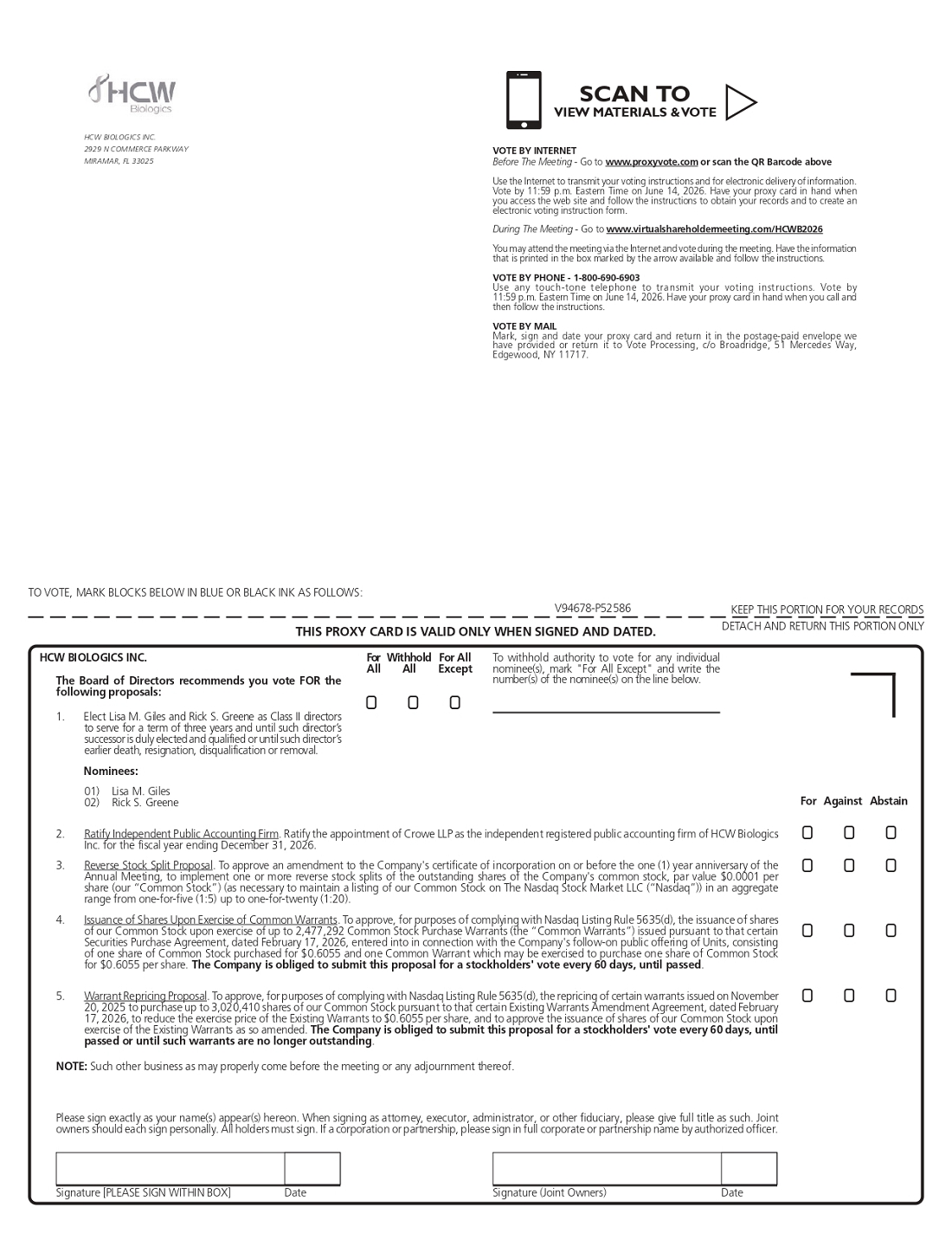
Exhibit 31.1
CERTIFICATION OF PRINCIPAL EXECUTIVE OFFICER PURSUANT TO
RULES 13a-14(a) AND 15d-14(a) UNDER THE SECURITIES EXCHANGE ACT OF 1934,
AS ADOPTED PURSUANT TO SECTION 302 OF THE SARBANES-OXLEY ACT OF 2002
I, Hing C. Wong, certify that:
| 1. | I have reviewed this Quarterly Report on Form 10-Q of HCW Biologics Inc. for the quarter ended March 31, 2026; |
| 2. | Based on my knowledge, this report does not contain any untrue statement of a material fact or omit to state a material fact necessary to make the statements made, in light of the circumstances under which such statements were made, not misleading with respect to the period covered by this report; |
| 3. | Based on my knowledge, the financial statements, and other financial information included in this report, fairly present in all material respects the financial condition, results of operations and cash flows of the registrant as of, and for, the periods presented in this report; |
| 4. | The registrant’s other certifying officer and I are responsible for establishing and maintaining disclosure controls and procedures (as defined in Exchange Act Rules 13a-15(e) and 15d-15(e)) and internal control over financial reporting (as defined in Exchange Act Rules 13a-15(f) and 15d-15(f)) for the registrant and have: |
| a) | Designed such disclosure controls and procedures, or caused such disclosure controls and procedures to be designed under our supervision, to ensure that material information relating to the registrant, including its consolidated subsidiaries, is made known to us by others within those entities, particularly during the period in which this report is being prepared; |
| b) | Designed such internal control over financial reporting, or caused such internal control over financial reporting to be designed under our supervision, to provide reasonable assurance regarding the reliability of financial reporting and the preparation of financial statements for external purposes in accordance with generally accepted accounting principles; |
| c) | Evaluated the effectiveness of the registrant’s disclosure controls and procedures and presented in this report our conclusions about the effectiveness of the disclosure controls and procedures, as of the end of the period covered by this report based on such evaluation; and |
| d) | Disclosed in this report any change in the registrant’s internal control over financial reporting that occurred during the registrant’s most recent fiscal quarter (the registrant’s fourth fiscal quarter in the case of an annual report) that has materially affected, or is reasonably likely to materially affect, the registrant’s internal control over financial reporting; and |
| 5. | The registrant’s other certifying officer and I have disclosed, based on our most recent evaluation of internal control over financial reporting, to the registrant’s auditors and the audit committee of the registrant’s board of directors (or persons performing the equivalent functions): |
| a) | All significant deficiencies and material weaknesses in the design or operation of internal control over financial reporting which are reasonably likely to adversely affect the registrant’s ability to record, process, summarize and report financial information; and |
| b) | Any fraud, whether or not material, that involves management or other employees who have a significant role in the registrant’s internal control over financial reporting. |
|
/s/ Hing C. Wong | |
| Hing C. Wong | |
|
Founder and Chief Executive Officer (Principal Executive Officer) |
Date: May 14, 2026
Exhibit 31.2
CERTIFICATION OF PRINCIPAL FINANCIAL OFFICER PURSUANT TO
RULES 13a-14(a) AND 15d-14(a) UNDER THE SECURITIES EXCHANGE ACT OF 1934,
AS ADOPTED PURSUANT TO SECTION 302 OF THE SARBANES-OXLEY ACT OF 2002
I, Rebecca Byam, certify that:
| 1. | I have reviewed this Quarterly Report on Form 10-Q of HCW Biologics Inc. for the quarter ended March 31, 2026; |
| 2. | Based on my knowledge, this report does not contain any untrue statement of a material fact or omit to state a material fact necessary to make the statements made, in light of the circumstances under which such statements were made, not misleading with respect to the period covered by this report; |
| 3. | Based on my knowledge, the financial statements, and other financial information included in this report, fairly present in all material respects the financial condition, results of operations and cash flows of the registrant as of, and for, the periods presented in this report; |
| 4. | The registrant’s other certifying officer and I are responsible for establishing and maintaining disclosure controls and procedures (as defined in Exchange Act Rules 13a-15(e) and 15d-15(e)) and internal control over financial reporting (as defined in Exchange Act Rules 13a-15(f) and 15d-15(f)) for the registrant and have: |
| a) | Designed such disclosure controls and procedures, or caused such disclosure controls and procedures to be designed under our supervision, to ensure that material information relating to the registrant, including its consolidated subsidiaries, is made known to us by others within those entities, particularly during the period in which this report is being prepared; |
| b) | Designed such internal control over financial reporting, or caused such internal control over financial reporting to be designed under our supervision, to provide reasonable assurance regarding the reliability of financial reporting and the preparation of financial statements for external purposes in accordance with generally accepted accounting principles; |
| c) | Evaluated the effectiveness of the registrant’s disclosure controls and procedures and presented in this report our conclusions about the effectiveness of the disclosure controls and procedures, as of the end of the period covered by this report based on such evaluation; and |
| d) | Disclosed in this report any change in the registrant’s internal control over financial reporting that occurred during the registrant’s most recent fiscal quarter (the registrant’s fourth fiscal quarter in the case of an annual report) that has materially affected, or is reasonably likely to materially affect, the registrant’s internal control over financial reporting; and |
| 5. | The registrant’s other certifying officer and I have disclosed, based on our most recent evaluation of internal control over financial reporting, to the registrant’s auditors and the audit committee of the registrant’s board of directors (or persons performing the equivalent functions): |
| a) | All significant deficiencies and material weaknesses in the design or operation of internal control over financial reporting which are reasonably likely to adversely affect the registrant’s ability to record, process, summarize and report financial information; and |
| b) | Any fraud, whether or not material, that involves management or other employees who have a significant role in the registrant’s internal control over financial reporting. |
| /s/ Rebecca Byam | |
| Rebecca Byam | |
Chief Financial Officer (Principal Financial Officer) |
Date: May 14, 2026
Exhibit 32.1
CERTIFICATION PURSUANT TO
18 U.S.C. SECTION 1350, AS ADOPTED PURSUANT TO
SECTION 906 OF THE SARBANES-OXLEY ACT OF 2002
In connection with the Quarterly Report of HCW Biologics Inc. (the “Company”) on Form 10-Q for the period ended March 31, 2026 as filed with the Securities and Exchange Commission on the date hereof (the “Report”), I certify, pursuant to 18 U.S.C. § 1350, as adopted pursuant to § 906 of the Sarbanes-Oxley Act of 2002, that:
| (1) | The Report fully complies with the requirements of section 13(a) or 15(d) of the Securities Exchange Act of 1934; and |
| (2) | The information contained in the Report fairly presents, in all material respects, the financial condition and result of operations of the Company. |
| Date: May 14, 2026 | By: | /s/ Hing C. Wong |
| Hing C. Wong | ||
Founder and Chief Executive Officer (Principle Executive Officer) |
Exhibit 32.2
CERTIFICATION PURSUANT TO
18 U.S.C. SECTION 1350, AS ADOPTED PURSUANT TO
SECTION 906 OF THE SARBANES-OXLEY ACT OF 2002
In connection with the Quarterly Report of HCW Biologics Inc. (the “Company”) on Form 10-Q for the period ended March 31, 2026 as filed with the Securities and Exchange Commission on the date hereof (the “Report”), I certify, pursuant to 18 U.S.C. § 1350, as adopted pursuant to § 906 of the Sarbanes-Oxley Act of 2002, that:
| (1) | The Report fully complies with the requirements of section 13(a) or 15(d) of the Securities Exchange Act of 1934; and |
| (2) | The information contained in the Report fairly presents, in all material respects, the financial condition and result of operations of the Company. |
| Date: May 14, 2026 | By: | /s/ Rebecca Byam |
| Rebecca Byam | ||
Chief Financial Officer (Principal Financial Officer) |